









![Kingdom Hearts Collection [I-III] Review](https://gazettely.com/wp-content/uploads/2026/10/Kingdom-Hearts-Collection-I-III-1-360x180.webp "Kingdom Hearts Collection [I-III] Review: KHII Holds Steady as Newer Entries Fluctuate 40")
The voices arrive before the film has any need to explain itself: measured, shaking, exhausted, preserved on U-matic tape that seems to fray at the edges while the testimony grows clearer. The Trial, Ulises de la Orden’s archival documentary about Argentina’s 1985 Trial of the Juntas, builds its force from that tension. The image looks damaged by time. The words do not.
The film is assembled entirely from courtroom recordings of the public tribunal that prosecuted former military leaders, including Jorge Rafael Videla, for crimes committed during Argentina’s dictatorship from 1976 to 1983. Under the language of national security, the regime kidnapped, tortured, raped, murdered, stole children, looted homes, and disappeared thousands of people marked as “subversives.” De la Orden condenses 530 hours of footage into a 177-minute film divided into 18 chapters, each centered on a phrase or theme pulled from the testimonies.
There is no voice-over, no present-day interview, no music cue telling us how to feel. That restraint matters. The film does not behave like a history lesson with archival clips inserted for emphasis. It behaves like evidence. The courtroom becomes the whole world, and the viewer has to sit with the same procedure, repetition, and moral exhaustion that justice requires.
An Archive Cut into Pressure
A documentary made from 530 hours of trial footage could easily become either shapeless or overexplained. De la Orden avoids both traps by organizing the film around witness testimony rather than legal mechanics. We hear about kidnapping, secret detention centers, torture, sexual violence, stolen babies, forged documents, theft, and killings described with a plainness that makes the horror harder to evade.
The 18-part structure gives the material a readable shape without softening it into a clean narrative arc. The “Night of the Pencils,” where high-school students were detained, tortured, and disappeared, appears through the testimony of survivor Pablo Alejandro Díaz. The “Night of the Ties,” which targeted labor lawyers and their families, becomes another example of a state apparatus that treated ordinary civic life as a crime scene waiting to be invented.
What struck me most is how the editing turns repetition into design. One witness describes a method of abduction. Another describes the same system from a different angle. A relative speaks into the absence left by a disappeared child or spouse. A survivor names the texture of a cell, the ritual of humiliation, the sound of a guard. The film risks emotional numbness because the catalogue of crimes is so vast, yet that risk is part of its moral logic. A tidy version would lie.
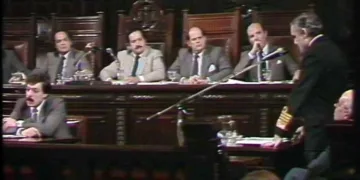
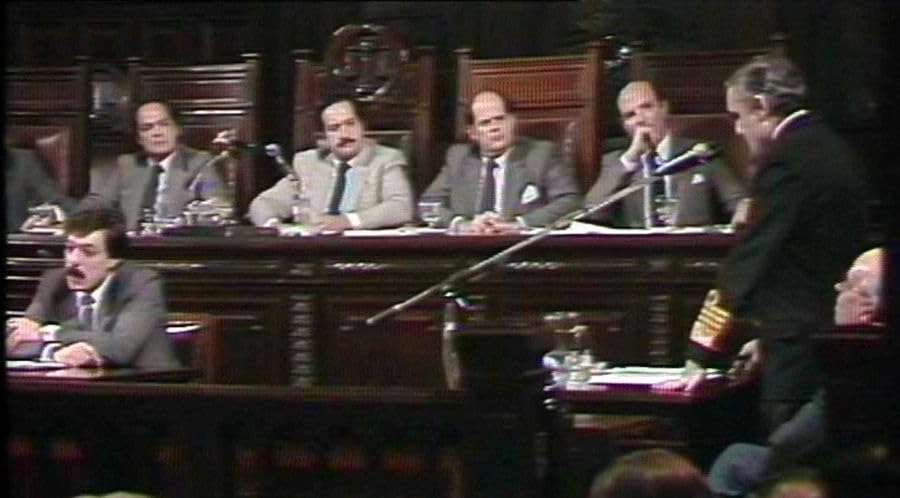
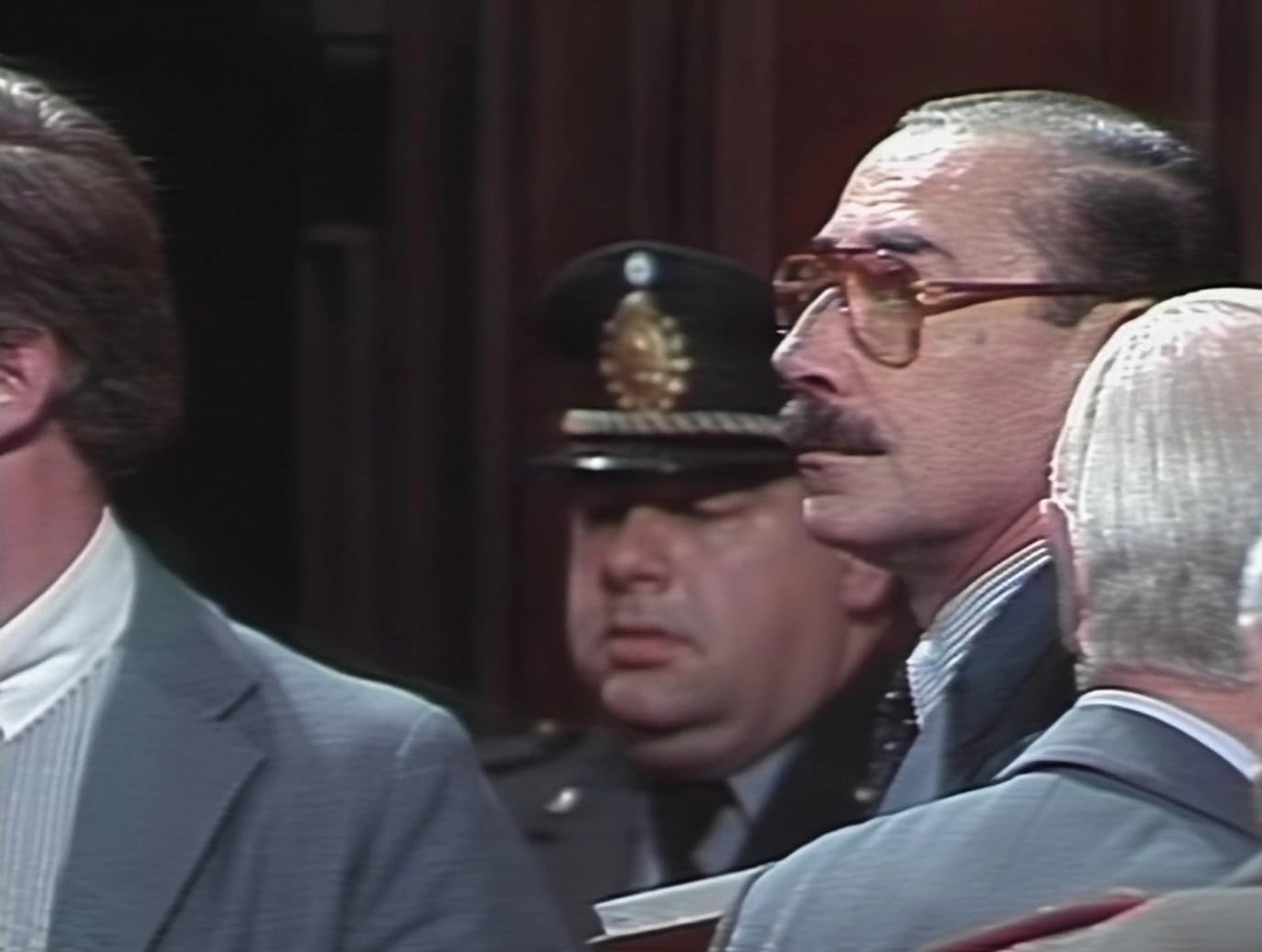
The courtroom rhythm becomes its own kind of editing pattern. A witness speaks. Prosecutor Julio César Strassera listens with drawn, weary concentration. Judges keep their faces still. The accused military officials sit behind lawyers, sometimes bored, sometimes smug, sometimes hidden by the room’s formal choreography. Spectators react with anger, grief, disgust, and at one point physical collapse. The film cuts among these faces without turning them into easy symbols.
The Ethics of Looking
The U-matic footage gives The Trial a strange visual power. The colors are smeared and harsh: brown wood, leather chairs, pink faces under hot lamps, gray suits, cigarettes, thick eyeglasses, damp foreheads. The image quivers and rolls at times, carrying the texture of a damaged record. Yet the roughness does not create distance. It makes the past feel trapped in the machine, still flickering because it has not been settled.
Many witnesses are filmed from behind or at oblique angles. At first, the choice seems purely practical, a consequence of camera placement in a formal courtroom. Gradually, it becomes one of the film’s strongest ethical decisions. Survivors break down while recounting torture, rape, and the disappearance of family members, but the camera rarely turns their pain into a frontal spectacle. Their voices carry the testimony. Their faces are protected from our appetite for visible suffering.
That framing also changes the scale of the film. The witnesses are individuals, each with a specific wound, yet they begin to form a collective body of memory. This matters because disappearance was designed to erase evidence: bodies gone, paperwork falsified, families denied certainty, language twisted until murder could pass as order. The film answers that erasure with speech. One person after another places a fact back into public record.
De la Orden also uses reaction shots with real precision. Strassera and Luis Moreno Ocampo sit through testimony with the haunted focus of people who know that language must somehow carry what bodies can no longer prove. The judges try to maintain composure. The gallery absorbs each account with visible strain. The defendants, by comparison, often look trapped less by guilt than by inconvenience. The most grotesque small detail is Videla reading Reflections on the Apocalypse during the proceedings, tucked into his papers like an escape hatch from the room he helped create.
Justice as Public Memory
The courtroom in The Trial is a legal space, but it is also theater in the deepest civic sense. A society forces its former rulers to hear testimony they tried to bury. The defense appeals to patriotism and procedure, and the words sound smaller each time they are placed beside descriptions of stolen babies, people thrown from planes into the sea, homes raided for cash and personal belongings, and detainees reduced to objects inside secret camps.
The irony is brutal. The accused receive microphones, attorneys, judges, scheduled hearings, and the protections of a court. Their victims were denied names, trials, graves, and in many cases any official acknowledgment that they had existed. When defense lawyers complain about the legitimacy or arrangement of the proceedings, the film lets the complaint hang in the air long enough for its obscenity to reveal itself. Due process is being extended to men who helped destroy it.
The film’s most unsettling idea is that state violence appears here as culture, not chaos. Testimonies point to fascist rhetoric, anti-left paranoia, anti-Semitism, religious purification language, bureaucratic theft, and a military class that treated cruelty as administration. A torturer’s slogan, a forged document, a stolen property deed, a child taken from murdered parents: each detail shows how terror moved through ideology, paperwork, money, and habit.
The final stretch gives Strassera’s “Nunca Más” the release one expects from a courtroom drama, with the gallery erupting as the judges order the room cleared. Then de la Orden cuts to a woman sobbing. It is the right image. Justice has happened, and grief has not moved an inch. The film understands that a sentence can punish the living perpetrators, while the dead remain beyond repair. Listening, here, is not passive. It is the work the record demands.
The historical archival documentary The Trial premiered at the Berlin International Film Festival on February 19, 2023, and is widely accessible on regional streaming platforms like Prime Video and Filmin. Directed by Ulises de la Orden, the film condenses 530 hours of television footage from the monumental 1985 Trial of the Juntas in Argentina. The narrative captures the raw courtroom testimonies that exposed the horrific human rights violations, systemic torture, and mass disappearances carried out under the nation’s military dictatorship.
Full Credits
Title: The Trial (El juicio)
Distributor: Polo Sur Cine, Prime Video, Filmin
Release date: February 19, 2023 (Berlinale)
Running time: 177 minutes
Director: Ulises de la Orden
Writers: Ulises de la Orden
Producers and Executive Producers: Ulises de la Orden, Alessandro Borrelli, Richard Copans, Dag Hoel, Gisela Peláez
Cast: Julio César Strassera, Luis Moreno Ocampo, Jorge Rafael Videla, Emilio Eduardo Massera, Roberto Eduardo Viola, Orlando Ramón Agosti, Myriam Lewin
Director of Photography (Cinematographer): Pablo Parra
Editors: Alberto Ponce
The Review
The Trial
The Trial turns courtroom footage into a grave, exacting act of memory. Ulises de la Orden’s editing gives 530 hours of testimony a clear shape without smoothing away the pain, and the damaged U-matic texture makes the past feel both archival and immediate. Its three-hour length can exhaust, and the accumulation of atrocity sometimes tests attention, yet that strain belongs to the experience. This is history preserved through faces, voices, silence, and procedure.
PROS
- Precise archival editing
- Powerful witness testimony
- Ethical oblique framing
- No manipulative score
- Haunting courtroom reactions
CONS
- Emotionally punishing length
- Repetition may numb some viewers
- Limited legal context
- Severe formal restraint