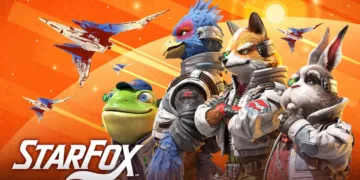




















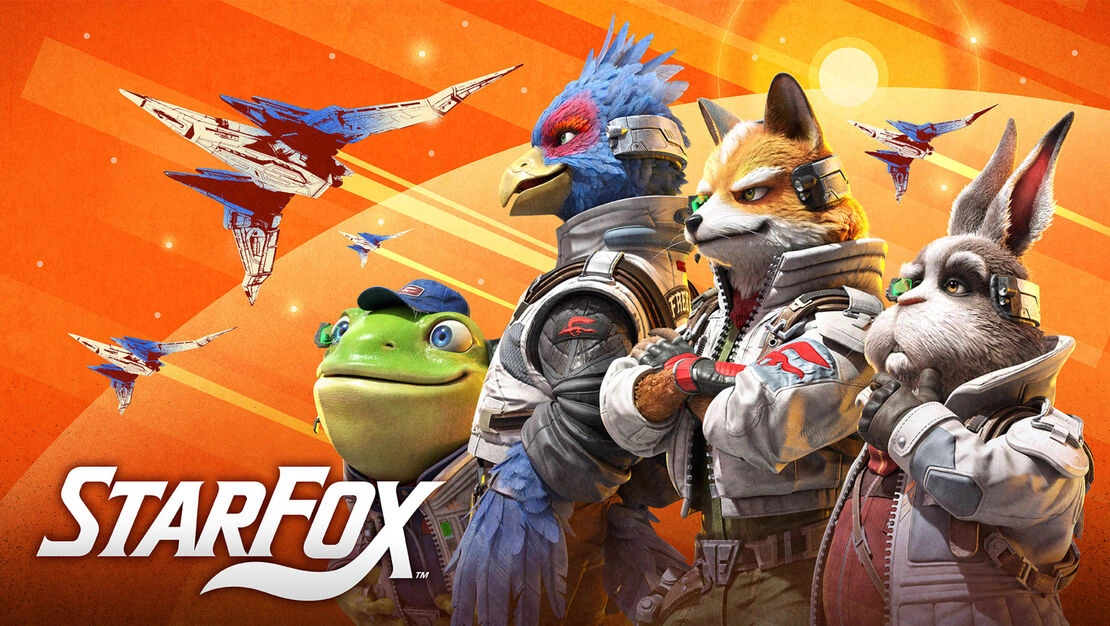

A good Star Fox run is a contract with repetition. You agree to fly Corneria again, chase Falco through the waterfall again, miss one medal by three hits again, then restart because now you know which enemy wave deserved the bomb. Nintendo’s new Star Fox for Switch 2, developed by Velan Studios, understands that contract better than any series entry since Star Fox 64.
That matters because this is Star Fox 64, rebuilt with modern visuals, expanded cinematics, Challenge Mode, online Battle Mode, co-op controls, lore menus, cosmetics, and a handful of Switch 2 features. The story still sends Fox McCloud, Peppy Hare, Falco Lombardi, and Slippy Toad across the Lylat system to stop Andross. General Pepper still points the team toward planets, bases, warzones, and cosmic hazards. Venom still waits at the end.
The important change is not the premise. It is how clearly the remake understands the old design loop: a short campaign becomes substantial when every route, medal, hidden path, and score target asks the player to improve.
The Campaign Is Still Built for Replays
A single Star Fox campaign run can be finished in roughly an hour, which sounds thin until the structure starts doing its work. Each run takes Fox through seven missions, but the full game contains a larger set of stages connected by branching routes. Corneria is the clean example. Fly through the stone arches, follow Falco through the waterfall, and the stage bends away from its standard ending into a different boss and a harder path.
That logic shapes the whole Lylat map. Fichina turns a bomb countdown into route pressure. Meteos hides a warp route inside a kaleidoscopic tunnel. Aquas slows the pace with the Blue-Marine. Zoness follows with polluted water and surfacing serpents that invite a cleaner kind of movement. Solar tests positioning against a hazardous surface. Area 6 throws the player into a fleet battle that feels like the campaign spending all its saved scale at once.
The remake makes this structure easier to parse without flattening it. After clearing a stage, the game can show route conditions and medal requirements, so the player no longer has to treat every secret like folklore passed around a playground.
That could have made discovery feel mechanical. Instead, it gives the score-chasing loop a useful checklist. If the hidden path requires flying through a specific set of structures or protecting allies during an enemy rush, the game gives you a target, then leaves execution to your hands.
Medals remain the best pressure system. They ask for high hit counts and surviving wingmates, so every charged shot, bomb, and lock-on has a cost. A weak run through Corneria is not a failure because you died. It is a failure because you used a bomb on the wrong wave, missed a clustered group, and let Slippy eat fire for half the level. The game grades attention, not persistence.
The one stiff choice is Expert Mode. Locking it behind medals on every campaign mission makes sense as a mastery reward, but it creates friction for players who want a tougher baseline after normal difficulty starts handing out extra lives like party favors. The system is honest. It is also a little stingy.
The Arwing Finally Matches the Memory
The Arwing feels sharp in a way that matters immediately. Dodging, boosting, braking, barrel rolling, locking charged shots, and managing bombs all sit close to the player’s inputs. The remake does not turn Star Fox into a modern free-flight shooter, which would miss the point. It keeps the rail-shooter spine and tightens the timing around it.
That spine lets Velan fill the screen with controlled spectacle. Corneria’s water reflections give the opening run a clean sense of speed. Katina’s mothership launches fighters with real mass. Sector X feels like a derelict base rather than a sequence of floating obstacles. Meteos looks properly cosmic, with the warp route turning into a color storm that still reads as a playable lane. The Cornerian fleet finally resembles a military force instead of a few gray blocks pretending to be one.
This is where the remake’s fidelity pays off. The stage layouts remain recognizable, so returning players can feel old muscle memory wake up. The same arches, formations, enemy waves, and boss patterns are there. The difference is that the game now sells the spaces those patterns occupy. The old Star Fox 64 often asked the imagination to finish the image. This version finishes it on screen.
Higher fidelity has a cost. Some enemies are easier to lose in the busier frame, and boss weak points can read less clearly than they did in the N64 version’s blunt visual language. A glowing target on a polygonal boss had no subtlety, which made it excellent feedback. Here, a rotating shield or exposed weak spot can blend into the spectacle for a second too long. Area 6 has a similar mismatch when huge ships burst apart with less weight than their new scale suggests.
Aquas shows the other risk of faithfulness. The underwater creatures now look far better, looming out of the murk with actual menace, but the stage still drags because its vehicle and pacing remain slower than the campaign around it. The remake improves the surface. It does not redesign the current underneath.
The Crew Gains Function, Not Depth
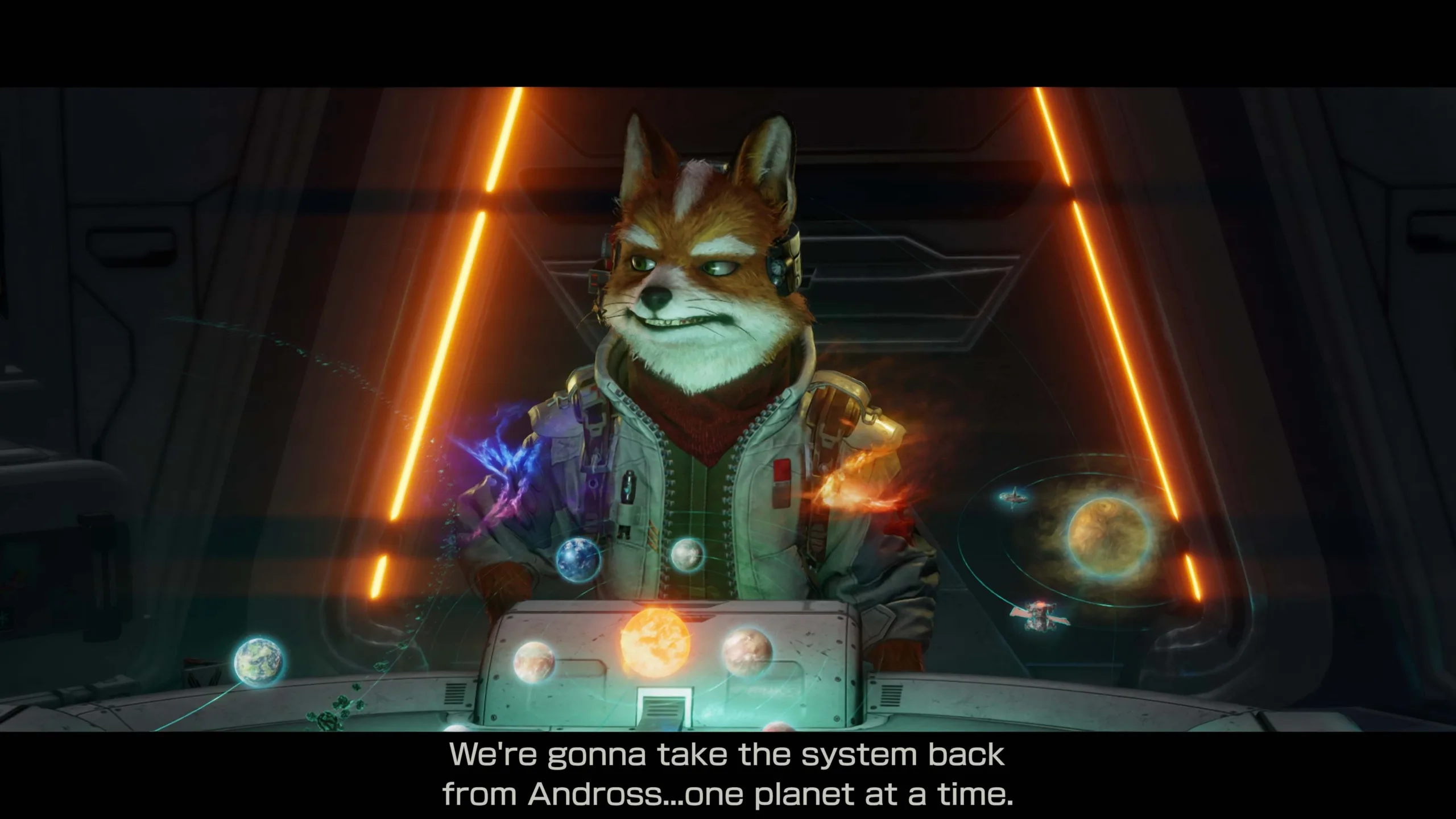
The new cinematics are one of the remake’s smartest additions because they connect the route system to the story logic. General Pepper no longer feels like a mission menu in uniform. He explains why one location matters, why another target is urgent, and why Star Fox is the crew being sent into the mess. When the player chooses between paths, the game frames that choice as a strategic decision inside a war.
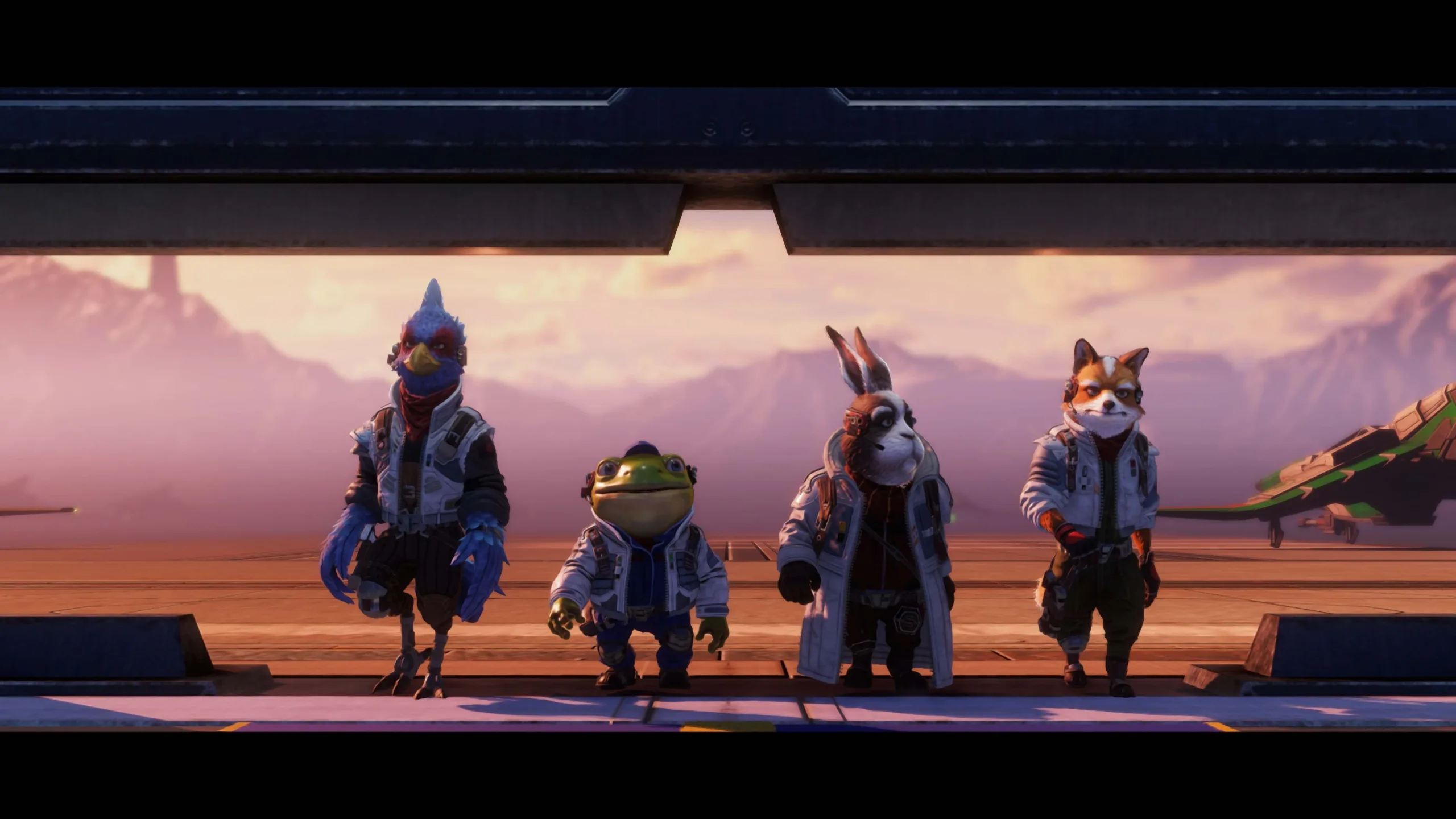
The Great Fox scenes give the team clearer roles. Fox is the cool professional who talks about payment while still behaving like the hero everyone knows he will be. Peppy carries the memory of James McCloud and the Venom Incident, which gives his advice weight beyond tutorial chatter. Slippy benefits most. The remake sells him as an engineering brain whose work on the Arwings explains his place on the team, even when his flying remains a public safety concern.
Falco is still Falco, which means the game has successfully preserved one of Nintendo’s great workplace irritants. His eye rolls, cocky lines, and constant need to be impressed make him abrasive in a useful way. When he pushes Fox toward the waterfall route on Corneria, the mechanical hint also becomes a character beat. He is testing the player and Fox at the same time.
The writing has limits. These scenes add texture, but the dialogue rarely has the oddball bite of the old game. The cleaner voice work gives the crew fuller performances, yet some classic lines lose the strange theatrical snap that made them stick. “Do a barrel roll!” sounds better produced. It also sounds less like a phrase that escaped a cartridge and entered human speech by accident.
The orchestrated soundtrack has no such problem. It gives each route the lift it needs, especially during fleet battles and warp sequences, and it keeps repeat runs from feeling routine. In a game built around doing the same thing better, that musical energy matters.
Challenge Mode Understands the Game
Challenge Mode is the best new system because it turns the campaign’s hidden discipline into explicit training. Once a stage is cleared, the mode opens versions with special objectives: beat Falco through Corneria’s obstacle line, defeat a boss inside a time limit, destroy enough objects in the environment, or hit weak points without wasting shots on a shield.
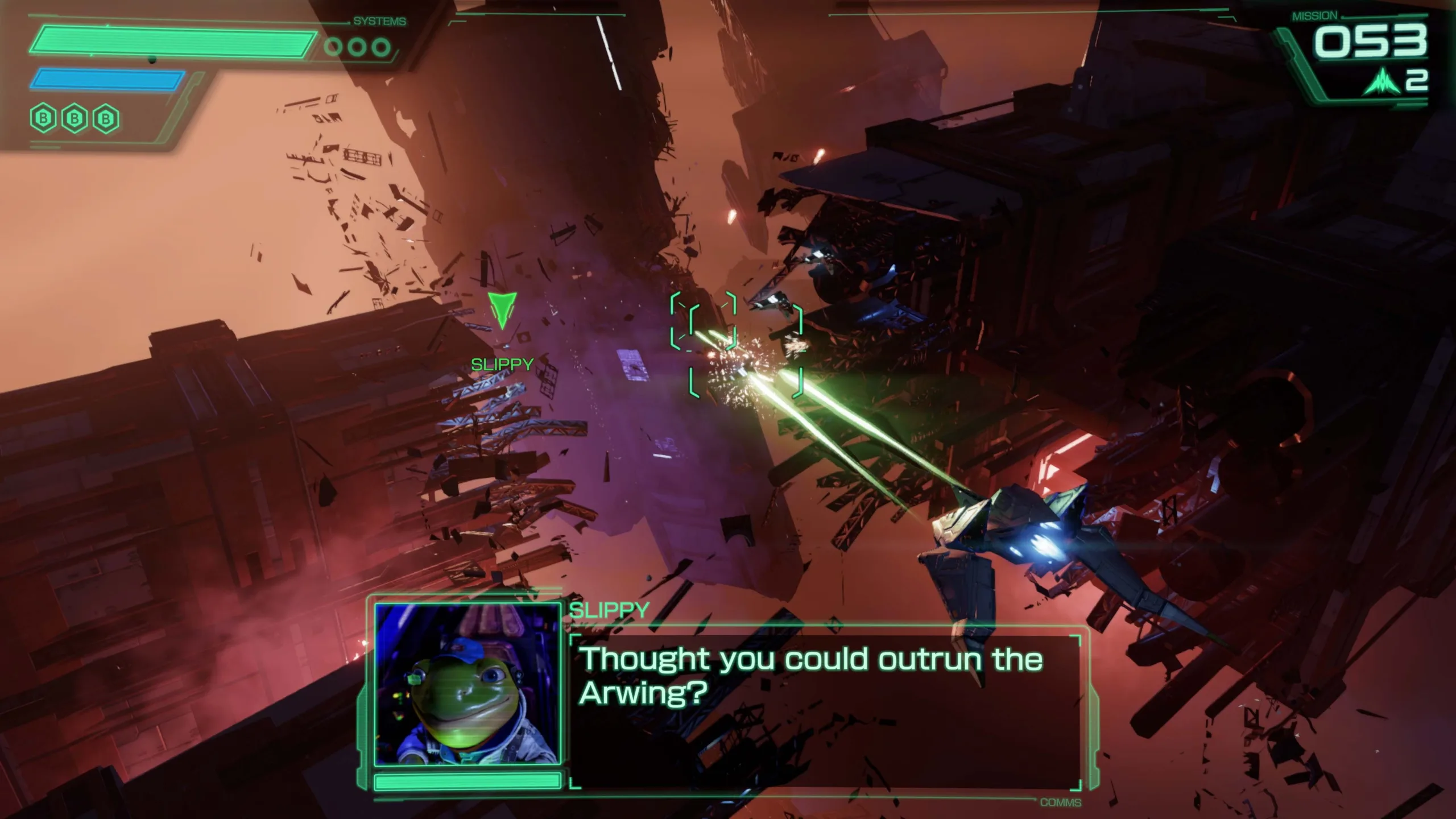
That last type is where the mode shows its teeth. Star Fox has always been partly about restraint. The player who fires at everything is usually leaving points on the table. Challenge Mode makes that lesson visible. It asks you to hold a shot, wait for a rotation, lock onto the correct enemy in a cluster, or save a bomb for the wave that turns one explosion into a medal run.
Some challenges lean hard on restarts. A single mistake against a shielded boss can mean replaying the whole stage, and the absence of generous checkpoints can turn mastery into irritation. Still, the mode’s harsher tasks fit the game’s arcade logic. A clean run is the point. The annoyance comes from knowing exactly what you did wrong.
The disappointment is that Challenge Mode rarely alters the rules in truly playful ways. A boss rush would have suited the combat model. Alternate crew scenarios could have given Falco or Peppy different objectives. Landmaster and Blue-Marine missions could have used stranger constraints. The mode is strong because it understands Star Fox. It is limited because it mostly asks the existing stages to work harder.
Battle Mode Has Good Ideas and Too Little Space
Battle Mode expands the old multiplayer idea into 4v4 online and bot matches, and the basic format works better than expected. Teams score through kills and map objectives, with each arena tied to a specific event. Corneria uses capture points. Fichina has meteorite collection. Sector Y sends players after cargo stolen from space pirates.
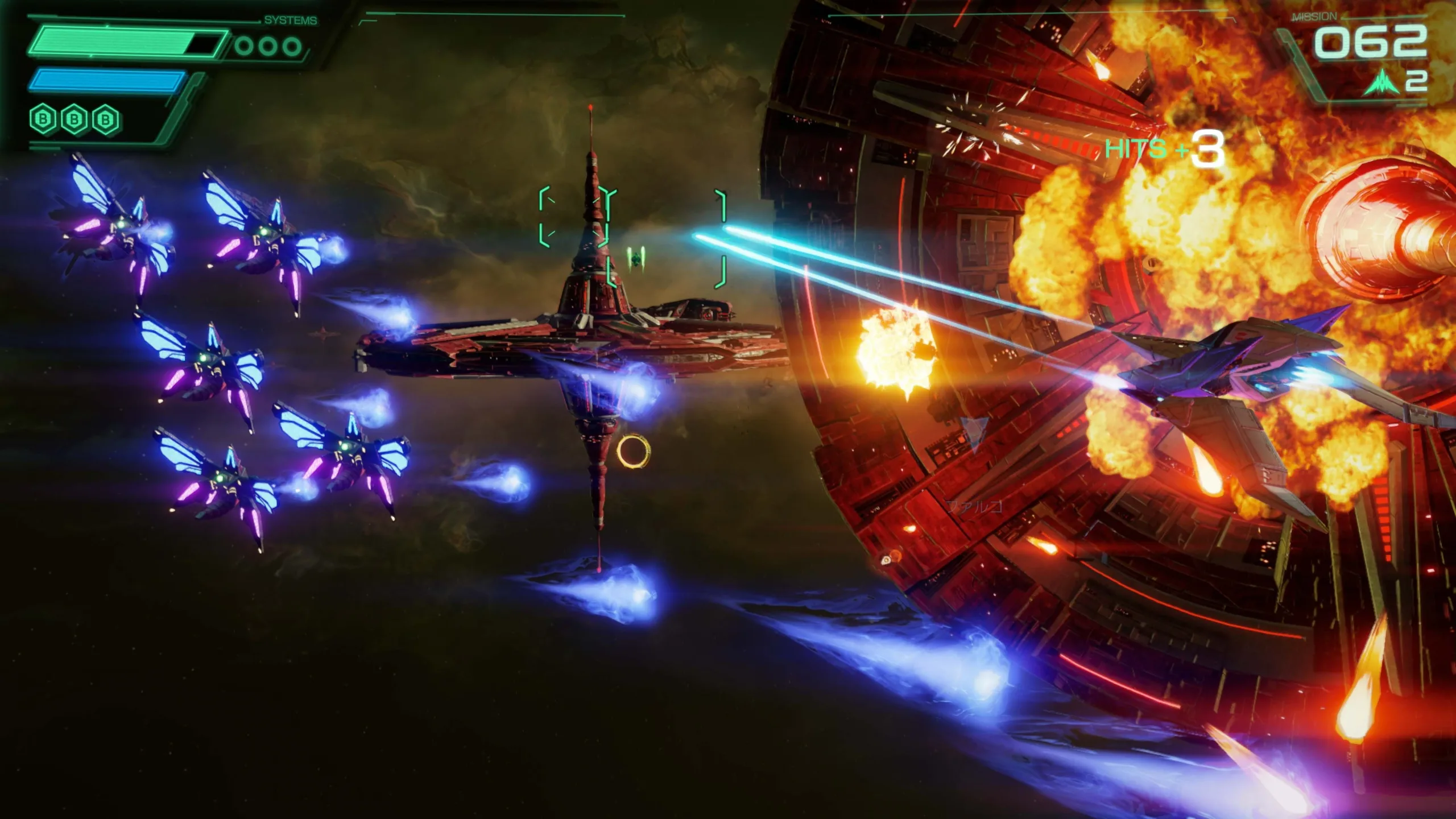
The power-ups give matches their best swings. Plasma Blast can melt an opponent who thinks distance equals safety. Smart Mines punish anyone trailing too close. Teleport-style tools and firepower boosts create brief moments where positioning matters as much as aim. The mode has enough chaos to feel social and enough objective pressure to avoid pure circling.
Then the map count hits. Three arenas are not enough, especially in a campaign with sixteen stages built for repeated play. Locking each objective to one map makes the pool feel smaller. The mode is enjoyable for a few matches with friends, and bots make it usable outside peak hours, but it currently feels like a side dish served on a very small plate.
The extras orbit the same problem of good ideas with tight limits. Co-op splits piloting and shooting between two players, which is charming for a parent handing a child the aiming role, less convincing as a main way to play. The Holoviewer adds useful lore on characters, planets, enemies, and James McCloud’s sacrifice. Camera-driven avatars are fun in theory, with facial movement mapped onto animal characters, but multiplayer restricts the usable roster to Star Fox and Star Wolf members. Letting players unlock Kat, Bill, or ROB64 and then keeping them away from matches is a strange way to ration joy.
Amiibo support is minor, limited to Fox, Falco, and Wolf cosmetics. Mouse controls are neat in Landmaster missions, then easy to abandon once the Pro Controller starts feeling right again.
A Reset That Still Needs a Sequel
The question hanging over Star Fox is not quality. This is a polished, responsive, handsome remake of the franchise’s best game. The harder question is purpose. Nintendo has returned to Star Fox 64 so often that the series can feel trapped in its own tutorial stage, forever proving that Corneria still works.
Here, Corneria does still work. So do the branching routes, medals, charged shots, wingmate rescues, route hints, and score optimizations. Velan’s remake sharpens the loop instead of burying it under modern padding. It respects the arcade shape of Star Fox, where a short run becomes a skill test through repetition.
That respect also shows the ceiling. Battle Mode needs maps. Challenge Mode could use wilder rule sets. The cinematics need sharper writing. Some stages needed more courage than polish. The game proves the Arwing still has a place, then stops short of proving where it should fly next.
For now, this is the cleanest way to play Star Fox 64 and the most convincing Star Fox has felt in years. As a remake, it knows exactly which systems to protect. As a reset, it has one job left: stop circling the same planet.
The Review
Star Fox
Star Fox is a careful remake that understands the system it inherited: short runs, branching routes, score pressure, hidden objectives, and repeated mastery. The Arwing feels cleaner, the stages look spectacular, and Challenge Mode gives the old campaign a smart training layer. The package loses lift when Battle Mode exposes its thin map pool, and the new cutscenes add texture without much bite. Still, as a systems refresh of Star Fox 64, this is sharp, respectful, and mechanically satisfying.
PROS
- Responsive Arwing controls
- Strong branching campaign loop
- Excellent visual remake
- Smart Challenge Mode objectives
- Better character context
CONS
- Thin Battle Mode map count
- Some weak stages preserved
- Expert Mode grind feels stiff
- Iconic voice lines lose charm