




























Sixty days becomes a child’s arithmetic in Miiku Sakanishi’s Memorizu. At the ferry terminal, Yuta tries to explain his absence to Hana, his kindergarten-age daughter, by turning time into units she can hold: sleeps, breakfasts, small repetitions. The explanation is tender and useless in the way parental explanations often are. Hana hears the number and searches for a loophole. If she sleeps often enough, can he come home sooner?
That exchange gives the film its emotional scale. Sakanishi does not treat separation as a grand wound. He treats it as a disturbance in ordinary rhythm. Yuta, played by Tasuku Emoto, leaves Tokyo for rural Kyushu to care for his father-in-law Makoto, whose broken leg has made it difficult to run his photography studio. Yuta’s wife Yuki stays behind with Hana, working as a tour guide and taking cheerful phone photos for visitors who want proof of where they have been.
The family has not broken. It has been stretched. Memorizu understands the terror of that stretch. Nothing catastrophic needs to happen. A child asks when her father is returning. A man boards a ferry. The sea outside the window keeps moving.
The Studio and the Old Man
Makoto’s photography studio is a place where time has learned manners. Clients sit, adjust their posture, wait for the old photographer’s eye to decide when they have become photographable. Issey Ogata plays Makoto with a dry gravity that never hardens into caricature.
He is proud, exacting, sometimes quietly impossible. When Yuta begins helping around the shop, Makoto notices every small deviation: how a customer is handled, how the work is approached, how the room itself is respected.
The early scenes between the two men draw their force from restraint. They share meals without intimacy. They complete chores without affection. Yuta opens the shop in the morning, walks Makoto’s dog, tries to make himself useful, and receives little verbal reward for it. Emoto gives him a lovely awkward patience, the kind that can look like weakness until it reveals itself as endurance.
Also Read





Sakanishi lets the relationship change through almost invisible gestures. Makoto’s regard for Yuta shifts during the work itself, when the younger man begins to understand that the studio is not merely a business. A stiff bridal couple loosens under Makoto’s direction.
A timid child responds to his command to grin. A customer’s portrait becomes a small treaty with disappearance. The birthday sequence lands because the film has refused to beg for it. By then, care has already entered the room and taken a seat.
Pictures Against Absence
The camera is everywhere in Memorizu, but rarely as accusation. Contemporary films often treat phones as little glowing coffins for attention. Sakanishi sees them with gentler eyes. Yuta sends videos and photos to Hana, fragments of Kyushu offered across distance: a sign, a path, a field, an animal, a sight too small to justify explanation and too precious to keep private.
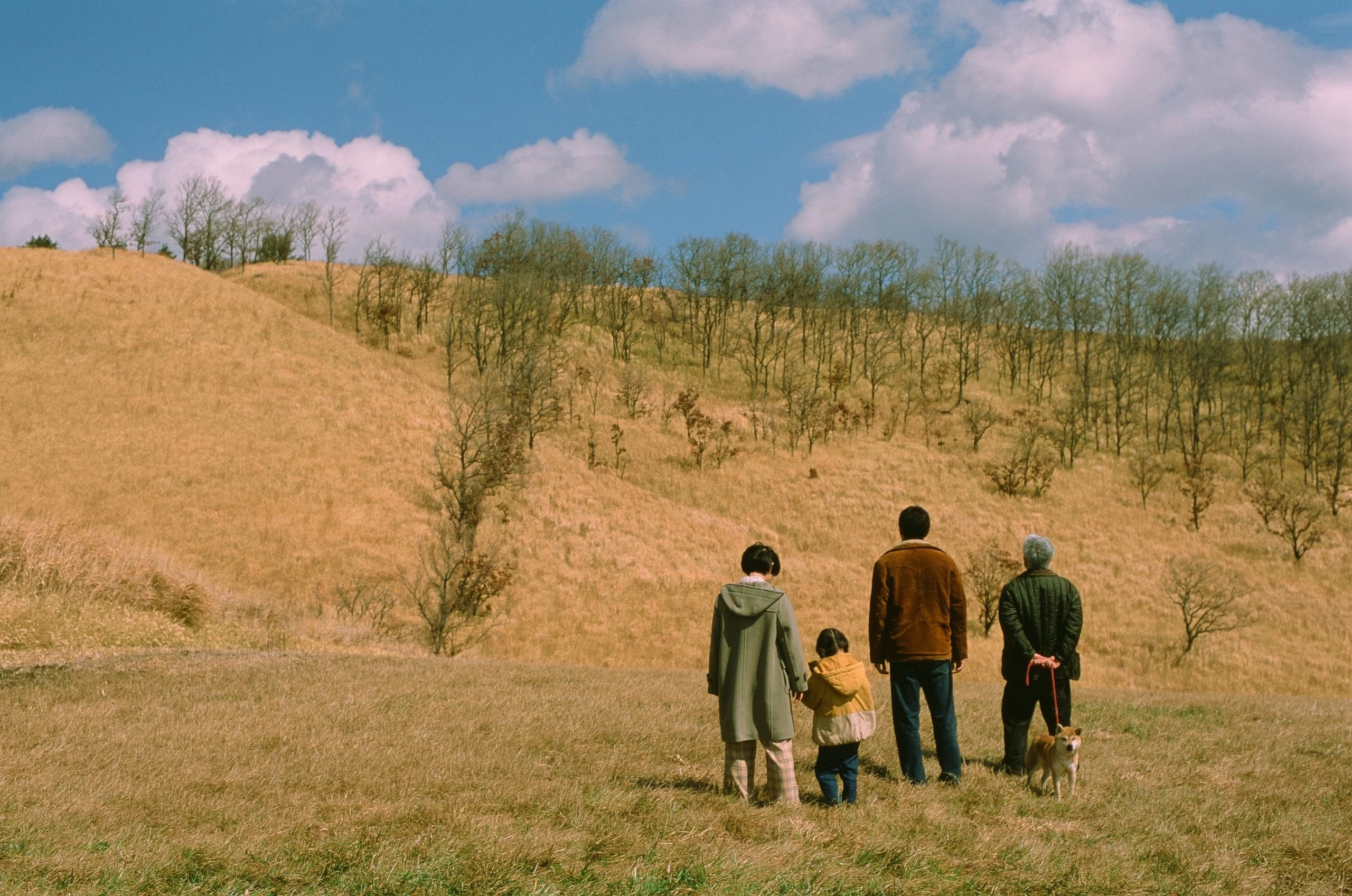
These phone images can jar against Yoichi Kamakari’s composed cinematography. The film’s rural frames have a patient, tactile beauty: a ferry window facing fog and water, towels hanging outside, smoke-blue mountains, shop fronts that seem arranged by memory rather than architecture. Then comes the blunt intimacy of a phone clip, vertical, casual, immediate. The rupture is not always elegant. It is honest.
Makoto’s analog world and Yuta’s digital one are not enemies here. The old man’s portraits and slides preserve ceremony. Yuta’s videos preserve contact. Yuki’s tourist photos preserve movement, evidence, the smiling insistence that a day happened. Each image is a small resistance against vanishing.
The late slideshow is the film’s quietest wound. Makoto projects images of Yuki as a child with her mother, and the past flickers not as information, but as weather. When Yuki recognizes the country lanes in those photographs, the recognition matters because the film has already taught us those roads through Yuta’s walks. A place seen casually becomes ancestral under the light of a projector.
The Rural Hour
Memorizu moves slowly because its subject is the portion of life that disappears when stories hurry. Yuta’s walks with the dog become the film’s breathing pattern. He sees a field beneath a mountain, an old farmer with a horse, a formal bow exchanged between strangers.
The scene returns, then returns again altered by absence. The farmer is gone. The horse remains. Yuta raises his hand anyway. That small repetition carries the film’s sorrow. The world keeps offering forms after the people have stepped out of them.
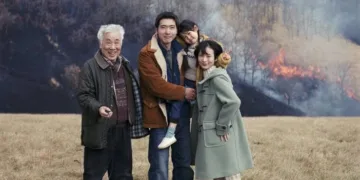
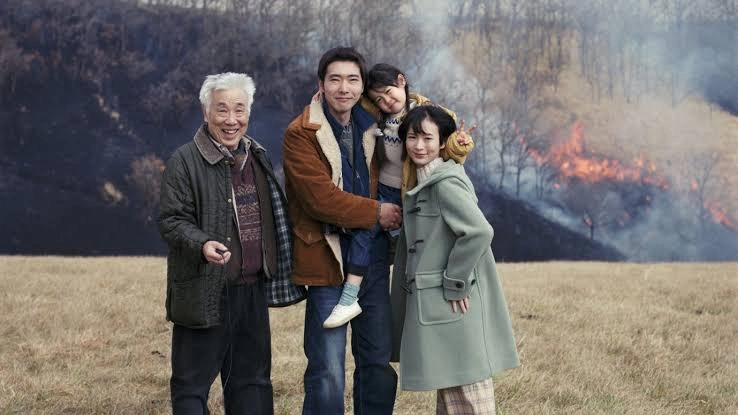
Kamakari’s framing often places people inside other frames: windows, doorways, ferry glass, studio interiors, roads bounded by fields. The effect is contemplative without becoming precious. The image keeps asking who is looking, who is being held, who will later need this view because the moment itself has passed. The tunnel and burning fields add a darker pulse to the rural calm, brief reminders that beauty here is not decorative. It is temporary matter under threat from time.
The sound design respects stillness. Wind, domestic quiet, footsteps, the soft noise of work, and music used with restraint give the film a texture close to waiting. Some viewers will find the pace too spare, and the Tokyo scenes with Yuki and Hana do not always carry the same density as Yuta’s life in Kyushu. The film’s emotional center remains with the two men in the studio, among portraits, meals, corrections, silences.
Still, what Sakanishi captures is rare: the sensation of memory being made before anyone knows it will be needed. A father records a road for his daughter. An old man saves faces for a town. A woman sees her childhood again in projected light. Somewhere, beyond the frame, the ferry keeps crossing.
The Japanese drama Memorizu celebrated its world premiere at the Tribeca Film Festival on June 7, 2026, before opening in Japanese theaters on June 12, 2026. Audiences can currently view this independent production on the global festival circuit and at select arthouse screenings, with international rights managed by sales agent Alpha Violet. The quiet narrative follows Yuta, a young professional from Tokyo who travels to a remote town in Kyushu to manage an old-fashioned photo studio for his recovering father-in-law, using exchanged smartphone videos to stay anchored to his wife and daughter.
Full Credits
Title: Memorizu
Distributor: Alpha Violet
Release date: June 7, 2026 (Tribeca Film Festival World Premiere), June 12, 2026 (Japan Theatrical Release)
Running time: 98 minutes
Director: Miiku Sakanishi
Writers: Miiku Sakanishi
Producers and Executive Producers: Masato Date, Yoshiho Fukuoka, Tomoo Tsuchii, Mitsuhiko Fujita
Cast: Tasuku Emoto, Moeka Hoshi, Issey Ogata, Yuu Kashii, Masayo Umezawa, Hiroko Isayama, Yusuke Narita, Fusako Urabe
Director of Photography (Cinematographer): Yoichi Kamakari
Editors: Shinichi Fushima
Composer: Young Chang Hwang Sound Team
The Review
Memorizu
Memorizu turns absence into a daily discipline: a ferry goodbye, a dog walk, a projected slide, a phone clip sent across the distance. Its slow pace asks for patience, and a few smartphone passages disturb the visual hush, yet Miiku Sakanishi’s debut carries rare tenderness in its attention to ordinary time. The film understands that memory does not announce itself. It waits in a lane, a photograph, a silence after someone leaves the room.
PROS
- Tender Yuta and Makoto dynamic
- Beautiful rural framing
- Strong use of photography motif
- Issey Ogata’s restrained performance
- Moving slideshow sequence
CONS
- Slow pace may test patience
- Phone footage can feel jarring
- Yuki and Hana feel thinner
- Minimal dramatic tension