

























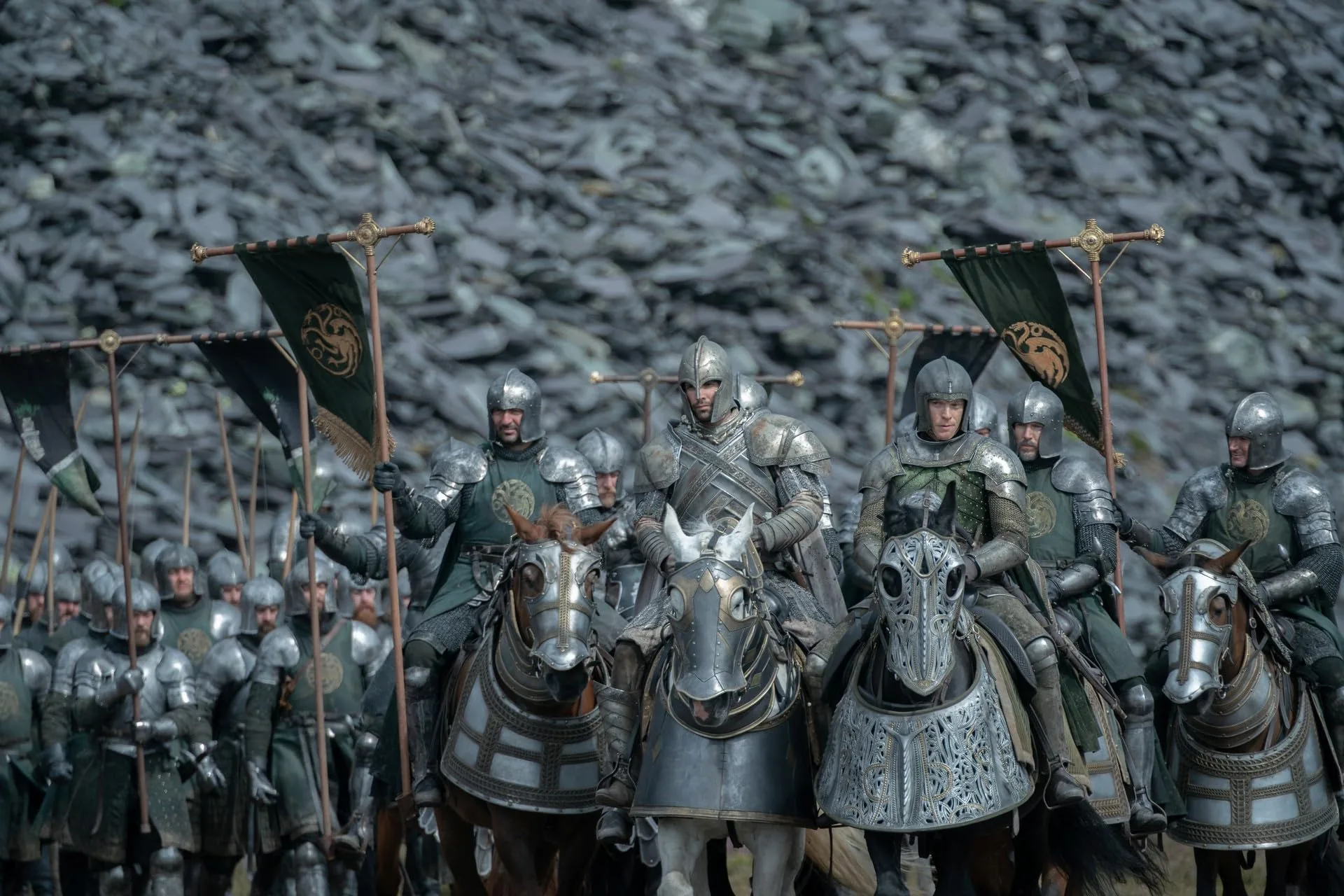

Ormund Hightower does not need Daeron crowned yet. First, he needs the boy to mistake obedience for character.
By treating submission as royal education, Ormund becomes the most consequential figure in House of the Dragon Season 3’s fourth episode. His occupation of Tumbleton initially resembles another strategic complication in a civil war already crowded with armies, dragons and claimants. Yet Ormund is pursuing something more ambitious than territorial advantage. He is building a king.
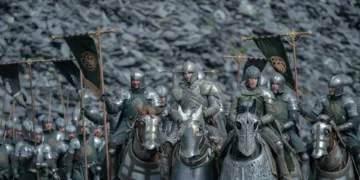
Tumbleton has declared for Rhaenyra, so Ormund fills the town with soldiers and loyalist civilians whom she cannot burn without destroying her own support. It is an elegant military trap with a particularly Westerosi ugliness: ordinary people become fortifications without being asked. Ormund then presents himself as their disciplined guardian, publicly punishing misconduct among his men and speaking of fairness as though fairness were another item of ceremonial clothing.
James Norton gives that performance of order a dangerous instability. Ormund’s immaculate self-presentation never quite conceals the rage pressing against it. His private eruptions expose the force required to sustain the public performance. Courtesy, discipline and calculated mercy are tools for arranging the world around him. When those tools fail, furniture receives the diplomatic consequences.

Daeron watches all of this with the vigilance of someone who has learned that another person’s mood can alter the physical conditions of a room. Benjamin Evan Ainsworth plays him as gentle, observant and frightened without turning him into a passive innocent. His quiet warning to a servant before Ormund loses control shows that he has retained an instinct to protect people with less power. That instinct is exactly what Ormund must break.
The execution forced upon Daeron therefore carries more weight than a conventional test of princely resolve. Ormund manufactures the severity he wants to find, then presents the result as character. Daeron must kill so that Ormund can call him capable of killing. The lesson arrives disguised as preparation for power, though its real purpose is dependence. A prince taught to mistake his guardian’s commands for his own convictions will remain useful long after the crown is placed on his head.
This gives the episode a more disturbing succession question than the familiar matter of who possesses the strongest claim. Who gets to shape a claimant before that person can form a will independent of the people protecting him?
Ormund provides the clearest answer, though the same logic spreads across the episode. Rhaenyra finally occupies the Iron Throne and immediately discovers that possession has not produced control. Rivals remain beyond her reach, allies withdraw, money is scarce and public confidence begins to rot beneath her. Emma D’Arcy carries the accumulated pressure through clipped exchanges and the fatigue surrounding every decision. Rhaenyra has achieved the position for which the conflict was supposedly fought, only to find that ruling consists largely of discovering how many things refuse to obey.
Her treatment of Ulf exposes the danger inside that anxiety. His value as a dragonrider makes his freedom appear intolerable, so protection becomes confinement. The graffiti attacking her children’s legitimacy provokes another defensive response. Her order to suppress the insult moves through the Gold Cloaks and returns as brutality against the smallfolk. Rhaenyra does not need to desire indiscriminate violence for her authority to produce it. A ruler’s vague fear becomes a subordinate’s generous permission.
The episode does not equate her with Ormund. Their motives, methods and degrees of cruelty remain distinct. Flattening every faction into identical corruption would make moral complexity remarkably easy to write and almost useless to think about. The sharper connection lies in how power converts understandable fear into decisions made on behalf of other people. Each ruler insists that circumstances have removed the possibility of choice, usually while exercising a great deal of it.
Daemon makes the contradiction harder to dismiss because his protective impulse toward Rhaena is genuine. Their encounter in the Vale allows Matt Smith a tenderness rarely available to him in this role. Daemon’s alarm, guilt and helpless attempts to find a solution suggest a father briefly stripped of the certainty that usually precedes his worst decisions.
Then he murders a shepherd.
The lie he carries back to Rhaenyra shields his daughter by assigning the consequences to someone whose life carries no political weight. Love remains present, transformed into a licence. Daemon’s affection for Rhaena and his willingness to sacrifice a stranger belong to the same decision, which is precisely why the scene resists easy moral accounting. Its sincerity makes the violence harder to dismiss. Affection armed with dynastic power can do immense damage.
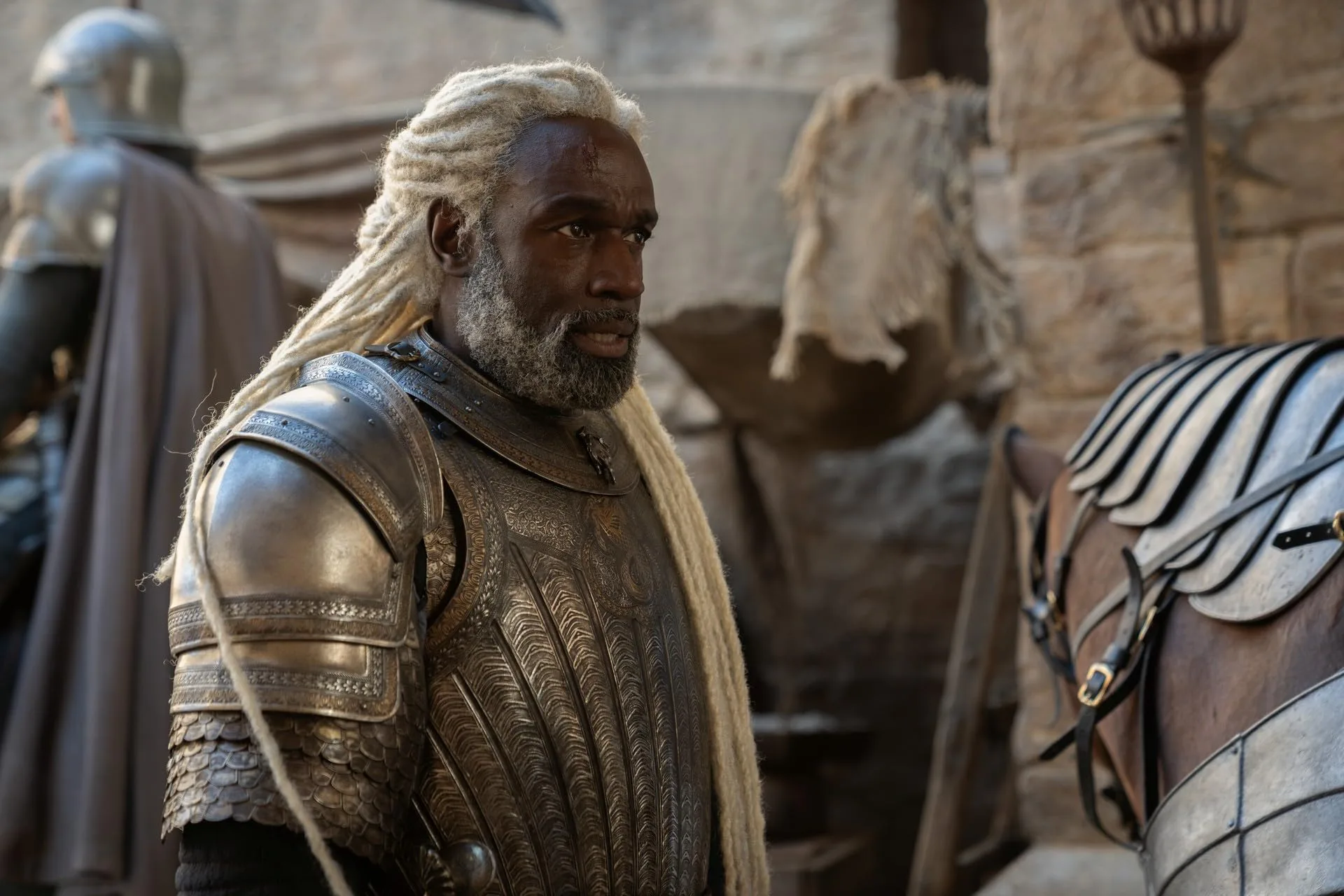
Aegon’s return to Rook’s Rest preserves another kind of sincerity. His grief over Sunfyre breaks through the humiliations that have reduced a former king to dependence on Larys and the uncertain hospitality of scavengers. Tom Glynn-Carney continues to locate feeling inside a man whose previous authority protected him from having to recognise other people’s humanity. Here, rank offers little protection, while his attachment to the dragon survives the destruction of almost everything surrounding it.
Larys keeps Aegon alive, though care and utility remain difficult to separate. That uncertainty matters. The episode’s argument would become mechanical if every relationship concealed only exploitation. Some people are protecting those they love. Some are preserving assets. Several are doing both and may no longer know where one motive ends.
Criston Cole offers the bleakest attempt to escape the pattern. His desire for a war without dragons imagines violence purified of the dynasty that has poisoned it. “Purity” becomes another political detergent, useful mainly for washing blood into a more flattering colour. Removing dragons changes only the method of killing and leaves the chooser untouched.
The episode’s many locations occasionally strain against one another. Tumbleton possesses the strongest dramatic pressure, while Aegon’s wandering humiliation risks repeating an idea the season has already established. Yet the scattered construction gains coherence whenever another storyline returns to the same question of guardianship, inheritance and control. Armies move across Westeros, though the more important conquest occurs within people who are still learning which desires belong to them.
Daeron hesitates with the weapon in his hand. That hesitation is the remaining evidence of a self Ormund has not finished shaping. Then obedience takes over.
“Tumbleton,” the fourth episode of House of the Dragon Season 3, premiered on HBO and Max on July 12, 2026. The episode shifts the narrative focus to the Reach, where Ormund Hightower’s (James Norton) invading Green host seizes the strategic town of Tumbleton, directly affecting civilians like Hugh the Hammer’s wife, Kat (Ellora Torchia). Meanwhile, Criston Cole (Fabien Frankel) and Gwayne Hightower (Freddie Fox) arrive at Harrenhal only to find Aemond Targaryen (Ewan Mitchell) missing, with Alys Rivers (Gayle Rankin) keeping his true, injured state hidden. The episode highlights the growing, messy toll of the civil war on everyday citizens while the Targaryens grapple with their internal rivalries. You can currently stream this episode on Max, alongside the rest of the third season.
Where to Watch House of the Dragon S03E04 Online






Full Credits
Title: House of the Dragon Season 3, Episode 4: “Tumbleton”
Distributor: HBO, Max
Release date: July 12, 2026
Rating: TV-MA
Running time: 56 minutes
Director: Clare Kilner
Writers: David Hancock
Producers and Executive Producers: Ryan Condal, George R. R. Martin, Sara Hess, Alan Taylor, Vince Gerardis
Cast: Emma D’Arcy, Matt Smith, Olivia Cooke, Fabien Frankel, James Norton, Benjamin Evan Ainsworth, Sonoya Mizuno, Gayle Rankin, Tom Bennett, Ellora Torchia, Freddie Fox, Matthew Needham
Composer: Ramin Djawadi
The Review
House of the Dragon S03E04
Episode 4 turns the struggle for succession into a study of how rulers are manufactured before they are crowned. James Norton and Benjamin Evan Ainsworth give the Ormund-Daeron relationship its menace and sorrow, while Daemon, Rhaenyra, Aegon and Larys complicate the episode’s argument that protection can become another claim of ownership. A few scattered subplots lack Tumbleton’s pressure, but the hour remains intellectually coherent and dramatically sharp. Its most frightening victory belongs to Ormund, who teaches obedience to call itself character.
PROS
- Norton’s volatile control
- Daeron’s coerced transformation
- Protection-as-power argument
- Strong moral contradictions
- D’Arcy and Smith’s restraint
CONS
- Uneven subplot momentum
- Repetitive Aegon humiliation
- Tumbleton overshadows other threads