




















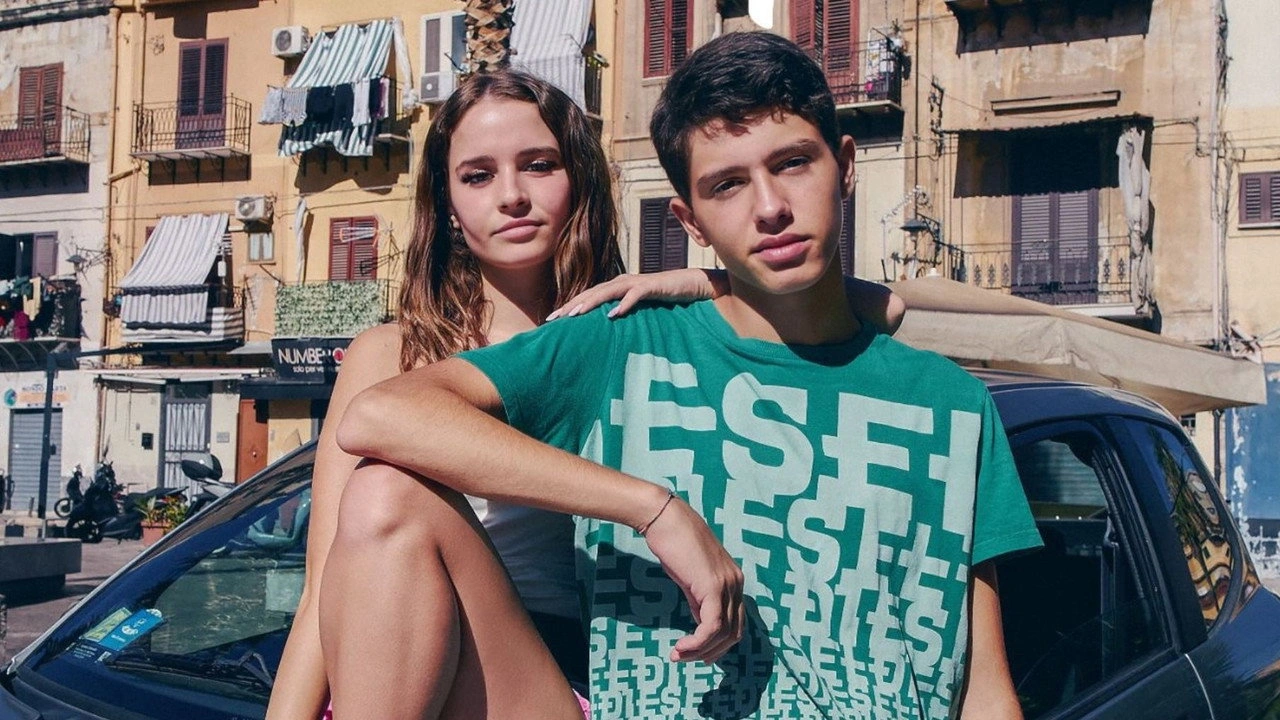

That distinction matters throughout Ketticè, Giovanni Tortorici’s study of a 16-year-old Palermo student whose apparent rebellion rarely carries consequences severe enough to threaten him. Giulio lives with his parents in a historic palazzo, attends private school, has ready access to money and a car, and treats academic failure with the languor of someone reasonably certain that catastrophe will be intercepted before arrival. Even his nominal place on a football team requires little commitment. He can drift because somebody else owns the shoreline.
Salvatore Gallina plays that privilege without turning Giulio into a monster. His detachment is quieter and stranger than cruelty. School bores him. Football barely registers. Girls pass through his attention. His mother Vittoria complains, his father Antonio occasionally intervenes, and Giulio absorbs their frustration like furniture absorbs cigarette smoke.
Tortorici sets this paralysis firmly in 2012. Facebook mediates friendships, breakups become posts, and the iPhone 5 carries the faint aura of modernity. The period detail avoids nostalgic worship. Technology gives Giulio countless ways to exhibit himself while offering no clue what self he wants to exhibit. A breakup provides the sharpest example. Elena ends their relationship by text. Giulio forces out a tear, photographs himself, and posts the image online. Grief becomes staging. Narcissus has Wi-Fi.
Ketty and the Geography of Risk
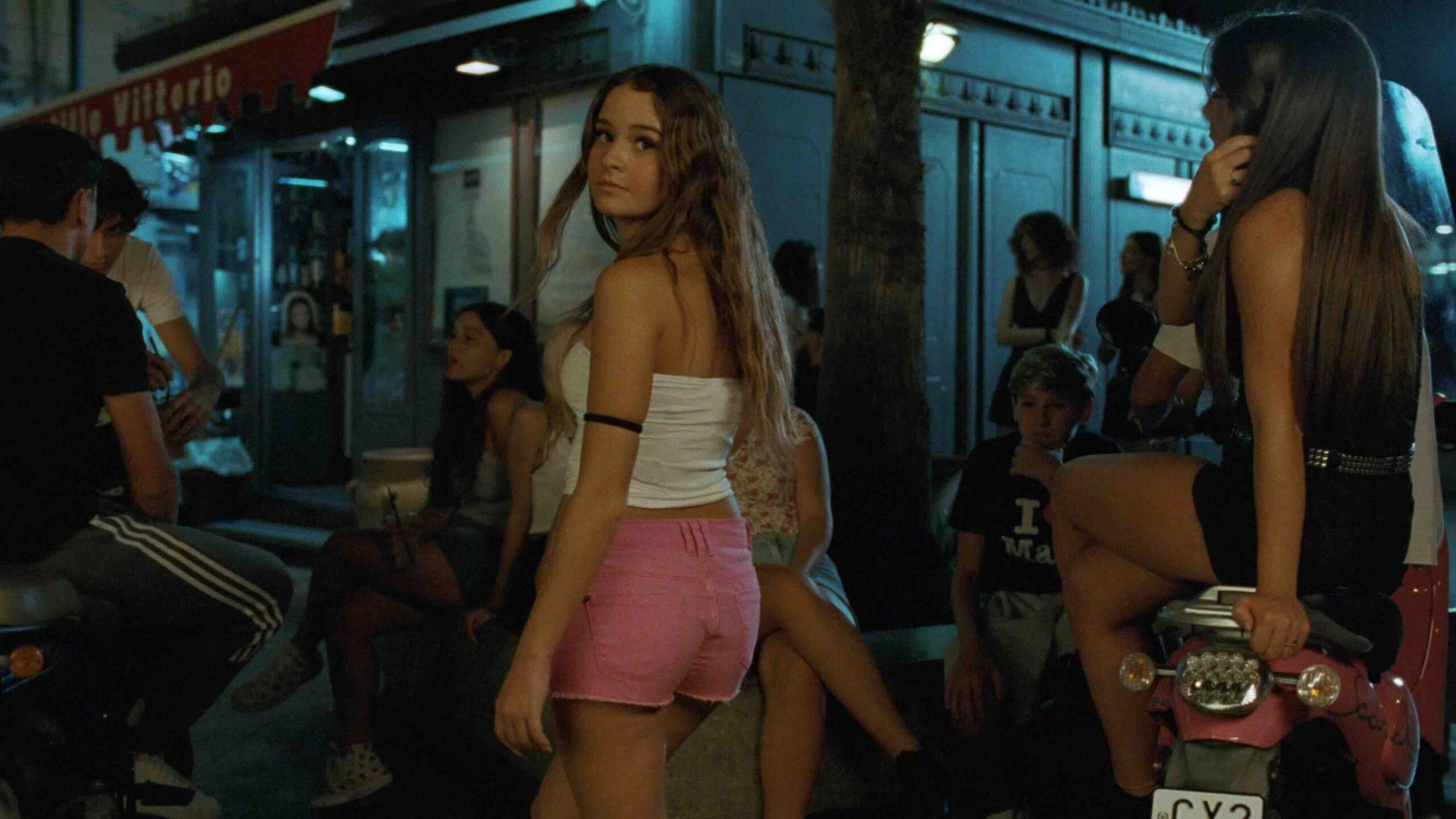
Ketty gives Giulio somewhere else to be. Rachele Testagrossa plays her with the alert physical confidence Giulio lacks. She has a reputation for fighting, knows where to buy marijuana, and belongs to social terrain his classmates can visit without ever being trapped there. Their connection resists a tidy romantic designation. Attraction exists, yet companionship seems equally important. Ketty supplies movement to a boy whose default condition is inertia.
Their repeated drives into Palermo’s Bonagia district gradually acquire ritualistic weight. Giulio spends around €20 each day buying weed near a square watched by a statue of Padre Pio. The religious icon presiding over minor illegality is almost too convenient, but Tortorici wisely leaves the irony sitting in the frame rather than circling it in red ink.
At first, these excursions carry the pleasurable charge of trespass. Giulio leaves his protected environment, buys something forbidden, smokes with Ketty, then returns to friends whose evening dramas concern flirting, gossip, jealousy, and reconciliation. The danger remains carefully scaled.
That imbalance becomes one of the film’s most interesting moral problems. Giulio can treat Bonagia as an experience. Ketty lives closer to the consequences represented by it. His intoxication can become an identity experiment precisely because money, family, and class remain behind him like invisible security guards.
The film is perceptive about this inequality yet less generous toward the people occupying Ketty’s world. Her wider circle sometimes arrives through hard poses, fights, makeup, and nail extensions, while Giulio’s wealthy classmates receive subtler behavioral distinctions. Tortorici sees the class divide clearly. His camera does not always distribute curiosity equally across it.
Adults in Broad Light
The teenagers frequently receive the film’s most precise observation, while adults are drawn with heavier strokes. Monica Bellucci turns that limitation into comic ammunition. Vittoria’s sneer could probably curdle milk at twenty paces. At dinner with Giulio’s grandmother, she fires acidic remarks across the table while Antonio mostly allows the hostility to pass over him. The grandmother attempts to impose culture on Giulio, Vittoria responds with theatrical irritation, and the boy remains cocooned in indifference.
Bellucci understands that Vittoria is close to caricature and leans into the heightened register rather than pretending otherwise. Her posture, pauses, and clipped attacks give the domestic scenes an enjoyable artificiality.
Still, Tortorici grants Giulio space to be contradictory while many adults remain fixed functions: the complaining mother, passive father, frustrated teacher, culturally insistent grandmother. The discrepancy produces an unintended joke. The people demanding that Giulio become mature are sometimes the least psychologically developed figures around him.
That may partly reflect adolescent perception. Parents at sixteen often seem less like people than recurring weather systems. Tortorici’s visual subjectivity supports such a reading, though the explanation cannot entirely rescue characters the film has chosen to flatten.
The Camera Changes Giulio’s Size
Tortorici’s strongest ideas arrive through camera position. A school sequence stretches boredom into physical duration. The camera crawls from a fed-up teacher across listless students, then continues toward the parking area in slow motion.
Time seems unwilling to cooperate with anyone inside the building. Normal speed returns only after Giulio starts his car and “You Spin Me Round” enters from the radio. The cut in tempo gives movement the quality of liberation, however trivial the destination may be.
The breakup scene is even cleaner. After Giulio kisses Elena, the camera sits low inside the car, enlarging him within the frame. For a moment, he possesses the proportions of the adult he imagines himself becoming. Her text arrives. The viewpoint rises toward eye level. Giulio shrinks back into adolescence before manufacturing his tear for Facebook.
It is an elegant visual joke with an ethical sting. Perspective does not merely record Giulio. It judges his self-image. Other flourishes are less disciplined. Slow motion appears often enough to announce itself, while distorted angles occasionally threaten to transform subjectivity into decoration. As Giulio’s marijuana use grows harder to control, though, those choices gain purpose. Space becomes less stable because his relation to it is less stable.
Oumeima El Khalil’s voice accompanying panoramic images of Palermo creates another productive dislocation. The music does not belong obviously to the landscape, yet the mismatch makes the city feel less like postcard Sicily and closer to remembered territory. Period pop and Italian rap perform a different task, fastening Giulio’s world to 2012 with embarrassing precision.
By the later passages, he has solved very little. Tortorici does something harder with that uncertainty: he changes how Giulio looks. A teenager who once turned emotion into a Facebook photograph begins, tentatively, to observe the world outside his own pose. The camera has been doing that work for him all along.
Ketticè had its world premiere in competition at the Locarno Film Festival on August 8, 2026. The Italian drama follows a disaffected teenager in 2012 Palermo struggling with adolescent apathy and the weight of everyday life.
Full Credits
Title: Ketticè
Release date: August 8, 2026 (Locarno Film Festival)
Director: Giovanni Tortorici
Writers: Giovanni Tortorici
Producers and Executive Producers: Gabriele Moratti
Cast: Salvatore Gallina, Rachele Testagrossa, Monica Bellucci
The Review
Ketticè
Ketticè finds adolescence in warped perspective: Giulio looks enormous from the floor of his car until one breakup text restores him to human scale. Giovanni Tortorici repeatedly lets framing, slow motion, and period music expose the vanity beneath teenage indifference, while Salvatore Gallina makes Giulio’s boredom feel lived rather than performed. The social divide surrounding Ketty receives rougher treatment, with working-class characters sometimes reduced to comic surfaces. Yet the film understands something darker about privilege. Giulio can afford to drift because the ground beneath him is unlikely to disappear.
PROS
- Expressive, subjective camerawork
- Gallina’s convincing detachment
- Sharp 2012 period texture
- Bellucci’s acidic comic presence
- Strong teenage social rhythms
CONS
- Working-class characters lack dimension
- Adults often become caricatures
- Slow motion can feel excessive