













Mira’s work requires black gloves, a chemical mixture, and the ability to leave before another person stops breathing. Denis Côté refuses to make that routine dramatic in the expected sense. Death arrives quietly, through appointments in parking lots and homes, and the lack of ceremony is precisely what makes Nobody’s Violence so uncomfortable.
Larissa Corriveau plays Mira, a woman providing an illicit form of assisted death to people who have decided they cannot continue living. One woman with lung cancer receives medication in a parked car. Mira tells her to drink water, then leaves. An elderly man listens to hard rock before his death, his small dog and cat nearby. Mira later takes the dog with her.
Côté leaves the organization behind these deaths deliberately unclear. There are no procedural explanations or scenes of bureaucratic preparation. The film cares about something harder to quantify: what happens to a person whose daily routine places her beside strangers during their final minutes.
Mira Among the Living
Corriveau gives Mira so little outward expression that watching her becomes an exercise in reading tiny changes. Her clients offer anger, gratitude, fear and sadness, while Mira answers with controlled gestures and distant eyes. The restraint never feels empty. It creates the sense that she has absorbed too many emotions to display any of them cleanly.
The animals reveal what Mira will not say. Taking the elderly client’s dog, Mario, breaks the professional rule her employers seem to value most: leave nothing behind and carry nothing away. Mario becomes evidence that Mira cannot keep every death contained inside the appointment.
That tension becomes explicit with Ludo, played by Philippe Rebbot. He thinks Mira stays too long with clients and becomes too involved. For him, emotional distance keeps the operation functional. For Mira, that distance is starting to look less like professionalism and closer to self-erasure.
Then she meets Pierrick, a young man dancing in the snow with the abandon of someone who appears completely alive. He calls himself Flanagan and decides Mira should be called Crystal. The joke matters because Mira suddenly receives an identity unrelated to her job.
Their intimacy soon develops a darker edge. Pierrick produces a pocket knife and talks about choosing to hurt himself rather than an opponent. Côté refuses the easy symbolism of making him a straightforward representative of life. Pierrick is energetic, funny and unstable at once, which makes Mira’s attraction to him considerably stranger and richer.
Life Inside the Death Business
The forest house shared by Ludo and his circle gives the film its most peculiar tonal shift. People connected to assisted death eat, drink, flirt and party around Mira, their appetite for pleasure sitting beside a profession built around mortality.
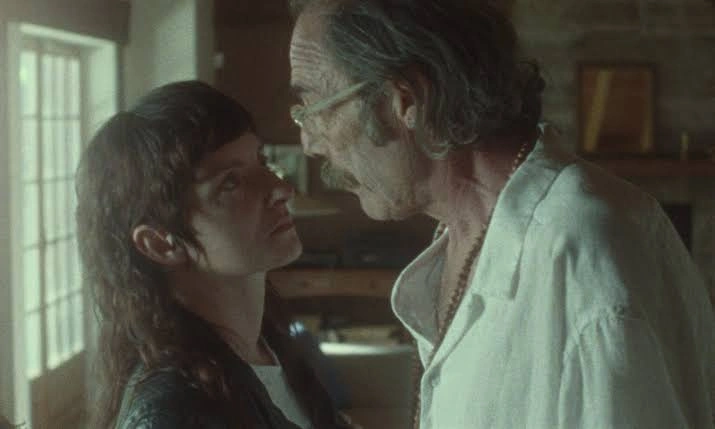
The setting could have become grotesque satire. Côté keeps it quieter. Mira stands at the edge of the festivities, watching people who seem perfectly capable of separating their work from everything that happens after it. Their ease makes her discomfort sharper.
I found this section especially effective because the film starts behaving like a thriller without announcing the change. A recurring man appears around Mira’s travels, locations begin feeling less secure, and Ludo’s friendliness acquires an uncertain charge. Nothing snaps into a conventional conspiracy plot. Côté simply allows suspicion to collect.
That gradual pressure changes how Mira’s earlier encounters register. She may have entered the work believing she was providing mercy, yet every client has left some trace. Ludo wants transactions. Mira keeps seeing people.
Grain and Fracture
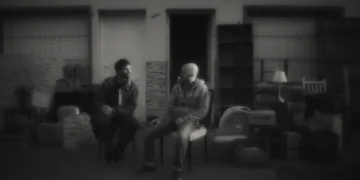
Cinematographer Vincen Biron shoots on 16mm, giving the images visible grain and a slightly faded quality. For anyone unfamiliar with the format, that texture comes partly from shooting on physical film rather than producing the cleaner surfaces common to digital cinematography. Here it makes Mira’s environment feel unstable, almost like something remembered incorrectly.
The snowy landscapes are especially effective. Mira frequently appears small against white expanses, isolated without Côté having to underline her loneliness through dialogue. Later greenery brings a different visual energy into the film, suggesting a world capable of renewal while Mira remains emotionally suspended inside it.
Terence Chotard’s editing makes that suspension harder to trust. Jump cuts and fleeting images interrupt otherwise measured sequences, sometimes resembling memories and sometimes feeling closer to intrusive thoughts. The film never labels them. Their uncertainty places us inside Mira’s deteriorating ability to compartmentalize what she has witnessed.
That formal looseness can make Nobody’s Violence demanding. Côté supplies few explanations, and viewers waiting for the recurring figures or the assisted-death organization to resolve into a conventional mystery may find the film frustratingly evasive.
Yet its strongest scenes use that uncertainty with remarkable precision. Mira spends much of the film helping people choose the moment when life ends. Through Pierrick, Mario, Ludo’s parties and the emotional fragments she carries between clients, she slowly encounters something her job has trained her to ignore: the messy, irrational attachments that make continuing to live possible.
Nobody’s Violence premiered at the Locarno Film Festival on August 8, 2026. The French-language Canadian drama follows a solitary woman traversing rural landscapes who is bound to others by mysterious death pacts.
Full Credits
Title: Nobody’s Violence
Distributor: Locarno Film Festival
Release date: August 8, 2026
Running time: 118 minutes
Director: Denis Côté
Writers: Denis Côté
Producers and Executive Producers: Guillaume Vasseur, Gabrielle Tougas-Fréchette
Cast: Larissa Corriveau, Philippe Rebbot, Pierrette Robitaille, Gabrielle Lazure
The Review
Nobody’s Violence
Nobody’s Violence turns assisted death into a haunting study of what repeated proximity to mortality does to the person left standing. Denis Côté keeps the moral questions deliberately unsettled, while Larissa Corriveau gives Mira’s emotional erosion a remarkably quiet physical presence. The grainy 16mm photography and fractured editing make her world feel increasingly unstable, especially once Pierrick and Ludo complicate the detachment her work demands. Its austerity will test some viewers, yet its best images linger with the uneasy persistence of memories you cannot quite place.
PROS
- Corriveau’s restrained performance
- Haunting 16mm cinematography
- Patiently accumulated tension
- Rich moral ambiguity
- Effective fractured editing
CONS
- Deliberately opaque storytelling
- Very slow pacing
- Supporting characters remain elusive