



























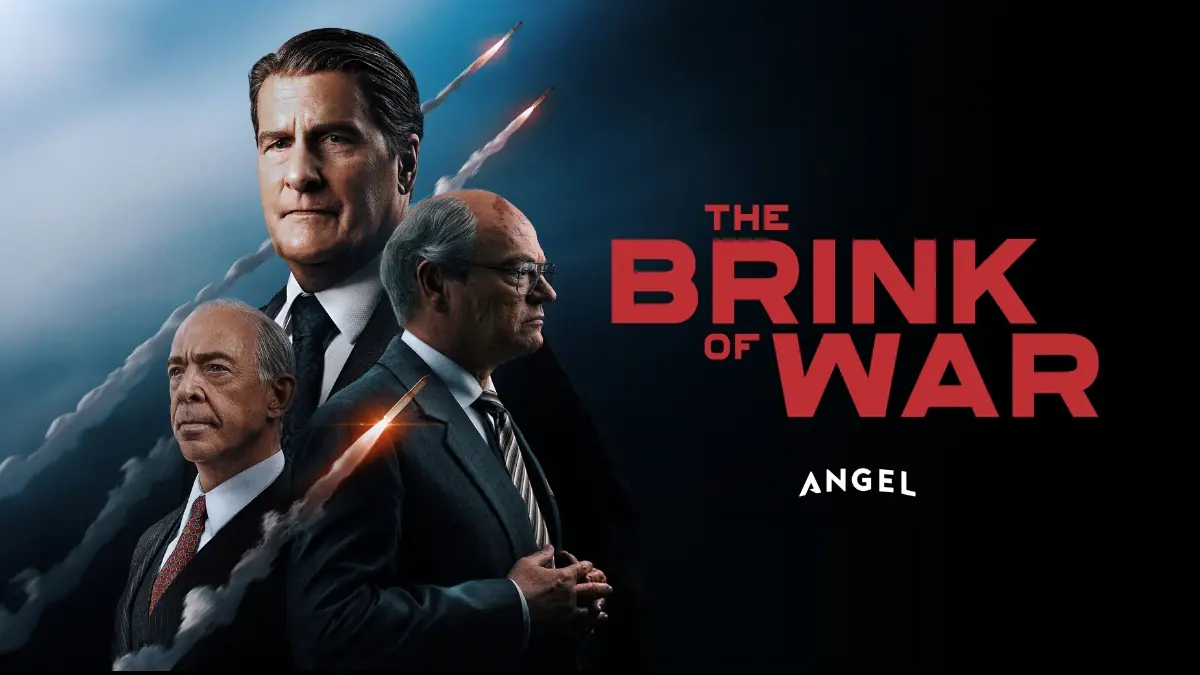

Reykjavík turns nuclear strategy into a question of distance. Michael Russell Gunn’s The Brink of War places Ronald Reagan and Mikhail Gorbachev across a wooden table and lets each concession alter the geometry of the room. The stakes are planetary, yet the drama works through smaller measurements: how long one man holds a position, how quickly the other tests it, which principle survives contact with the possibility of an agreement. When the film later shortens the table as compromise draws nearer, the gesture is almost comically literal. It also exposes the film’s best idea. Peace here exists through relation. Neither leader can manufacture it alone.
That makes the movie’s Reagan-centered historical framing harder to accept than the negotiations themselves. Gunn is strongest when he treats the Reykjavík summit as an encounter between political actors who can surprise, obstruct and alter one another. Gorbachev does not arrive merely to receive Reagan’s wisdom. He proposes meaningful arms reductions, challenges the American commitment to the Strategic Defense Initiative, and forces the talks toward the point where agreement becomes imaginable and then unreachable. The drama needs his agency. Without it, Reagan would be giving speeches into furniture.
Jared Harris understands that function immediately. His Gorbachev carries the impatience of a man who expects to be heard and the discipline of someone who knows every apparent concession will be examined for weakness. Jeff Daniels gives Reagan a practiced geniality, then tightens him whenever the conversation hits a principle he refuses to trade. The performances create a useful parity because both men appear capable of changing the temperature of the room. Daniels occasionally leans into familiar Reagan mannerisms strongly enough for the representation to feel performed twice, once by Reagan and again by Daniels, while Harris is freer to build a political personality instead of reproducing a public icon.
The movie’s surrounding machinery is less even-handed. Reagan receives a network of interpreters who reinforce his moral position. George Shultz can translate policy into counsel; Nancy Reagan gives him an intimate space in which conviction can be restated without challenge. Human-rights arguments receive special moral weight, and the film keeps returning to Reagan’s language of freedom as if repetition itself can settle the dispute. Gorbachev has positions, objections and rhetorical force, yet less of the film exists to explain the world from inside his political predicament.
This imbalance matters because The Brink of War is already good at showing that diplomacy resists ownership. The most productive scenes are built from mutual constraint. Gorbachev can push Reagan toward reductions, Reagan can push Gorbachev on human rights, and both can reach the edge of a deal before SDI becomes the point neither side can cross. Reagan looks strongest when the film allows Gorbachev to be formidable; the central room repeatedly proves the value of that parity.
Gunn’s visual choices sometimes recognize that complexity with surprising clarity. Split-screen compositions stress simultaneous positions rather than a simple hero-versus-obstacle arrangement. The shrinking table turns political convergence into physical convergence. It is a neat device, perhaps too neat, but the idea beneath it is sound. Every inch removed from the space between the leaders represents something both men had to surrender, risk or reconsider.
Then the film grows anxious about leaving that meaning unattended. The score pushes at moments that already carry their own pressure. Famous formulations and speech-ready declarations arrive with the polished authority of lines already engraved on a monument. The rhetoric often tells the audience which historical weight to feel before the scene has finished earning it. A film built around bargaining keeps slipping into commemoration.
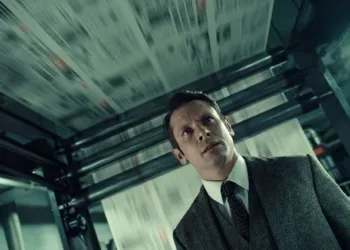
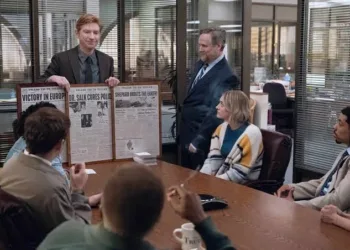
The reporter material and the contrasting public roles of Raisa Gorbachev and Nancy Reagan could have sharpened this concern with political image-making. They show that leadership at this level is partly performance for people outside the room, with spouses, press coverage and public expectation shaping how the summit will be remembered. Yet these passages often feel peripheral because the film rarely lets them disturb its preferred hierarchy. They widen the stage without significantly changing who is allowed to own the meaning of what happens on it.
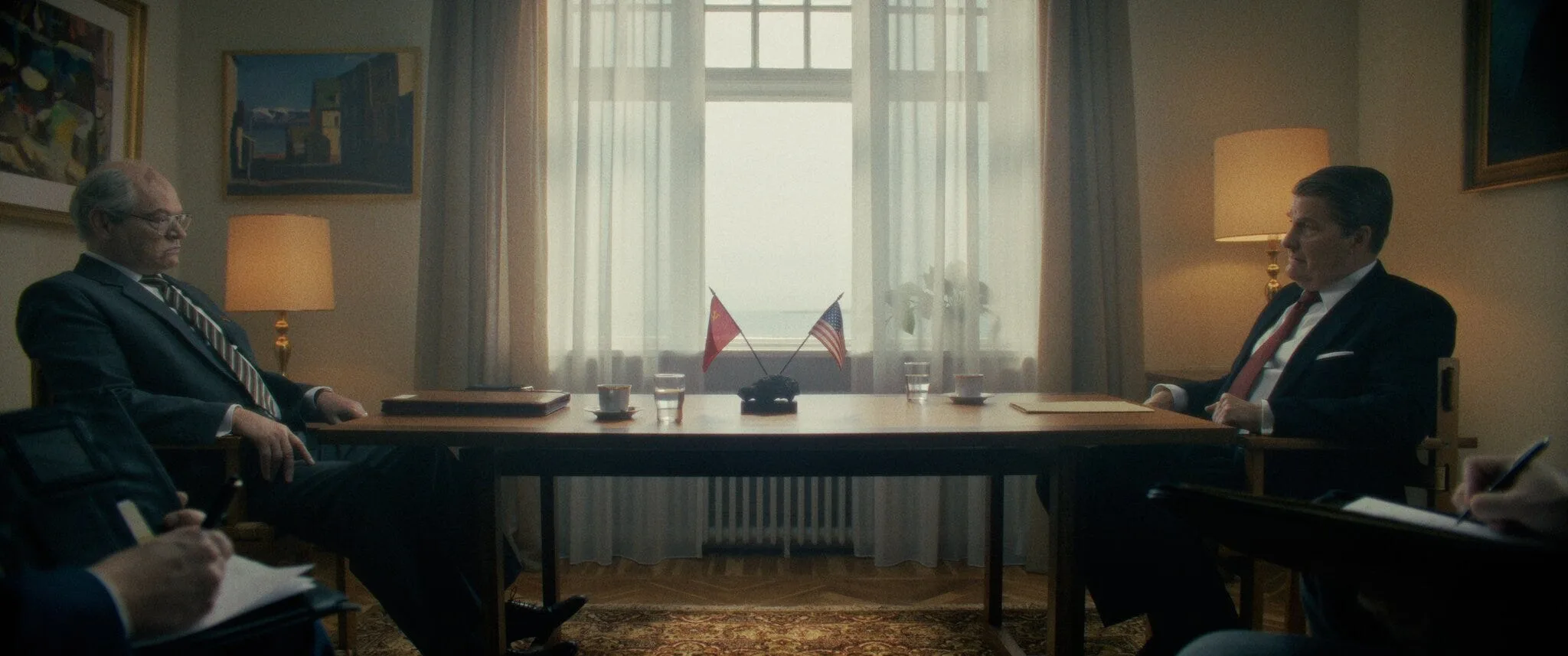
That ownership becomes the film’s central problem once the summit reaches its impasse. Reagan’s defense of SDI is treated as principle, Gorbachev’s resistance is treated as obstruction, yet the dramatic facts the film has established are less tidy. Each position helps create the deadlock. The impasse emerges from the structure of the negotiation, with both leaders holding positions the other cannot accept. The room frames history as a relation between incompatible powers.
The ending strains against that lesson. The summit’s lack of an immediate sweeping agreement is folded into a larger story of Reagan’s moral and political success, and the film starts converting shared diplomatic risk into individual legacy. That may satisfy the commemorative instinct behind the project, but it weakens the drama Gunn has built. Harris’s Gorbachev, Daniels’s Reagan, the shrinking distance, the stalled agreement and the repeated acts of concession have already made a stronger case: history moves here because neither side controls it.
The Brink of War is most alive when it allows that loss of control to remain visible. Its table is a better historian than its mythology. The closer Reagan and Gorbachev come to agreement, the clearer the film makes the dependence between them. By the time it tries to turn that dependence into a singular inheritance, the room has already told a different story.
Where to Watch The Brink of War (2026) Online




Full Credits
Title: The Brink of War
Distributor: Angel Studios
Release date: August 14, 2026
Rating: PG
Running time: 117 minutes
Director: Michael Russell Gunn
Writers: Michael Russell Gunn
Producers and Executive Producers: Matt Aragachi, Michael Russell Gunn, Chris Hammond, John Logan Pierson, Tyler Zacharia
Cast: Jeff Daniels, Jared Harris, J.K. Simmons, Hope Davis, Branka Katić, Aya Cash, Guy Burnet, John Ross Bowie, Adrian Rawlins, Jóhannes Haukur Jóhannesson
Director of Photography (Cinematographer): Magdalena Górka
Editors: Michael L. Sale, Laura Yanovich
Composer: Austin Wintory
The Review
The Brink of War
The Brink of War finds its sharpest drama in the Reykjavík negotiations, where Jeff Daniels and Jared Harris make diplomacy feel reciprocal, contingent, and politically dangerous. Gunn’s shrinking-table device gives that mutual dependence a clean visual form. The film loses force when its surrounding rhetoric and final framing concentrate historical ownership around Reagan, weakening the parity that makes the talks persuasive. It remains a strong actors’ showcase with a more interesting political contradiction than its commemorative instincts seem willing to admit.
PROS
- Harris’s formidable Gorbachev
- Daniels’s controlled Reagan
- Tense negotiation exchanges
- Effective shrinking-table motif
CONS
- Reagan-centered historical framing
- Pushy score
- Overemphatic political rhetoric
- Peripheral reporter material