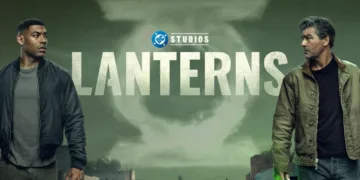




















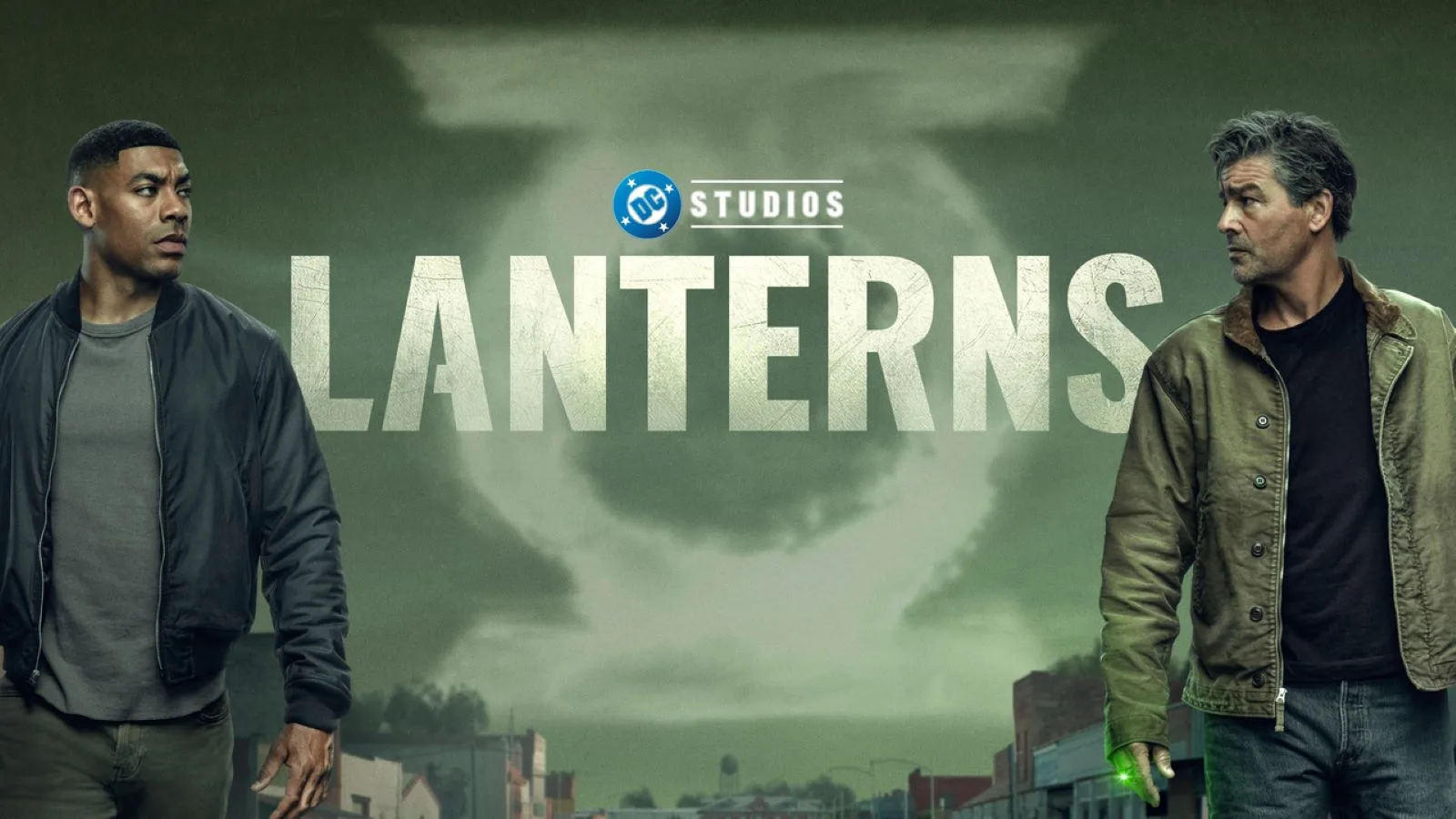

For John Stewart, excellence is preparation; for Hal Jordan, authority has already become habit. One man has spent his life becoming the sort of person an institution should trust, while the other has occupied that trust long enough to treat it like private property. Lanterns builds its strongest material from that imbalance. Across its first seven episodes, the Green Lantern ring becomes less interesting as a superhero artifact than as a license granted by a system whose standards seem to change according to the person standing before it.
Hal’s version of worthiness sounds almost absurdly simple. He remembers being asked if he was afraid and answering no. That answer helped define him. John arrives carrying a very different education in fear. As a child, his father places him through a severe test involving an apple and a gun, teaching him that fear must be controlled before the world gets a chance to read it as weakness. The series later makes the racial dimension explicit, connecting John’s discipline to the expectations placed on a Black man who has learned that composure is rarely treated as optional.
That distinction gives the mentorship its real charge. Hal can be impulsive, sarcastic, territorial and openly resistant to replacement because his authority is already established. John enters as the candidate. He has the training, the restraint and the résumé of someone who has spent years removing every possible reason to reject him. Hal still calls him “Junior,” withholds meaningful access to the ring during training and behaves as if succession were an insult rather than an ordinary feature of service. The comedy in their clashes works because the power imbalance beneath it is never entirely comic.
The ring itself makes John’s case better than the dialogue sometimes does. His background in architecture shapes intricate constructs and reveals a mind that thinks through form, structure and possibility. Hal tends toward blunt solutions and casual improvisation, including the wonderfully ridiculous use of cosmic power to produce a dollar for a jukebox. He can accuse John of lacking creativity while standing inside a system that has already licensed his own eccentricity. The joke carries a sharper point than several speeches manage: institutions often call freedom a virtue after deciding who is allowed to exercise it.
This is where Lanterns can become too eager to explain its own intelligence. John’s childhood, his self-control and his awareness of racial expectation give the character a coherent history, yet the writing periodically insists on translating that history into thesis statements. A line that directly frames the unfairness of asking a Black man in America about fear says aloud what his posture, preparation and relationship with Hal have already made clear. The series trusts Hal to be contradictory. John is sometimes asked to be representative.
That burden matters because Kyle Chandler’s Hal is permitted a great deal of human mess. Age has not turned him into a solemn monument. He is abrasive, funny, insecure about replacement and capable of using experience as both wisdom and shield. His swagger can read as confidence in one scene and institutional entitlement in the next. John begins from a tighter register, his restraint carrying the pressure of someone who knows every mistake will be counted. Their conflict grows from the unequal space each man is allowed to occupy.
The same tension appears in the series’ form. Rushville is presented through the familiar grammar of rural crime television: cars, motels, diners, local authority and suspicious deaths. The two Lanterns spend long stretches in ordinary clothes while the cosmic apparatus sits at the edge of the frame. Yet the Green Lantern mythology keeps leaking through. Constructs flare into existence. Aliens and stranger corners of the mythology press against the procedural surface. Hal keeps a carnivorous plant around. The show periodically remembers that prestige seriousness and comic-book weirdness have no natural obligation to cancel each other out.
Those moments matter because the tonal question mirrors John’s predicament. Early on, the series seems intent on proving that this superhero story can behave itself inside an HBO crime drama. John is likewise introduced through discipline, competence and restraint, carrying the burden of proving that he belongs. Hal gets to be odd sooner. The television around him does too.

By the seventh episode, both pressures begin to loosen. John’s exchanges with Hal become less rigid, allowing irritation, humor and personality to disturb the controlled surface. The series also grows stranger and emotionally less predictable. Its crime-story machinery remains useful, yet it stops acting as a certification stamp for seriousness. Green Lantern imagery and character eccentricity start occupying the same dramatic space without apology.
That shift sharpens what has been working underneath the investigation from the beginning. Lanterns is strongest when worthiness is treated as a social judgment rather than a mystical fact. Hal has lived inside approval long enough to mistake it for identity. John has been trained to pursue approval as if one imperfect response could revoke the future. Their conflict gives the ring a political meaning without requiring the mythology to become a lecture.
The first seven episodes leave that pressure in motion. John is finally allowed to become less rigid at roughly the same point that the series becomes less afraid of its own strangeness. The connection does not need to be perfectly causal to be revealing. Lanterns becomes more persuasive once John no longer has to spend every scene auditioning for the right to belong inside the Corps, or inside the argument built around him.
Lanterns premieres on August 16, 2026, and is available to stream on Max while airing weekly on HBO. You can watch the series directly on HBO Max or tune in to HBO during its network television broadcast. The plot follows veteran intergalactic lawman Hal Jordan and his new recruit John Stewart as they are drawn into a gritty, Earth-based mystery investigating a dark murder in the American heartland.
Where to Watch Lanterns Online

Full Credits
Title: Lanterns
Distributor: HBO, Max, Warner Bros. Discovery, DC Studios
Release date: August 16, 2026
Rating: TV-MA
Running time: 50–60 minutes
Director: James Hawes, Stephen Williams
Writers: Chris Mundy, Damon Lindelof, Tom King
Producers and Executive Producers: Chris Mundy, Damon Lindelof, Tom King, James Gunn, Peter Safran, James Hawes, Ron Schmidt
Cast: Kyle Chandler, Aaron Pierre, Kelly Macdonald, Garret Dillahunt, Poorna Jagannathan, Ulrich Thomsen, Nathan Fillion, Jason Ritter
Director of Photography (Cinematographer): Jason Oldak, Jules O’Loughlin
Editors: Leo Trombetta, David Eisenberg
Composer: Trent Reznor, Atticus Ross
The Review
Lanterns
Through seven episodes, Lanterns finds its sharpest idea in the unequal freedom granted to Hal Jordan and John Stewart. Their mentorship turns Green Lantern selection into a question of institutional permission, while the show’s strongest comic-book flourishes arrive as John begins to loosen. The writing can overstate its racial argument, and the prestige-crime shell sometimes constrains the stranger material. Still, the series has a confident political and character engine that gives its superhero mythology real friction.
PROS
- Hal and John’s power dynamic
- Ring constructs reveal character
- Institutional critique has bite
- Late tonal loosening
CONS
- John’s themes get over-explained
- Prestige-crime restraint constricts weirdness
- John carries heavy representative burden