

















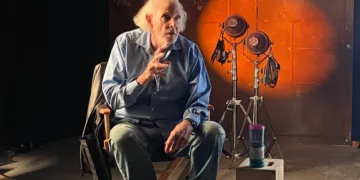












Émile has spent decades teaching other people how to read love, which gives his retirement-day lecture a faintly comic arrogance before his private life has even collapsed. Standing before his final class, he reaches for French literature to explain waiting, folly, devotion, and desire, speaking with the composure of a man who believes the subject has yielded its secrets. By the time he returns home, that confidence has become almost useless.
Martin Provost builds Love Lessons around the humiliation contained in that contradiction. Émile, played by Fabrice Luchini, discovers that Barbara has chosen another man after years of living inside a marriage he considered stable.
His first response is fury, yet Provost gradually reveals why Barbara might have wanted another life. Émile poured his attention into teaching, dismissed her parties and interests, and treated his own tastes as evidence of superior judgment. The joke is sharp because the failure is so ordinary. Expertise has given Émile a vocabulary for love without teaching him how to notice another person.
A Professor Back in Class
Luchini makes Émile’s self-importance entertaining precisely because he never turns it into harmless eccentricity. When Émile becomes preoccupied with the younger man Barbara has chosen, his outrage keeps sliding from heartbreak into class-conscious disdain. The camper van bothers him almost as much as the affair. Even betrayal must apparently meet certain aesthetic standards.

That comic pettiness matters. Provost refuses the easier story in which an abandoned husband merely has happiness restored to him. Retirement strips away two structures Émile assumed were permanent, his classroom and his marriage, leaving him to discover how thoroughly he has confused routine with intimacy.
Luchini plays that disorientation through shifts in posture and rhythm. Émile can deliver ideas with professorial control, then become physically awkward once an exchange requires emotional honesty. His irritation arrives quickly; self-recognition takes longer. The performance never asks the audience to forget how condescending he has been.
Romantic comedy has often treated maturity as the point at which people are supposed to understand themselves. Love Lessons finds comedy in the opposite possibility. Age has supplied Émile with experience, habits, and quotations. Wisdom remains pending.
Second Chances Have Their Own Terms
The women around Émile prevent his crisis from becoming a flattering story of masculine rediscovery. His sister provides the bluntest resistance to his self-pity, turning domestic conversations into small confrontations with habits he would prefer to describe as principles.
Elsewhere, an old romantic connection offers the seductive fantasy of correction. Returning to someone associated with youth seems, for a moment, like a way to repair the road not taken. Provost treats those encounters with greater sobriety than the premise initially suggests. Memory can preserve attraction, yet it cannot preserve the people who once felt it.
Another relationship develops from a far darker encounter. Émile recognizes a woman in severe emotional distress and responds in the only language he initially trusts, giving her books. The gesture is slightly absurd and deeply sincere. Their connection grows through hesitation rather than instant romantic certainty, and that patience gives the film some of its gentlest scenes.
Emmanuelle Devos, Chiara Mastroianni, and Carole Bouquet give the surrounding relationships distinct temperatures, from wounded reserve to comic aggression. Bouquet’s animal-rights activist is especially useful whenever Provost wants Émile’s controlled world invaded by someone with no interest in respecting its boundaries.
What matters is that these women do not exist as prizes distributed according to Émile’s improved behavior. Some have already discovered that leaving a marriage can produce relief. Others want companionship without surrendering independence. Their choices repeatedly interrupt Émile’s tendency to interpret desire as a problem he can solve intellectually. His education comes from discovering that another person’s freedom remains intact after attraction begins.
Love Beyond the Lecture Hall
Provost keeps the film buoyant through awkward flirtations, bruised conversations, and Émile’s recurring inability to translate theory into conduct. Melancholy slowly gathers beneath that comedy, especially once failed marriages and wasted years stop functioning as setup and begin to feel like histories these characters must carry forward.
Guillaume Schiffman’s photography gives those private disappointments an expansive setting. Dieppe’s port, cliffs, and coastal light open the film outward, while the interiors feel comparatively ordinary. The contrast suits Émile, whose ideas about love have always been larger and tidier than the rooms where people actually live it.
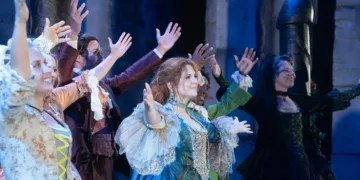
The former students periodically return in direct-to-camera recitations of love poetry. The device could have felt decorative, yet it works as a gentle rebuke to Émile’s earlier authority. The young people repeat the literature; their former teacher is now learning what those words cost once translated into life.
The narrative still moves along a recognizable three-act path, and several emotional destinations become visible early. Provost does not disguise that familiarity. His sharper choice lies elsewhere: characters past fifty are allowed sexual desire, selfishness, loneliness, bad judgment, and fresh attachments without being presented as adorable exceptions to youth’s supposed ownership of romance. Émile’s final education is therefore less romantic than social. Love survives age easily enough. Certainty is what wears out.
Love Letters premiered in August 2026 at the Locarno Film Festival, with a theatrical release in France scheduled for November through Memento Distribution. The comedy-drama follows a retired literature professor whose orderly life is upended on his final day of teaching when his wife abruptly leaves him.
Full Credits
Title: Love Letters (Demain je tombe amoureux)
Distributor: Memento Distribution
Release date: August 2026 (Locarno Film Festival)
- Director: Martin Provost
Writers: Martin Provost
Producers and Executive Producers: François Kraus, Denis Pineau-Valencienne
Cast: Fabrice Luchini, Emmanuelle Devos, Chiara Mastroianni, Carole Bouquet
Director of Photography (Cinematographer): Guillaume Schiffman
The Review
Love Lessons
Love Lessons finds its sharpest insight in treating romance after fifty as ordinary human desire rather than a sentimental exception. Martin Provost lets Émile’s literary certainty collapse against women who possess desires, disappointments, and futures independent of him, while Fabrice Luchini makes that education funny without softening the character’s complacency. The familiar three-act structure limits surprise, yet the Dieppe setting, dry comic exchanges, and recurring classroom poetry give the film an appealing texture. Its modest rebellion is allowing aging people to remain unfinished.
PROS
- Luchini’s prickly comic performance
- Strong late-life romantic perspective
- Women retain meaningful agency
- Effective comedy and melancholy
- Beautiful Dieppe photography
CONS
- Predictable three-act progression
- Several supporting threads feel slight
- Some emotional turns arrive neatly