



























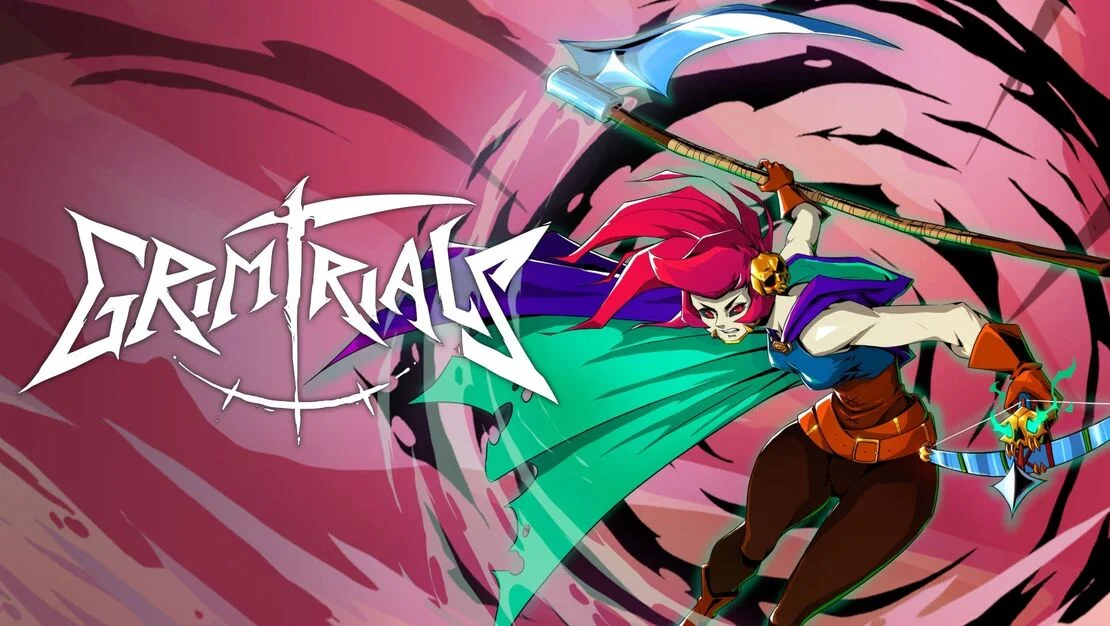

Grim Trials wastes little time making death bureaucratic. Avelin has already lost her life when she arrives at The Academy, and Death offers her a new occupation: become a Reaper, purify seven sinful souls, confront the baggage she carried into the afterlife, and maybe earn another chance to see Timmy, the person she left behind.
Developed by Glory Jam and published by Soft Source, the game places that setup inside a structure roguelite players will recognize immediately. Avelin enters a Trial Ground, clears interconnected hexagonal rooms, collects temporary upgrades and crafting materials, fights a boss, then returns to The Academy. Failure sends her back sooner.
The difference lies in how many systems are layered around that cycle. Skill trees, weapons, accessories, consumables, affinities, crafting grades, blessings, enchantments, and NPC quests all begin competing for attention surprisingly early. The brief tutorial explains movement and combat cleanly, then largely trusts players to untangle the rest. Genre veterans will probably manage. Newcomers may spend their first few runs learning menus almost as much as enemy patterns.
Scythes, Crossbows, and Seven Walls
Avelin’s combat kit has a useful split between aggression and mobility. Scythes handle close-range combinations, while the crossbow lets her pressure enemies from a safer distance and can be manually aimed when precision matters. Her dash grants a short invulnerability window and clears small gaps, turning good positioning into the foundation of survival.
Special attacks complicate the rhythm in a welcome way. They consume Fervor, which builds as Avelin attacks enemies and objects, so sitting back rarely feels optimal. Early opponents often stagger under sustained attacks, letting an aggressive player control encounters before enemies can finish their own animations.
Blessings are where individual runs start developing personalities. Charon’s Shock can add a stun effect at the end of a dash. Ereshkigal’s Toxin gives ranged attacks a chance to poison targets. Nergal’s Edge ties melee damage to Avelin’s health. Finding the same blessing again upgrades it, which makes committing to a particular combat idea far more useful than collecting random bonuses.
The seven sinful souls disrupt that comfortable rhythm. Bosses demand considerably sharper preparation than ordinary rooms, and some encounters expose the gap between a decent build and one strong enough to survive. Repeated failures may send Avelin back to gather ore, monster parts, Soul Runes, and potion ingredients before another attempt. That escalation belongs to the genre, but Grim Trials sometimes leans on statistical preparation where its best peers lean harder on learned execution.
Building a Better Reaper
The progression system gives failed attempts a practical value. Souls collected during runs convert into Soul Runes, which can improve abilities and support weapon enchantment. Skill allocations can also be reset, allowing experimentation without permanently punishing an early mistake.
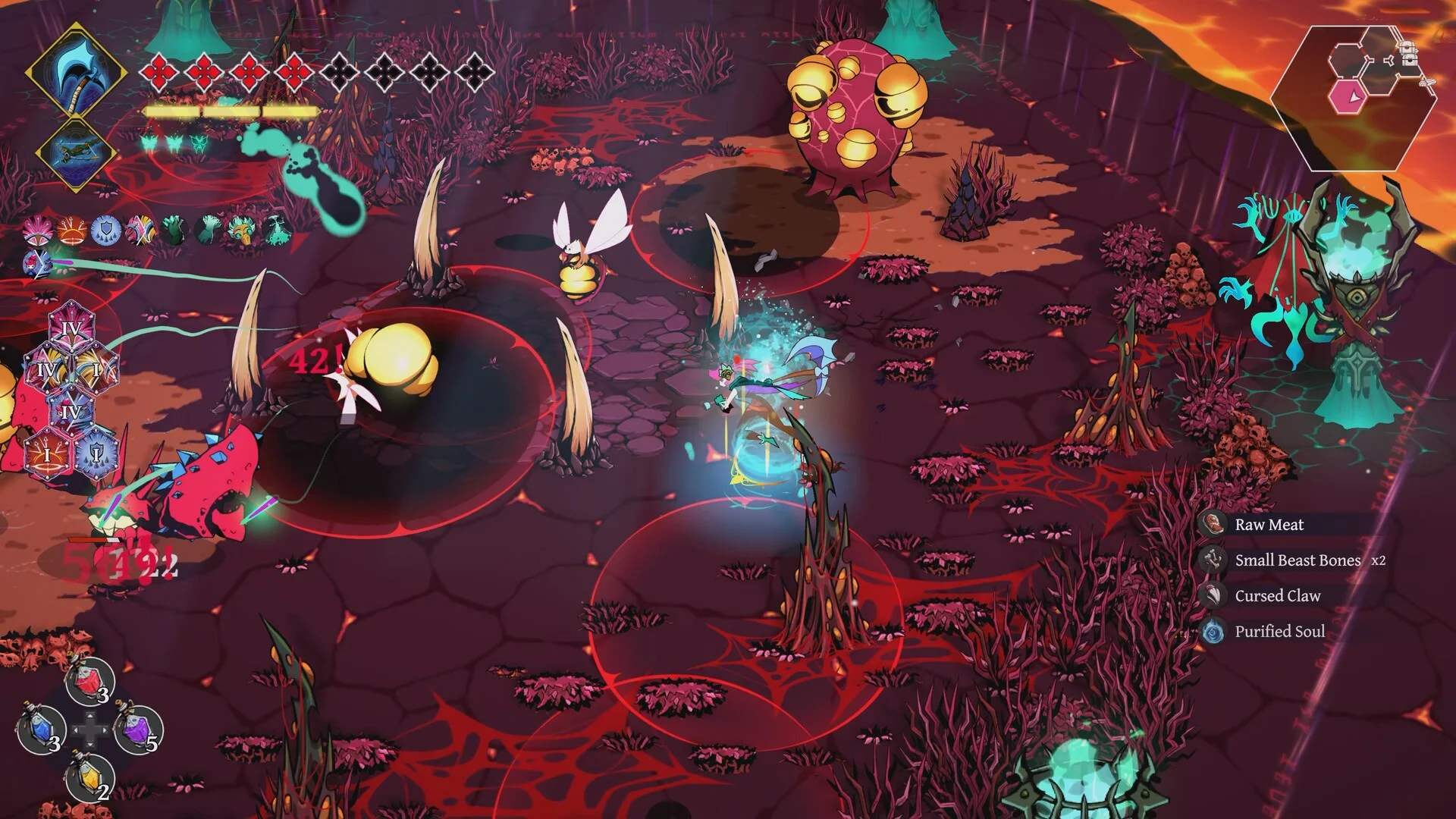
That flexibility matters because specific combinations can change how Avelin approaches an arena. Improving her dash and pairing it with Aftershock, for example, turns an escape tool into part of an offensive rotation. Grim Trials is strongest when upgrades create changes like that, rather than simply increasing numbers.
Crafting has its own wrinkle. Materials such as bronze ore, red crystals, beast bones, grim shrooms, and monster pelts must be gathered during trials, sometimes processed, then used to create equipment or consumables. Crafting itself involves short timing sequences. Better inputs can raise the quality of weapons and accessories, while precise potion crafting may produce extra items.
The tutorial’s Soul Reaver demonstrates the idea well. Compared with the basic Reaper Scythe, it hits harder and briefly stuns enemies, immediately showing why collecting recipes matters. Poorly crafted equipment can later be reforged, so a bad timing sequence hurts without permanently wasting the recipe.
Procedural room placement keeps material runs from becoming identical. Treasure rooms, encounters, and paths move around, while the map records explored sections and permits backtracking. Players hunting every resource can clear the whole layout before facing the sinful soul.
Runs rarely demand an enormous uninterrupted commitment, either. Longer attempts can sit around the 25-minute mark, giving the structure a brisker cadence than roguelites built around hour-long survival marathons.
Life at The Academy
The Academy prevents all that repetition from feeling purely mechanical. Pytra handles blacksmithing with an enthusiasm that makes the afterlife seem strangely employable. Kai initially keeps Avelin at arm’s length. Ivanya’s coldness gradually gives way to a quieter sense of care. Namélés mostly wants attention, which means the game correctly recognizes that any underworld institution improves when it contains a dog you can pet.

Affinity progression and NPC quests reward those conversations with recipes and additional character material. These relationships also strengthen Avelin’s own story because each resident carries some history that reflects the game’s recurring interest in loss, acceptance, and unfinished lives.
The main plot is less patient. Avelin’s grief over Timmy gives the trials an emotional motive beyond promotion within the Reaper profession, yet the final stretch resolves that thread faster than the Academy relationships suggest it should.
Visually, each Trial Ground uses supernatural scenery to distinguish its combat spaces, from lava and statues to dense clusters of trees. The decoration occasionally becomes a practical hazard when Avelin catches on scenery during hectic fights, though the environments remain readable most of the time.
The heavy-metal soundtrack fits the combat even better. Exploration themes can settle into rhythmic chanting beneath routine encounters, then guitar riffs push forward when a sinful soul appears. Grim Trials may borrow much of its structural vocabulary from established roguelites, but few of them send you back into purgatory with quite this much distortion pedal.
The Review
Grim Trials
Grim Trials takes a recognizable roguelite framework and gives its runs extra texture through flexible Soul Rune builds, timing-based crafting, compact Trial Grounds, and blessings that can meaningfully reshape Avelin’s combat style. The seven sinful souls expose its biggest weakness, since boss difficulty sometimes turns preparation into material farming rather than mechanical mastery. Still, The Academy, its personable residents, and a heavy-metal soundtrack give repeated deaths enough character to keep the cycle moving.
PROS
- Flexible Soul Rune builds
- Satisfying melee and ranged combat
- Crafting rewards player execution
- Strong heavy-metal soundtrack
- Compact, replayable Trial Grounds
CONS
- Abrupt boss difficulty spikes
- Repetitive material farming
- Limited enemy-pattern variety
- Story resolves too quickly