



























The strangest feeling in Girl Group is relief. It arrives whenever Rebel Wilson’s Tassie Young stops talking long enough for the younger singers around her to perform. The movie suddenly loosens. A competition number, a rehearsal, even a scrappier performance with mismatched costumes can make the film feel warmer and more alive than the scenes built around its star. Then Tassie takes the room back, and the spell breaks.
That push and pull defines almost everything Wilson’s film gets right and wrong. Tassie is a former member of Gurlfriends, a late-1990s pop act formed after five schoolgirls impress a talent scout at a performance encouraged by their teacher, Mrs. Browmaker. Gurlfriends become stars, Tassie leaves for a solo career, and the gamble collapses.
Years later, the group plans a reunion without her, replacing her with Nicole Scherzinger’s wildly competitive new member. Tassie spirals, lands in legal trouble after drinking and driving, and is assigned community service at a youth center, where she ends up mentoring teenage singers for a record-label competition.
The setup is shamelessly familiar, and familiarity itself is not the problem. Comfort movies survive on recognizable shapes. The trouble is that Girl Group keeps reminding you of the older movies it wants to revive without discovering a new emotional rhythm of its own.
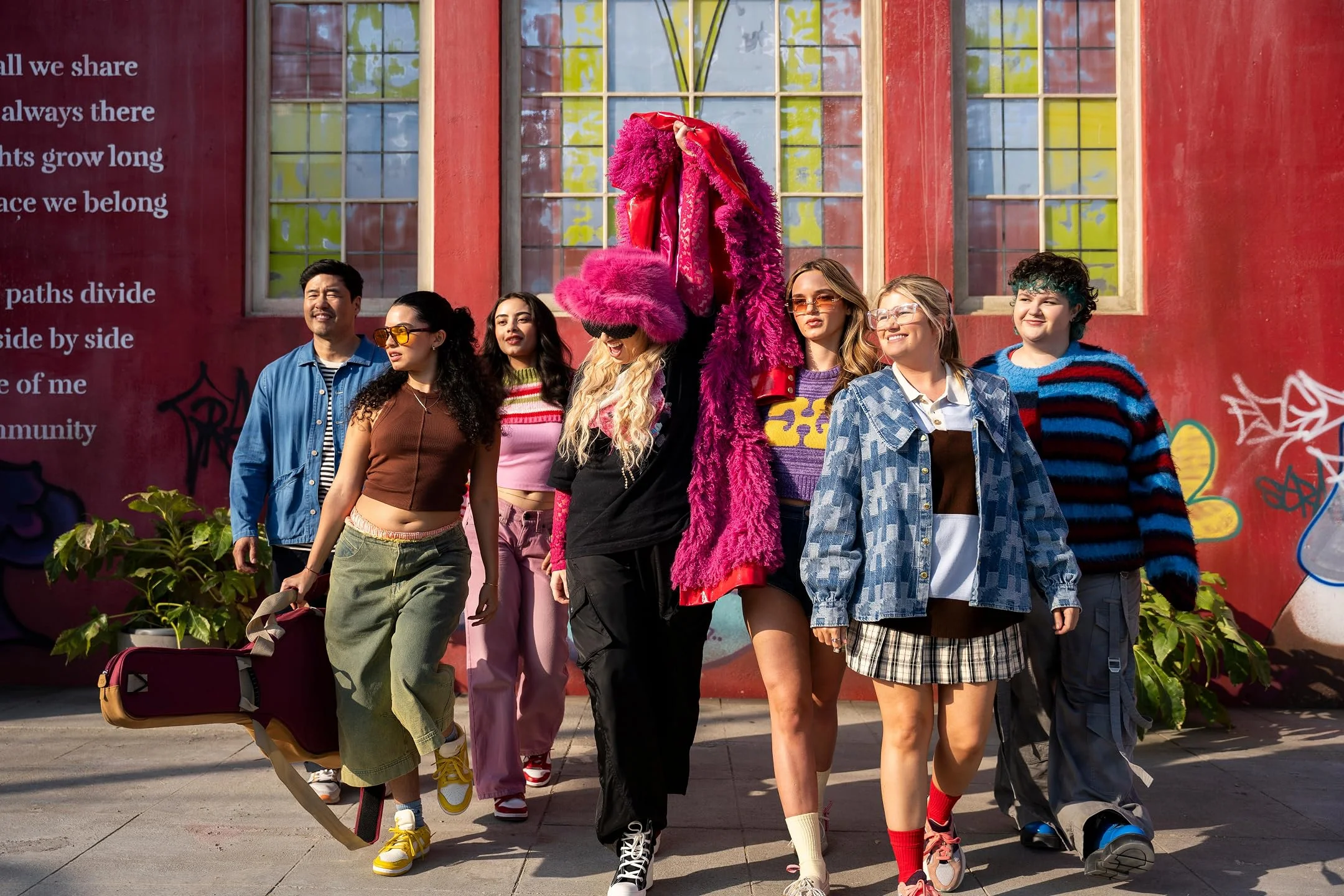
Pitch Perfect hangs over the film so heavily that the title is referenced inside the story. The casting doubles down on the nostalgia: Mel C, Shaznay Lewis, Ashley Roberts, and Scherzinger connect the fictional Gurlfriends to several real eras of pop. That should make the film feel like an affectionate handoff between generations. Too often, it feels like the older generation refusing to leave the stage.
You can sense the better movie every time the teenagers push back against Tassie. She approaches them with the instincts of someone who still believes polished image, sexual confidence, and star-making machinery are the obvious route to success. They do not accept that vision without question. One of the clearest conflicts comes when the younger women challenge the sexualized imagery Tassie presents as empowerment, identifying the male gaze behind the supposed liberation.
The movie has something sharp in its hands there. Pop history is full of women being sold freedom in packaging designed by somebody else, and Girl Group briefly lets two generations argue about that contradiction. Then it moves on, which is where the film loses its emotional center.
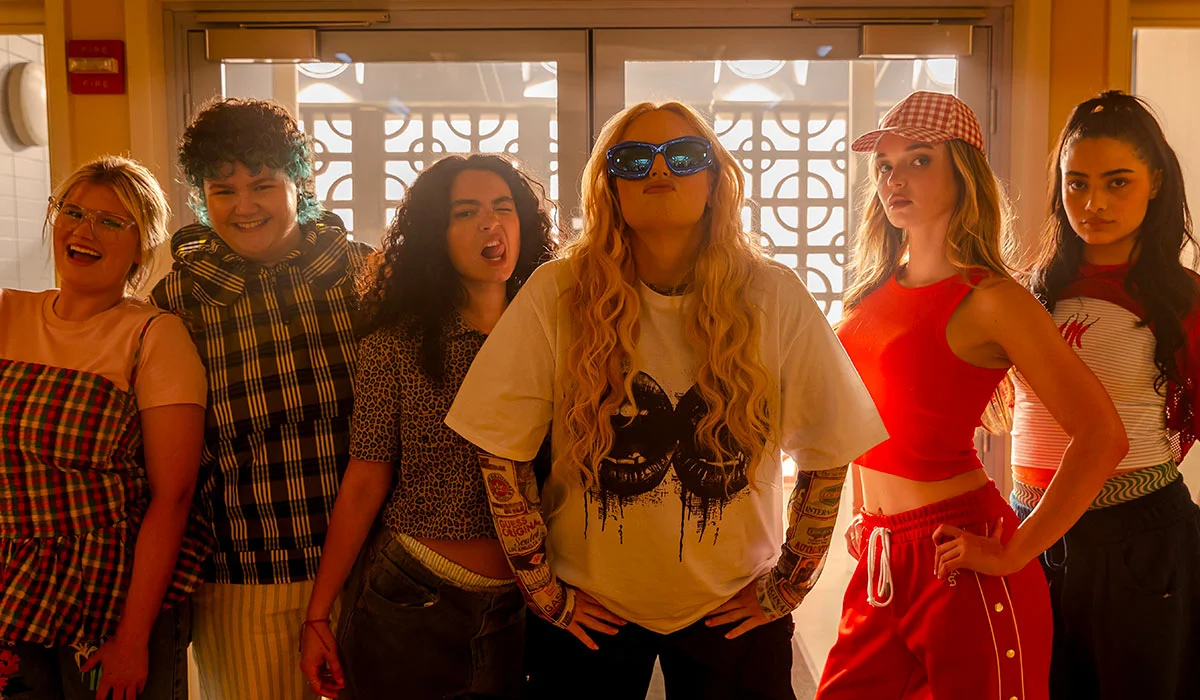
The young performers should be the people who force Tassie to change, yet their stories are repeatedly pushed aside for her comic routines and comeback anxieties. Chabely Ponce brings an easy presence to an acoustic-guitar-playing singer, while Lilah Pate gives the group’s emerging leader a confidence that makes you want to stay with her. Their chemistry suggests a version of the movie built around girls learning how to perform together without becoming copies of the stars Tassie remembers. The film keeps returning to Tassie before that idea has enough room to grow.
Wilson’s comedy makes that imbalance harder to ignore. The humor leans heavily on sex, bodies, digestive distress, celebrity references, and the assumption that bluntness creates its own punch line. A child telling Tassie she looks like she “ate Sabrina Carpenter” is a useful example of the problem: the joke is current, loud, and easy to understand, but it tells us very little about anyone involved. Jennifer Coolidge gets saddled with a nutrition-bar gag built around laxative consequences. Elsewhere, references to tampons and oral sex arrive with the same basic strategy.
Scherzinger fares better because her comedy comes from character. At Mrs. Browmaker’s funeral, her replacement member turns mourning into a singing contest, then collapses into harmonized emotion. It is ridiculous, but the ridiculousness belongs to her vanity. She wants to dominate even grief. That is a joke with a pulse. The film could use far more of that specificity.
The musical sequences are where Girl Group finally starts trusting its cast. Performances staged in malls, training spaces, and competition venues let the younger ensemble communicate through timing, movement, and shared energy rather than exposition. The covers span different pop generations, which gives the music a function beyond recognition. Tassie keeps reaching backward, while the girls are trying to decide what they want to sound like now.
The strongest expression of that conflict comes when their less polished original number is set against a slicker Destiny’s Child performance. The rougher staging, mismatched presentation, and lack of obvious spectacle make the sequence feel closer to the group these girls have actually become. For once, the movie’s idea of authenticity has a physical form. You can see the difference between copying a template and occupying the stage as yourself.
That feeling matters because so much of Girl Group looks synthetic. Several Los Angeles settings have a bright, overly polished quality that keeps the world at arm’s length, and the visual smoothness clashes with a story supposedly interested in messy reinvention. The movie keeps talking about finding a voice while presenting a world scrubbed of texture.
There is still pleasure in watching the young cast sing and dance, and the real girl-group veterans bring an affectionate charge simply by being present. Wilson clearly understands the appeal of this kind of pop comedy. What she seems less willing to do is surrender control to the ensemble her story needs.
The final musical stretches come closest to solving that problem. Tassie’s value as a mentor becomes clearest when the girls no longer feel like extensions of her comeback plan. Their voices start separating from hers. Girl Group spends most of its runtime trying to recreate a feeling from the past, yet its best moments arrive when the younger performers stop recreating anything at all.
Girl Group premiered at the Toronto International Film Festival in September 2026. The comedy follows a disgraced former girl group star who must coach an unruly band of teenagers to win a major record label competition.
Where to Watch Girl Group (2026) Online
Full Credits
Title: Girl Group
Distributor: Live Nation Productions, Metro-Goldwyn-Mayer
Release date: September 2026 (Toronto International Film Festival)
Running time: 1 hour 36 minutes (96 minutes)
Director: Rebel Wilson
Writers: Alana Da Fonseca, Rebel Wilson
Producers and Executive Producers: Stella Bulochnikov, Peter Coleman, Neil Jones, Paula P. Manzanedo, Jessica Olthof, Jules Powell, Robin Rapino, Christopher Scott, Matt Williams, Rebel Wilson, Rob Yeomans
Cast: Rebel Wilson, Jennifer Coolidge, Nicole Scherzinger, Randall Park, Sheridan Smith, Jamie-Lee O’Donnell, Guz Khan, Jolene Blalock
The Review
Girl Group
Girl Group finds flashes of joy whenever its younger performers are allowed to sing, dance, and shape the stage for themselves. Those moments carry warmth that Rebel Wilson’s recycled comic routines, synthetic presentation, and nostalgia-heavy structure rarely match. The generational conflict over pop stardom and empowerment could have given the film real emotional weight, but it keeps returning attention to Tassie before the younger ensemble can fully claim the story. The music occasionally finds the voice the screenplay cannot.
PROS
- Energetic young ensemble
- Strong musical sequences
- Nicole Scherzinger’s sharp self-parody
- Promising generational conflict
CONS
- Tassie overwhelms the ensemble
- Too many tired broad-comedy gags
- Generational themes remain underdeveloped
- Artificial-looking presentation
- Heavy reliance on nostalgia