

























![Kingdom Hearts Collection [I-III] Review](https://gazettely.com/wp-content/uploads/2026/10/Kingdom-Hearts-Collection-I-III-1-360x180.webp "Kingdom Hearts Collection [I-III] Review: KHII Holds Steady as Newer Entries Fluctuate 37")





Documentaries about big, abstract ideas often struggle to find a human anchor. Death & Taxes solves this by rooting its exploration of American wealth disparity in a conflict that feels intensely personal. The film introduces us to its director, Justin Schein, as he attempts to understand his father, Harvey, a successful executive from a bygone era.
Their relationship is the engine of the story. Harvey is a man singularly focused on one thing: ensuring his fortune avoids the grasp of the estate tax upon his death. For Justin, that same tax represents a civic good.
This raw, intimate setup turns a national political debate into a tense family dialogue, placing the viewer directly at the dinner table where these opposing worldviews collide. It’s a work that asks what we owe to our society versus what we owe to our own bloodline.
Portrait of a Patriarch
Harvey Schein is built like a classic protagonist from the bootstrap generation: he started with nothing and leveled up through sheer force of will. The film carefully pieces together his story, showing his ascent from Depression-era poverty to the peak of corporate power at Sony. He is not presented as a simple villain hoarding gold; the filmmaking is too nuanced for that.
The camera captures his genuine charm, his fierce intelligence, and his competitive fire, seen in anecdotes about him championing the Betamax format—a commercial failure he was, technically, right about. Yet, it also shows a volatile temper capable of turning him into a “fire-breathing monster,” and a paradoxical frugality, like insisting on walking when a cab is an option.
The documentary skillfully connects his anti-tax fervor to a foundational belief that he alone earned his wealth and must protect it from a government he views as wasteful. This conviction becomes a glaring contradiction when the film points out that his own education was funded by the G.I. Bill, a massive government program.
This revelation works like a key lore item in a game, unlocking a new understanding of the character’s entire belief system and exposing the selective memory at the heart of his personal myth.
A Nation’s Argument at the Dinner Table
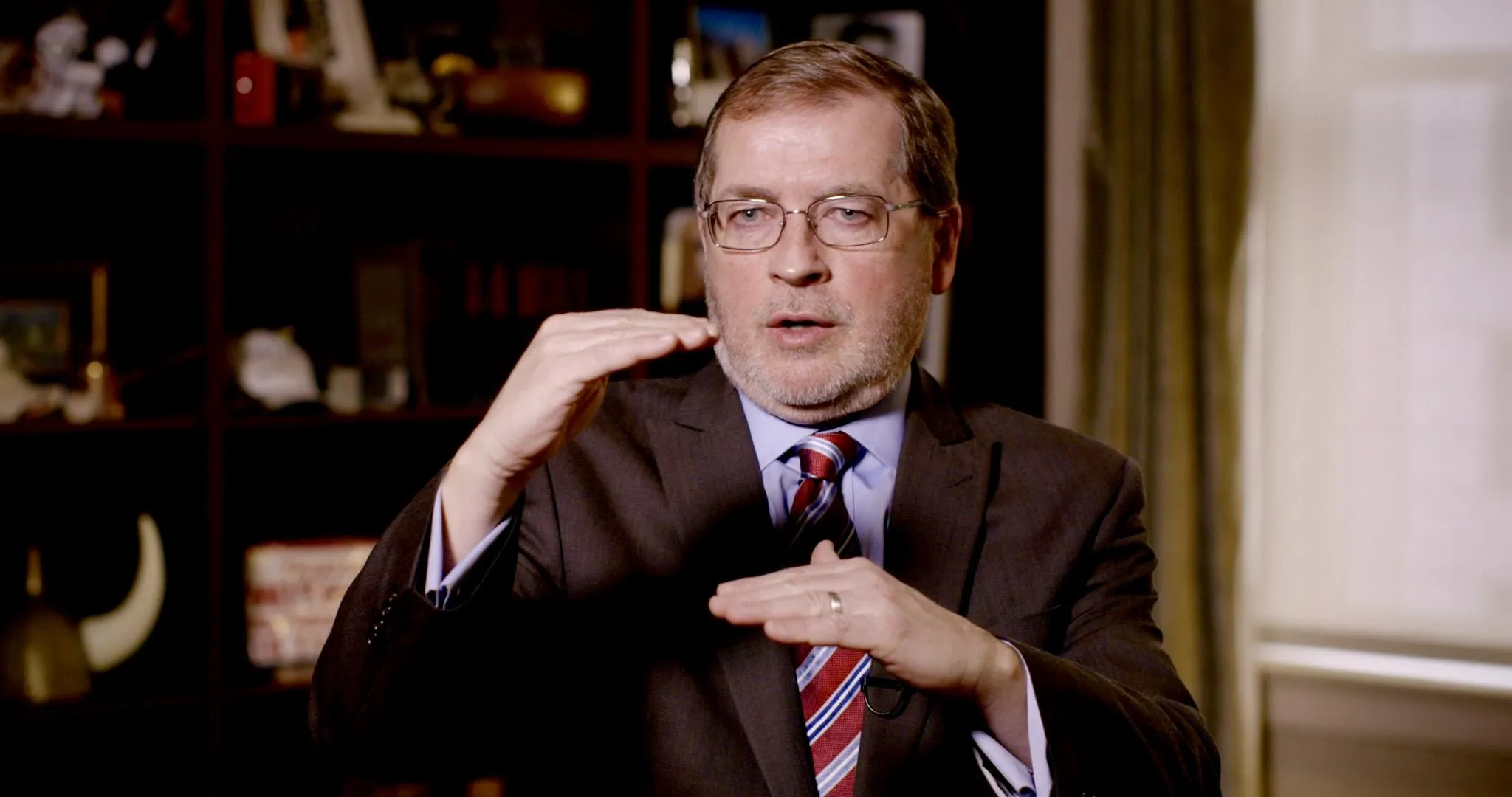
The film’s structure cleverly expands the family’s personal battlefield into a map of America’s ideological landscape. A disagreement between father and son over dinner fluidly transitions into a segment featuring advocates like Robert Reich and Grover Norquist.

The editing here is key; the jump from a raw, handheld family moment to a polished talking-head interview has a powerful effect. It prevents the film from becoming a dry lecture by constantly reminding us of the human stakes. The experts function as a kind of Greek chorus, giving formal names to the political philosophies that Harvey and Justin express with raw emotion.
Director Justin Schein uses archival footage of presidents discussing tax policy not as a history lesson, but as a way to show how this rhetoric has shaped his father’s thinking for decades. The grainy texture of home videos showing a younger, happier family offers a poignant contrast to the stark political realities of the present.
Harvey’s devotion to Fox News is presented as the logical endpoint of this path, a feedback loop reinforcing his worldview. The film effectively demonstrates how a personal identity is constructed and reinforced by political media, turning one family’s arguments into a reflection of a divided nation.
The True Bottom Line
The emotional weight of Harvey’s financial obsession lands hardest in the film’s final act, where the narrative pacing slows to a more contemplative rhythm. His single-minded pursuit of tax avoidance directly leads to the fracturing of his marriage.

His wife, Joy, a dancer who put her own passions aside for the family, emerges as a fully formed character through her decision to leave. Her move is not just a reaction; it is an act of self-preservation against a man consumed by a single idea. As Harvey faces a terminal illness, the camera stays with him, capturing a figure stripped of his bombast.
His eventual admission that his lifelong quest now feels “ridiculous” is a quiet, devastating payoff. The film suggests that the most significant inheritance is not the money that is saved, but the lessons learned from a parent’s life.
It forces the question of what a person leaves behind if their existence is defined solely by accumulation. Justin Schein’s inheritance, it seems, was not a tax-free fortune, but the wisdom to understand what his father lost, captured forever in the honest, difficult, and loving portrait that is this film.
Death & Taxes premiered at DOC NYC and had its New York theatrical premiere at the IFC Center, beginning on July 18, 2025.
Full Credits
Director: Justin Schein, Robert Edwards
Writers: Alan Berliner, Purcell Carson, Robert Edwards, Brian Redondo, Justin Schein
Producers: Justin Schein, Robert Edwards, Yael Melamede
Executive Producers:
Cast: Matthew Desmond, Darrick Hamilton, Paul Krugman, Frank Luntz, Grover Norquist, Anne Price, Robert Reich, James Bandler, Chuck Collins, Clive Davis
Director of Photography (Cinematographer): Justin Schein
Editors: Purcell Carson, Brian Redondo
Composer: Bobby Johnston
The Review
Death & Taxes
Death & Taxes succeeds by turning a sprawling, contentious political issue into an intimate and deeply personal story. It avoids being a dry policy lecture by focusing on the fascinating, contradictory figure of Harvey Schein and the emotional cost of his lifelong obsession. The film is a thoughtful and moving examination of the American Dream, legacy, and the complex bonds between a father and a son. It thoughtfully questions what we value, leaving the viewer to ponder what is truly worth passing on to the next generation.
PROS
- Connects a large-scale political debate to a relatable, human story.
- Presents a layered and memorable portrait of its central subject, Harvey Schein.
- Skillfully blends personal home videos with archival footage to build emotional depth.
- The narrative provides a satisfying and poignant emotional resolution.
CONS
- Viewers seeking a deep dive into tax policy might find the focus on family drama too prominent.
- The filmmaker’s lack of specificity about his family's exact level of wealth can feel like a minor omission.
- The observational pacing in the final act may not appeal to all viewers.







