













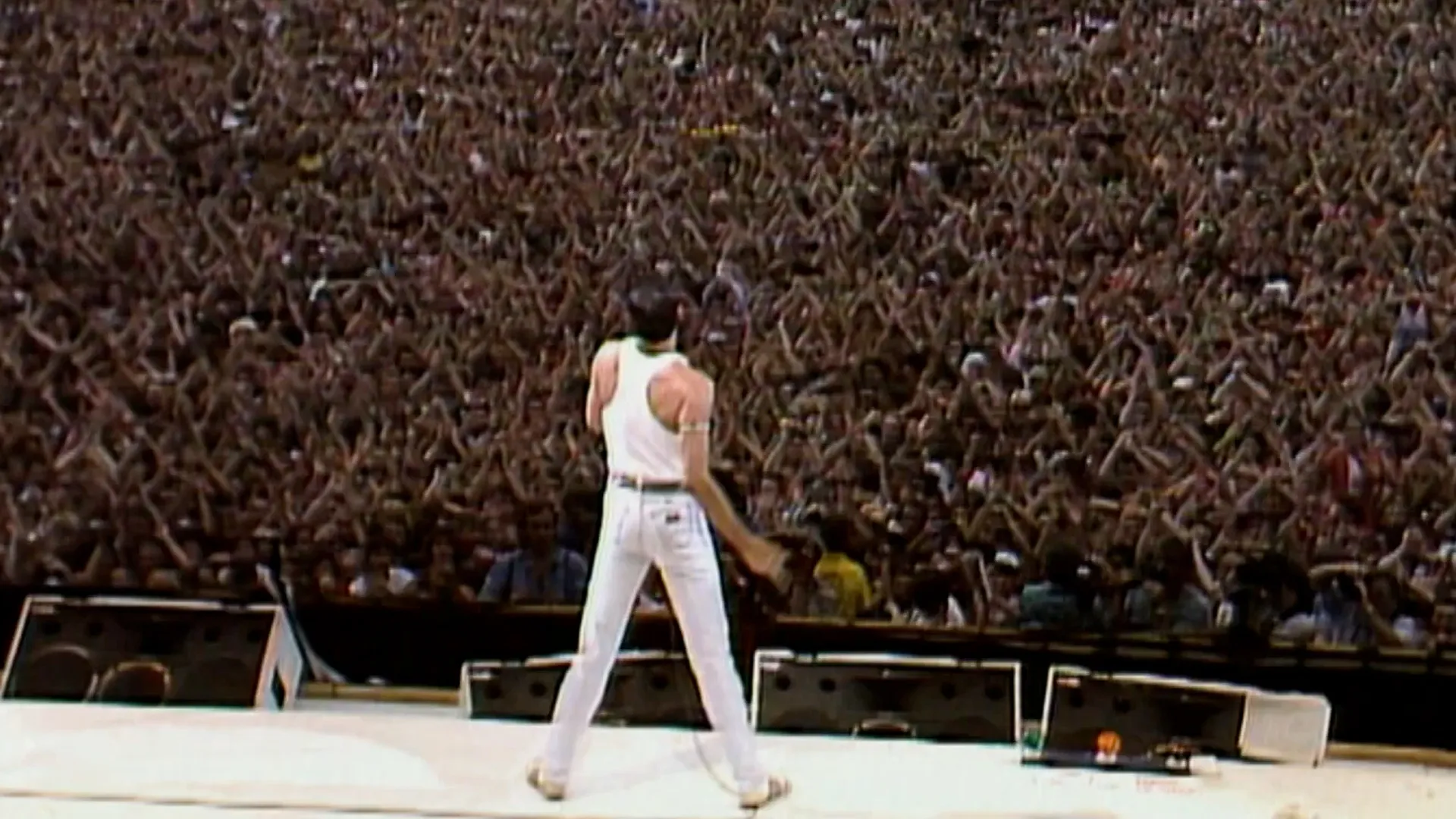

An event like Live Aid exists in the cultural memory less as a historical fact and more as a piece of modern mythology. To revisit it 40 years on, as the BBC’s documentary series does, is to risk puncturing a legend. Live Aid: When Rock ‘n’ Roll Took on the World thankfully avoids simple nostalgia.
Instead, it positions the phenomenon as a cultural artifact born of a specific, peculiar moment in time. The series begins not with a triumphant guitar riff, but with the broadcast that started it all: Michael Buerk’s stark report on the Ethiopian famine.
The footage feels like an alien transmission, cutting through the neon-drenched, synthesizer-heavy fug of 1980s pop culture. This documentary frames the subsequent musical uprising not as a simple charity drive, but as a frantic, ambitious, and deeply flawed experiment.
It investigates what happens when pop-star idealism, armed with astonishing cultural power, runs headfirst into the intractable wall of geopolitical disaster. It asks what the effort revealed about the era, its stars, and our own relationship with mediated tragedy.
The Catalyst and the Chorus
The engine of the entire enterprise was, of course, Bob Geldof. The series portrays him not merely as a hero but as a man possessed, a waning pop star from the Boomtown Rats who found a cause that consumed him. His immediate, furious reaction to the famine report provides the documentary’s narrative thrust.
We see his transformation from musician to activist happen in what feels like real-time, his sheer bloody-mindedness cutting through industry complacency. The creation of “Do They Know It’s Christmas?” with Midge Ure is shown as a frantic burst of creativity, with Geldof’s raw, off-key demo serving as a humorous starting point for a global anthem. Ure’s technical polish was the necessary counterpart to Geldof’s raw passion.
What follows is a remarkable chronicle of herding rock royalty in a pre-internet age of landlines and diaries. With a phone and an unstoppable will, Geldof assembled a who’s who of 1984 British pop at Sarm West Studios. Duran Duran, Spandau Ballet, Sting, and Bananarama all appear, looking impossibly young and slightly bewildered by the gravity of the task.
The archival footage from inside the studio crackles with a unique energy—a mix of massive egos, genuine concern, and the intoxicating feeling of history being made. The documentary captures the moment perfectly: polished pop personas were left at the door in service of a raw, collaborative effort.
We watch George Michael meticulously perfect a single vocal line with startling professionalism, and see a hyper-earnest Bono find a way to make the song’s most awkward lyric—”Well tonight thank God it’s them, instead of you”—into its most powerful, spine-chilling moment.
A Global Stage and Its Flaws
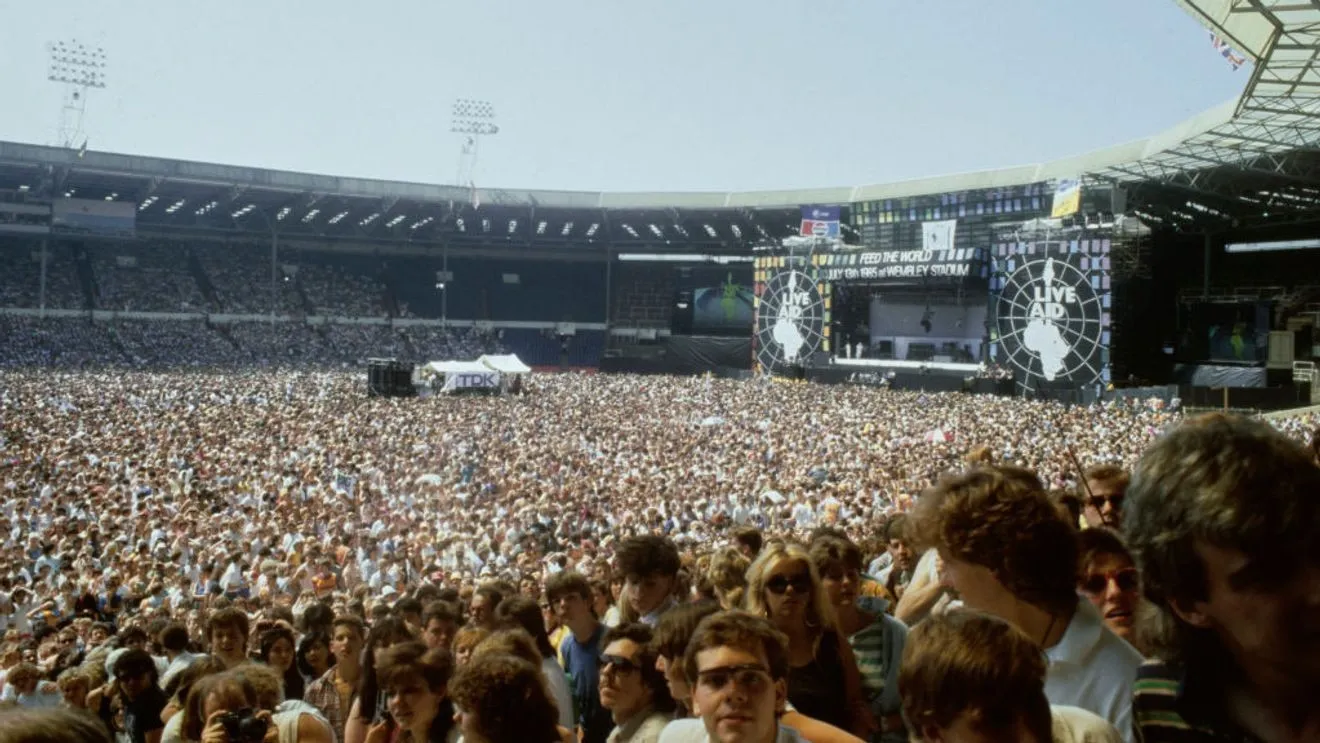
From the single came the concerts, an undertaking of staggering ambition that represented the peak of television’s monocultural power. The documentary captures the raw spectacle of the dual-venue broadcast, a technical marvel that reached nearly two billion people.
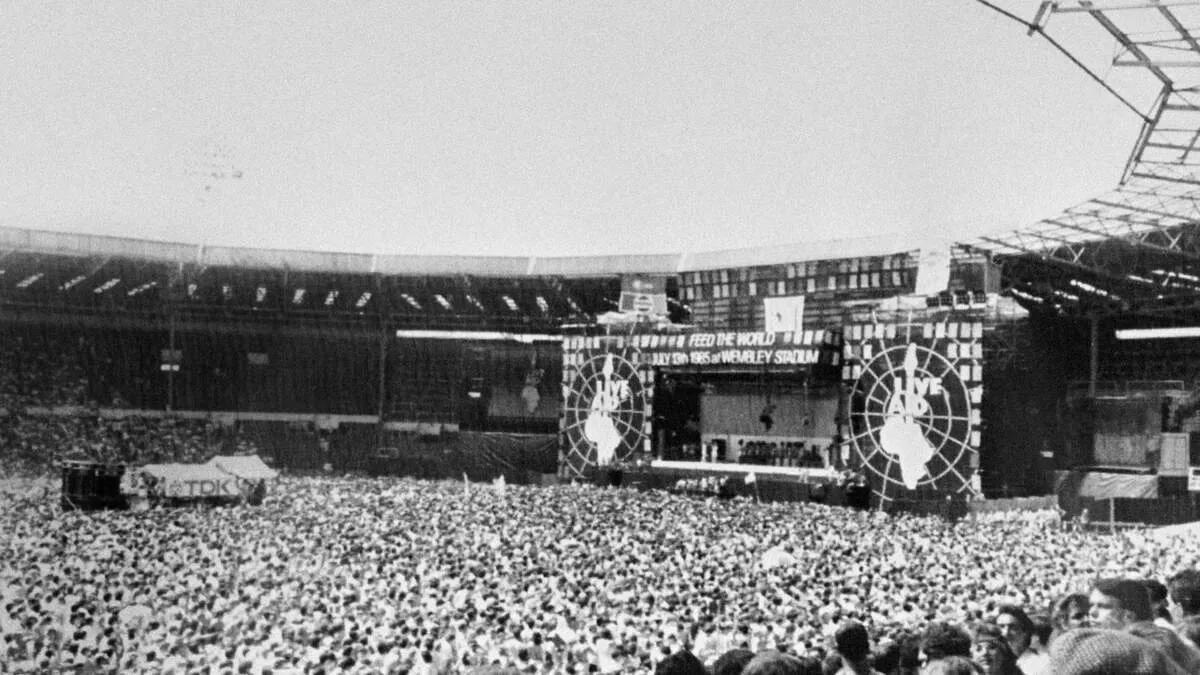
It spends time soaking in the atmosphere of that day, from the sun-drenched optimism of Wembley Stadium in London to the slightly different rock-and-roll energy of JFK Stadium in Philadelphia.
The series dutifully replays the iconic moments that have become rock legend: Queen delivering a tight, explosive performance that would redefine their legacy, an act Geldof himself admits he initially resisted. Paul McCartney’s microphone famously fails during “Let It Be,” a perfect metaphor for the moments when good intentions met logistical friction.
Yet, after establishing the grandeur, the series turns a sharp, critical lens upon the project. It directly confronts the charge of “white saviourism,” presenting the parade of mostly white British and American pop stars not as a malicious oversight but as a systemic reflection of the industry’s power structure.
The documentary explores the inherent power imbalance of wealthy Western artists defining the narrative for an African crisis. Geldof’s defense is included, and it is brutally pragmatic: he needed the artists who sold the most records to raise the most money possible to stop people from dying. It’s a collision of pure intent with the cynical mechanics of capitalism.
The film also gives voice to the lyrical critiques from Ethiopians, who point out that their nation has an ancient Christian tradition and is home to the Blue Nile. This detail makes the song’s most famous lines a work of well-meaning, almost embarrassing, fiction that reveals the deep chasm of understanding between the fundraisers and the people they aimed to help.
The Aftermath and Enduring Legacy
The documentary follows Geldof’s full metamorphosis into an unlikely political operator, a scruffy musician who found himself confronting world leaders with the same energy he brought to the stage. His televised ambush of Margaret Thatcher over VAT on the single and his recalled, profane takedown of Ethiopia’s President Mengistu show a man completely uninterested in diplomatic niceties. He was a punk rocker in the halls of power.
The series is clear about the tangible results: massive sums of money were raised and directed to aid, and the movement was instrumental in future third-world debt cancellation. But it also reveals the profound personal cost. In one of the film’s most unguarded moments, the modern-day Geldof breaks down completely while remembering hearing the song on the radio in Ethiopia, overcome by the shame and rage of the moment. It is a crack in the armor of the operation’s “mad general.”
Ultimately, the documentary presents Live Aid as a historical singularity, a product of a bygone, analogue age that seems impossible to replicate in today’s fragmented digital landscape.
The sheer focus required—the reliance on terrestrial television, the physical act of buying records, the absence of social media’s instant critique—is foreign to the modern world. The sentiment offered by Tony Blair, that the effort likely saved millions of lives, is left to stand as the bottom line. For all its imperfections and contradictions, its humanitarian achievement remains a powerful, complicated truth.
Live Aid: When Rock ‘n’ Roll Took on the World is a four-part docuseries that premiered on July 13, 2025, on CNN.
Full Credits
Directors: Thomas Pollard, Max Stern
Producers: Brook Lapping, Jamal Osman, Olivia Bernhardt Brogan, Tom Pollard, Angus Macqueen
Executive Producers: Amy Entelis, Lyle Gamm, Norma Percy, Tanya Shaw
Cast: Bob Geldof, Midge Ure, Bono, Sting, Nile Rodgers, Mike Mitchell, Birhan Woldu, Tony Blair, George W. Bush, Olusegun Obasanjo, Richard Curtis
Editors: Zeb Achonu, Matt Ashton, Toby Marter
The Review
Live Aid: When Rock 'n' Roll Took on the World
Live Aid: When Rock 'n' Roll Took on the World is an exceptional piece of cultural analysis, not just a nostalgic look back. It masterfully dissects its own myth, presenting the monumental event with all its passionate idealism, glaring flaws, and messy contradictions intact. The series is essential viewing for understanding the birth of modern celebrity activism and the power of media in an era just before our own. It trades simple celebration for a far more resonant and honest examination of a moment that was both magnificent and deeply complicated.
PROS
- Moves beyond simple nostalgia to offer a sharp, critical analysis.
- Directly confronts the event's flaws, including its paternalism and lyrical naivety.
- Exceptional use of archival footage captures the raw energy of the period.
- Presents a complex, humanizing portrait of Bob Geldof's ambition and its personal cost.
CONS
- The focus is heavily on the British-led Band Aid, with less screen time for the American side.
- Viewers expecting a straightforward concert film may find the deep political and social analysis extensive.
- Features less full musical performances than some might hope for.