





















The television game show is a peculiar cultural artifact, a ritualized contest that reflects the anxieties and aspirations of its era. Match Game, in its various incarnations, has always been a fascinating specimen. It presents a simple, almost primal, challenge: align your thoughts with those of the famous.
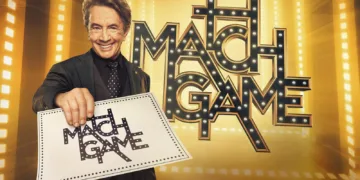
It’s a test of shared cultural consciousness disguised as a bit of light entertainment. Now, it returns to the airwaves, a ghost from television’s past reanimated for a new age. The most significant change, the new spirit guiding the proceedings, is the installation of Martin Short as host.
The game remains the same—two contestants attempt to fill in a blank and match the answers of six celebrities to win cash—but the context has shifted entirely. The question is whether the old formula can function in a world where a shared consciousness feels like a distant memory.
Anarchy’s New Anesthetist
A host in a show like this is not merely a traffic cop; they are the central nervous system, the figure responsible for modulating the frequency of the chaos. Martin Short assumes this role with a kind of surgical precision that is both impressive and slightly unsettling.

He is the embodiment of the trickster archetype inserted into a corporate machine, a flash of pure, unadulterated performance energy tasked with managing a format that has grown stiff with age. His comedic style is a relentless barrage of verbal dexterity, a constant stream of quips and playful jabs aimed at the panelists, particularly those he intuits can handle the heat.
He seems to be operating on a higher intellectual plane than the game itself, finding amusement not in the answers but in the absurdity of the entire situation. His self-deprecating joke, “Time flies when you’re phoning it in,” feels less like a throwaway line and more like a moment of profound, painful honesty. He knows the vessel is flawed, but he is professionally obligated to keep steering.
His physicality is a key departure from the show’s recent past. The long, skinny microphone, a phallic totem connecting previous hosts to the patriarchal lineage of Gene Rayburn, is gone. Short is untethered, working with a lapel mic that frees him to become a kinetic force.
He uses this freedom sparingly, a small gesture here, a pained reaction there, but the potential for physical explosion is always present. This restraint feels deliberate, as if he understands that unleashing his full comedic power would simply overwhelm the fragile structure of the show. He is a concert pianist asked to play “Chopsticks.”
His interactions with the civilian contestants are perhaps the most telling aspect of his tenure. In an age where so much unscripted television feeds on the humiliation of ordinary people, Short is remarkably, almost philosophically, gentle. He refrains from the easy ridicule of a bad answer.
There is no sneering condescension, no implicit mockery of a contestant’s earnestness. He treats them as collaborators in a strange piece of performance art, shielding them from the potential apathy of the panel. This approach positions him as a benevolent guide, a protector of the game’s innocent core against the encroaching cynicism of its celebrity participants.
He manages the show’s mechanics with an effortless competence, a professional steadying a ship that is, perhaps, taking on water. Short is the show’s strongest asset, a brilliant performer dropped into a system that may be beyond his help. He is the perfect solution to a problem the show’s producers seem unable to correctly identify.
The Atomization of Wit
The celebrity panel on Match Game should function as a single comedic organism, a six-headed hydra of wit and spontaneity, breathing fire in unison. The panel on this new version, however, represents a kind of terminal atomization, a perfect diorama of our disconnected social media age. There is no collective energy, no sense of a shared project.

Instead, we have six individuals performing in isolation, each seemingly playing for their own highlight reel, their own potential viral moment. The chemistry is not just absent; its absence is a tangible presence, a vacuum at the center of the show. This is a reflection of a broader cultural condition where the individual brand, the curated persona, has supplanted the messy, unpredictable joy of collaborative performance. The panel is not a conversation; it is a series of monologues shouted into a void.
The archetypes of this failure are painfully clear. There is the bored veteran, a once-sharp comedian who now seems to be radiating a palpable sense of “I’m above this.” His answers are perfunctory, his engagement minimal. There is the misguided disruptor, a performer who seems to believe they are on a different show entirely, perhaps the improv-heavy parody Snatch Game.
Their answers are often abstractly funny but have zero chance of matching the contestant, a fundamental betrayal of the game’s central conceit. It is a selfish mode of play. There are the studio co-stars of the host, whose established scripted chemistry evaporates under the hot lights of unscripted gameplay, proving that professional rapport does not always equal personal spark.
Compounding this is the very definition of “celebrity” in our fractured media landscape. The panels of the 1970s, while not A-list, were composed of figures from a somewhat monolithic culture. They were regulars on the talk-show circuit, stars of Broadway, or familiar faces from a handful of television networks. The audience shared a common frame of reference with them. Today’s panel is drawn from a dozen different digital kingdoms.
There might be a sitcom actor, a streaming-series star, a social media influencer, and a character actor from a prestige drama. Their fame is niche, their cultural currency specific to their silo. This creates a strange vacuum of recognition. The viewer is left asking not “What will they say?” but “Who are they?” When the audience has no investment in the “stars,” it becomes profoundly difficult to care about their answers, witty or otherwise. The panel is a collection of strangers not only to the audience, but to each other.
The Banality of the Blank
At its core, the failure of this revival is structural, a deep-seated rot in its very foundation. The soul of Match Game is not the host or even the panel; it is the question. The fill-in-the-blank prompt is the source code for the comedy, the carefully constructed vessel that is meant to be filled with wit.

Here, the code is broken. The questions are a masterclass in poor design, monuments to a profound misunderstanding of what made the format work. They lack the clever innuendo, the sly ambiguity, the gentle nudge toward the risqué that historically prompted funny and surprising responses. This is a catastrophic failure of the writers’ room.
A properly engineered Match Game question is a work of art. It creates a specific “possibility space,” narrowing the field of potential answers just enough to encourage convergent thinking while leaving ample room for inspired lunacy. A classic prompt might be: “Dumb Dora is so dumb, she thinks a furlough is a type of BLANK.”
The door is open for answers related to animals, pasta, clothing, anything with a similar sound. The new questions are either hopelessly convoluted (“After his long flight from Dubai, the tired businessman said his biggest problem was his BLANK”) which invites a thousand boring answers, or painfully simple, leading to one obvious, unfunny response.
This faulty architecture directly hobbles the panel. It is an act of creative sabotage. Even the most brilliant comedian would struggle to find inspiration in these prompts. They are the comedic equivalent of a brick wall. This connects to a larger shift in television production, a modern corporate aversion to risk. The 1970s show danced on the edge of network censorship, using double entendre as its primary tool. The humor was generated in the gap between what was said and what was meant.
This new version is sanitized, its language scrubbed of all danger and wit. It is a product designed not to offend anyone, and as a result, it fails to entertain anyone. The palpable flatness of the production, the eerie quiet from the studio audience, serves as the most honest critique. The audience is not a laugh track; it is a barometer, and the pressure in this studio is dangerously low. The show has its ringmaster, but the circus itself has been dismantled and sold for parts.
“Match Game” is a revival of the classic game show format, which returns to ABC hosted by Martin Short. This iteration, referred to as “season 6”, premiered on Wednesday, July 23, 2025, at 9 p.m. ET/6 p.m. PT.
Full Credits
Director: Harbinder Singh
Writers: Not explicitly mentioned for the 2025 revival, though Frank Wayne created the original format.
Producers: Alycia Rossiter, Martin Short
Executive Producers: Alycia Rossiter, Martin Short
Cast: Martin Short, Selena Gomez, Cara Delevingne, Kevin Nealon, Anthony Anderson, Ziwe, BD Wong, Andrea Martin, Randall Park, Thomas Lennon, Constance Zimmer, Jackie Tohn, Robert Smigel, Ana Gasteyer, Ego Nwodim, Pete Holmes, Caroline Rhea, Jay Pharoah, Phoebe Robinson
Composer: Score Productions
The Review
Match Game
This revival is a tragic mismatch of talent and material. Martin Short is a masterclass in hosting, a brilliant comedic force single-handedly trying to resuscitate a show that is dead on arrival. His efforts are sadly wasted on a production crippled by catastrophically dull writing and a celebrity panel that displays all the chemistry of a random group of strangers in a waiting room. The game's fundamental spark is gone, leaving only a hollow, unfunny echo.
PROS
- Martin Short delivers a sharp, witty, and professional hosting performance.
- The host's interactions with contestants are gentle and respectful.
CONS
- The fill-in-the-blank questions are uninspired and lack comedic potential.
- The celebrity panel has no discernible chemistry or group dynamic.
- Panelists often deliver answers that ignore the objective of matching the contestant.
- The overall atmosphere of the show feels flat and lifeless.