
























An actress, Rose, stands at a precipice. It is a classic setup. A career-defining role hangs in the balance, contingent on the absurd demand that she shed pounds she does not possess. Simultaneously, her body stages a quiet, biological coup: a pregnancy she was assured by medicine and trauma was an impossibility.
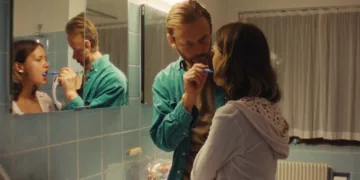
The world conspires to close in. Her boyfriend, Travis, a man of breathtaking unseriousness, and his mother, Martha—a chilling Sheryl Lee, whose ownership of her son’s progeny is nothing short of feudal—present a united front of external control.
They have plans for her, for the child. Rose has other ideas. Her flight from their suffocating benevolence is not toward freedom, but toward a clinical solution in a remote town. She checks into The Crown Inn in Idyllwild, seeking a sterile anonymity. She finds something else entirely. The place is not a refuge; it is a crucible.
The Geometry of a Breakdown
The transition from a recognizable world is a clean rupture in the film’s visual grammar. Rose’s Los Angeles is a landscape of desaturated normalcy, all flat lighting and unremarkable spaces. Then, a hard cut, and she arrives at The Crown Inn.

The place bleeds color. The production design commits fully to a hyperreal, Pepto-Bismol pink, a palette so aggressive and pervasive it feels less like an aesthetic choice and more like a symptom of a deeper malady. This is the world of the roadside love hotel reimagined as a psychic wound, a garish, textured space governed by the logic of a fever dream.
Aron Meinhardt’s camera often remains static, trapping Rose within expressionistic frames, or glides through the interiors with a disquieting fluidity that mimics the act of spying. Events unspool with a sinister lack of cause. A “pink milk tonic” is offered with the cheerful malevolence of a fairy-tale poison. Suites bear names like “The Lovin’ Oven,” a detail of such arch humor it borders on hostile.
The inhabitants are not characters but archetypes wandering a shared psychosis. We meet Ada (Lara Clear), the manager, perpetually armed with a martini and pickled in an apathy so profound it feels like a philosophical stance.
There is Lillian (Madeline Brewer), the antagonistic guest whose invasive posture and boundary-less curiosity position her as a projection of pure id. And then there is Sid (Sarah Rich), the receptionist, a figure of such wide-eyed, almost damaged innocence she seems to have wandered in from another, sadder story.
When a crib mysteriously appears in Rose’s room and Sid expresses genuine confusion, thinking Rose must have brought it, the walls of reality do not just bend. They dissolve. This is no mere motel; it is a meticulously constructed prison of the mind, and its locks are all internal.
An Anatomy of Trauma
The Crown Inn, then, is a phantasmagoric stage—an architectural manifestation of Rose’s fractured consciousness. The film posits that to confront the labyrinth of one’s past, one must first build it, brick by hallucinatory brick. Every garish corridor, every smoking vent clogged with debris, every locked door is a physical correlative for a piece of her history and her fear.
The puzzle-box narrative, structured in chapters, mirrors the non-linear, associative nature of recalling trauma. The women Rose encounters are not people but psychic shrapnel, splintered facets of her own identity she must now integrate or discard.
Sid is the ghost of an innocence violated, the childhood pain that was systematically ignored by those meant to protect her. Lillian is her inverse: a snarling embodiment of suppressed rage and self-destructive impulse, the woman Rose both fears and, perhaps, needs to become to survive.
The narrative probes a deep, existential anxiety surrounding motherhood, presenting it not as a miracle but as a potential hereditary curse. The unspoken tyranny of Rose’s own mother echoes in the chilling, corporate-like control of Martha, creating a terrifying continuum of female subjugation.
Rose’s fight for an abortion becomes more than a choice; it is a desperate metaphysical act of severing this lineage, a reclamation of her own biological and narrative future. Her struggle is for a fundamental self-determination against a world that seeks to define her, a flight from a destiny written by others onto the very flesh of her body.
A Controlled Hallucination
Julie Pacino’s debut is a work of formidable visual confidence, a declaration of aesthetic allegiance. The cinematic grammar is steeped in the language of her predecessors; one feels the oppressive shadow of Lynch in the dream-logic and the violent beauty of Argento in the weaponized color palette.
The casting of Sheryl Lee is less an homage than a direct invocation, a knowing nod to the film’s surrealist lineage. Yet, the execution, a collaboration of precise craft, feels distinct. Meinhardt’s cinematography renders the motel as a beautiful, toxic terrarium, while the editing by Matyas Fekete and Raaghav Minocha stitches scenes together with a jarring rhythm that keeps the audience perpetually off-balance.
The score by Jackson Greenberg and Pam Autuori, with its use of anxious percussion and disembodied panting vocals, becomes a key player in manipulating audience perception, a constant auditory reminder of the body in distress.
Amidst this carefully orchestrated chaos, Lucy Fry’s performance as Rose is a masterclass in restraint. She is the film’s essential anchor, her grounded, intelligent presence a necessary counterweight to the heightened, expressionistic performances of the supporting cast. She charts Rose’s psychological disintegration with subtle shifts in posture and a gaze that flickers between terror and resolve.
The others are magnificent forces of nature: Lee’s villainy is terrifying in its smiling certainty, Brewer’s energy is feral and unpredictable, and Sarah Rich’s portrayal of broken purity is a standout. The film they inhabit is not a story in the traditional sense, but a piece of psychogeography—a challenging, guided tour through a consciousness at war with itself.
“I Live Here Now” is a drama, horror, and thriller film. It premiered at the 29th Fantasia International Film Festival in Montreal, Canada on July 24, 2025.
Full Credits
Director: Julie Pacino
Writers: Julie Pacino
Producers: Kyle Kaminsky, Julie Pacino
Executive Producers: Robert Schwartzman, Cole Harper, Phil Toronto
Cast: Lucy Fry, Madeline Brewer, Matt Rife, Sheryl Lee, Cara Seymour, Sarah Rich, Lara Clear
Director of Photography: Aron Meinhardt
Editors: Mátyás Fekete, Raaghav Minocha
Composer: Jackson Greenberg, Pam Autuori
The Review
I Live Here Now
An ambitious and visually arresting debut, I Live Here Now is a deeply unsettling psychodrama that prioritizes atmospheric dread over narrative coherence. While its stylistic debts to Lynch and Argento are clear, Pacino crafts a potent, claustrophobic world anchored by a phenomenal lead performance from Lucy Fry. It is a challenging, often abstract journey into a fractured mind—a beautiful, meticulously designed nightmare that will alienate as many as it mesmerizes. It succeeds as a stunning piece of psychogeography, even if it falters as a conventional story.
PROS
- Visually stunning cinematography and a bold, saturated color palette.
- A powerful and grounding lead performance from Lucy Fry.
- Masterfully crafted atmosphere of psychological dread and anxiety.
- Ambitious, confident direction for a debut feature.
- Strong, stylized work from the supporting cast.
CONS
- The abstract, surrealist narrative may be inaccessible or frustrating for some viewers.
- Can feel derivative of its clear cinematic influences.
- Prioritizes mood and symbolism over plot development and character backstory.