





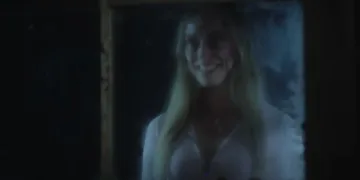










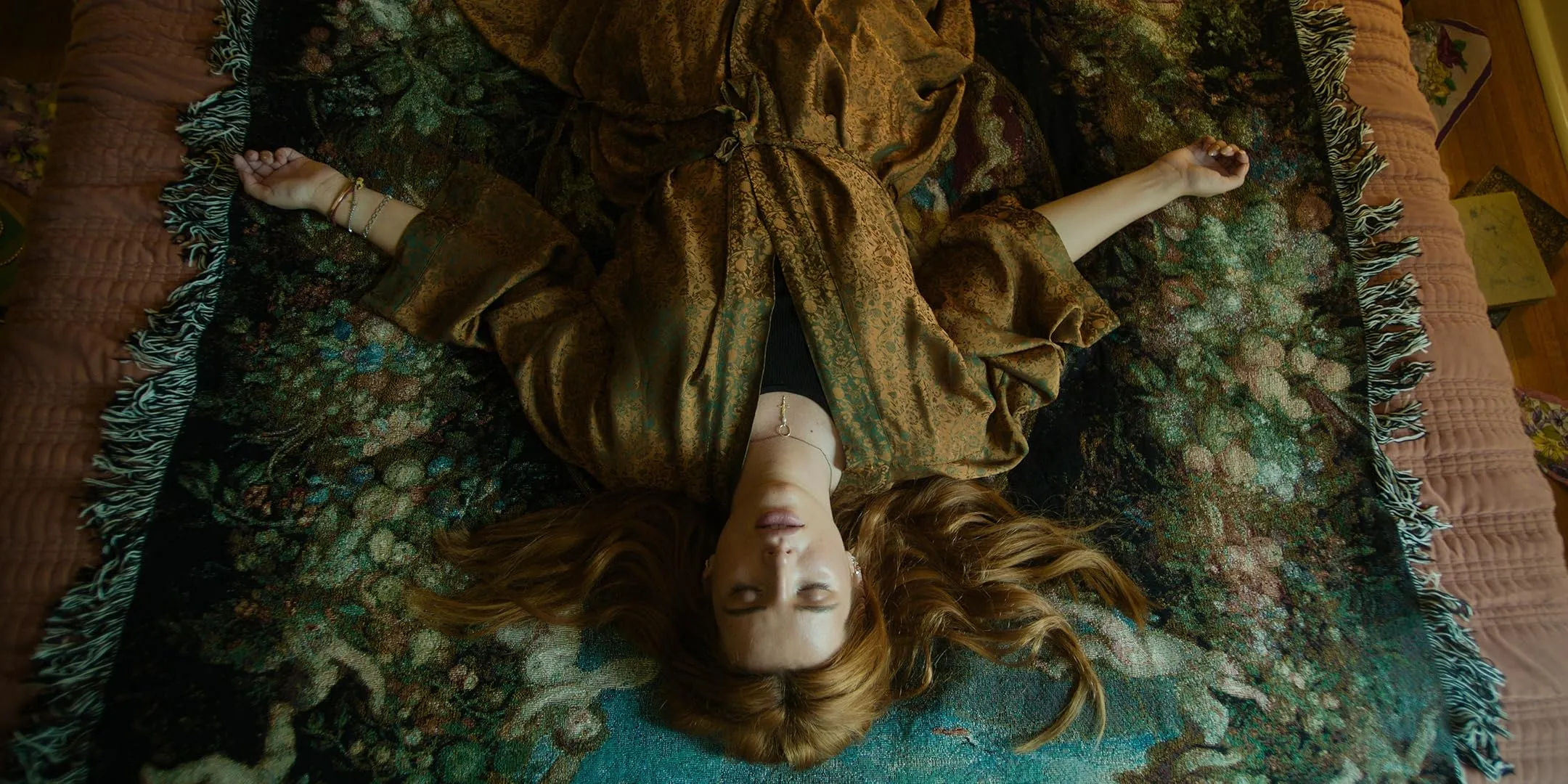

There is a particular kind of quiet that precedes violence. In Saint Clare, it is the quiet of a pious college student, Clare Beecker, whose devotion to Catholicism seems absolute. She lives in a small town, a place seemingly scrubbed of any real sin, and she moves through it with an unassuming grace. Yet, this placid surface conceals a brutal truth.
Clare is a vigilante, a self-appointed executioner of predators, channeling her sociopathy into what she perceives as a divine mission. She recites the words of Joan of Arc—“Everything I have said and done has been in the hands of God”—and she means it.
This equilibrium of faith and bloodshed is disrupted when Clare notices a pattern of missing young women, a local tragedy met with institutional indifference. The silence of the authorities becomes her call to action, pushing her from isolated acts of righteous slaughter into a systematic investigation.
The film establishes its darkly stylish atmosphere here, a potent mixture of coming-of-age sincerity, black comedy, and Southern Gothic dread. It posits a world where, stripped of protection, a young woman must become her own avenging angel.
Anatomy of a Sociopath
Clare’s psychology presents a fascinating paradox: the relatable sociopath. Unlike cinematic counterparts driven by ego or hedonism, her violence is presented as a vocation. It is a job. This reframes her condition, asking a genuinely thorny question: is a sociopath still a monster if their pathology is channeled into a arguably pro-social function?
The film doesn’t answer, but the query hangs over every scene. Her methods depend entirely on this dissonance. She uses her perceived innocence not as a disguise but as a lure, a weaponized fragility that is perhaps the film’s sharpest commentary on gendered power dynamics.
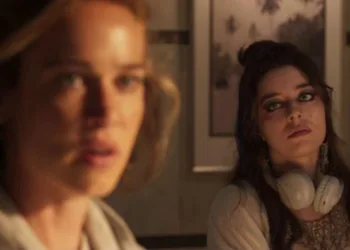
Bella Thorne’s performance is the linchpin. Her work is a study in purposeful coldness, an insular and remote quality that is essential for the character’s credibility. The stillness she projects is unnerving; her face remains a placid mask even as she plans or executes a kill, making the eventual bursts of violence feel more like a mechanical process than an emotional outburst. It’s a performance of radical subtraction.
Her physicality is likewise efficient, eschewing flashy choreography for a sense of brutal pragmatism. Her only confidant is “Mailman Bob,” a ghost or psychic imprint from a past killing. Played by Frank Whaley with a perfect note of weary resignation, Bob is more than a plot device. He is the walking, talking embodiment of collateral damage, a constant reminder that even her most “righteous” acts are not without their messy human cost. He is the conscience she cannot generate on her own.
Style Over Substance, or Style As Substance?
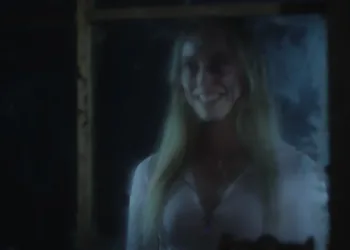
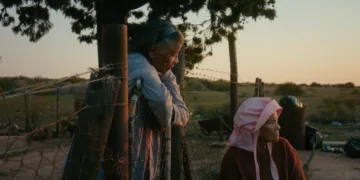
Director Mitzi Peirone shoots Saint Clare with a kind of controlled, aesthetic aggression. The film’s look—a self-aware teen noir filtered through a Southern Gothic lens—is its most confident feature. It is a world of deep, bruised shadows punctuated by sickly neon, a place where peeling paint and dilapidated buildings are shot with an almost fetishistic reverence.
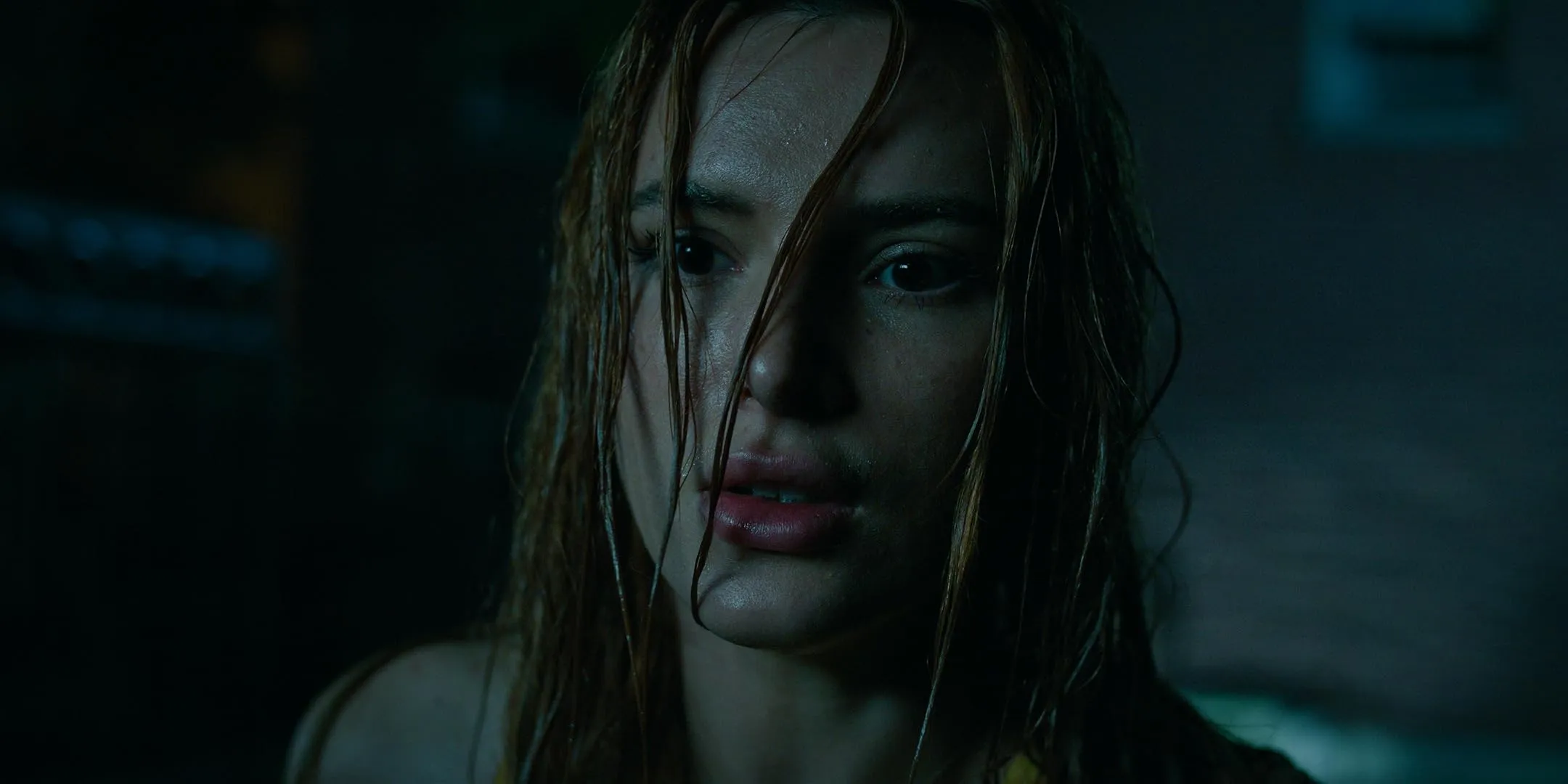
This visual grammar is not mere decoration. The camera often frames Clare as a small figure in a hostile landscape right before she violently inverts the power dynamic. Peirone’s most audacious choice is to link Clare’s dissociative episodes directly to social anxiety.
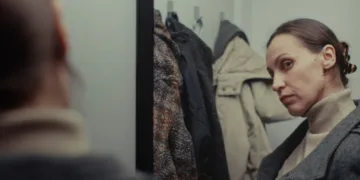
The visual chaos of kaleidoscopic imagery and jarring sound design erupts not when she faces a killer, but when she navigates a party or a police interrogation. The film visually argues that for Clare, the “normal” world of human interaction is the true horror, a more profound threat than any dark alley.
This powerful subjective reality makes the film’s eventual narrative turn so disappointing. The structure cleaves into two distinct movies that are at war with one another. One is this intimate, hallucinatory character study. The other is a generic mystery-thriller.
As Clare investigates the town’s central conspiracy, the story loses its unique energy and adopts the rhythm of a much lesser film. It asks us to invest in a predictable human trafficking plot when it has already offered the far more compelling internal conflict of its protagonist’s soul. The mystery feels impersonal, its villains obvious, its twists telegraphed miles away. It’s a narrative bait-and-switch where the replacement is markedly inferior to the original offer.
A Queen Without a Court
A protagonist this complex requires a world that can withstand her. Saint Clare fails to build one, leaving her in a solipsistic vacuum. The supporting characters are underdeveloped satellites, existing only to reflect her strangeness or to become victims of her mission.
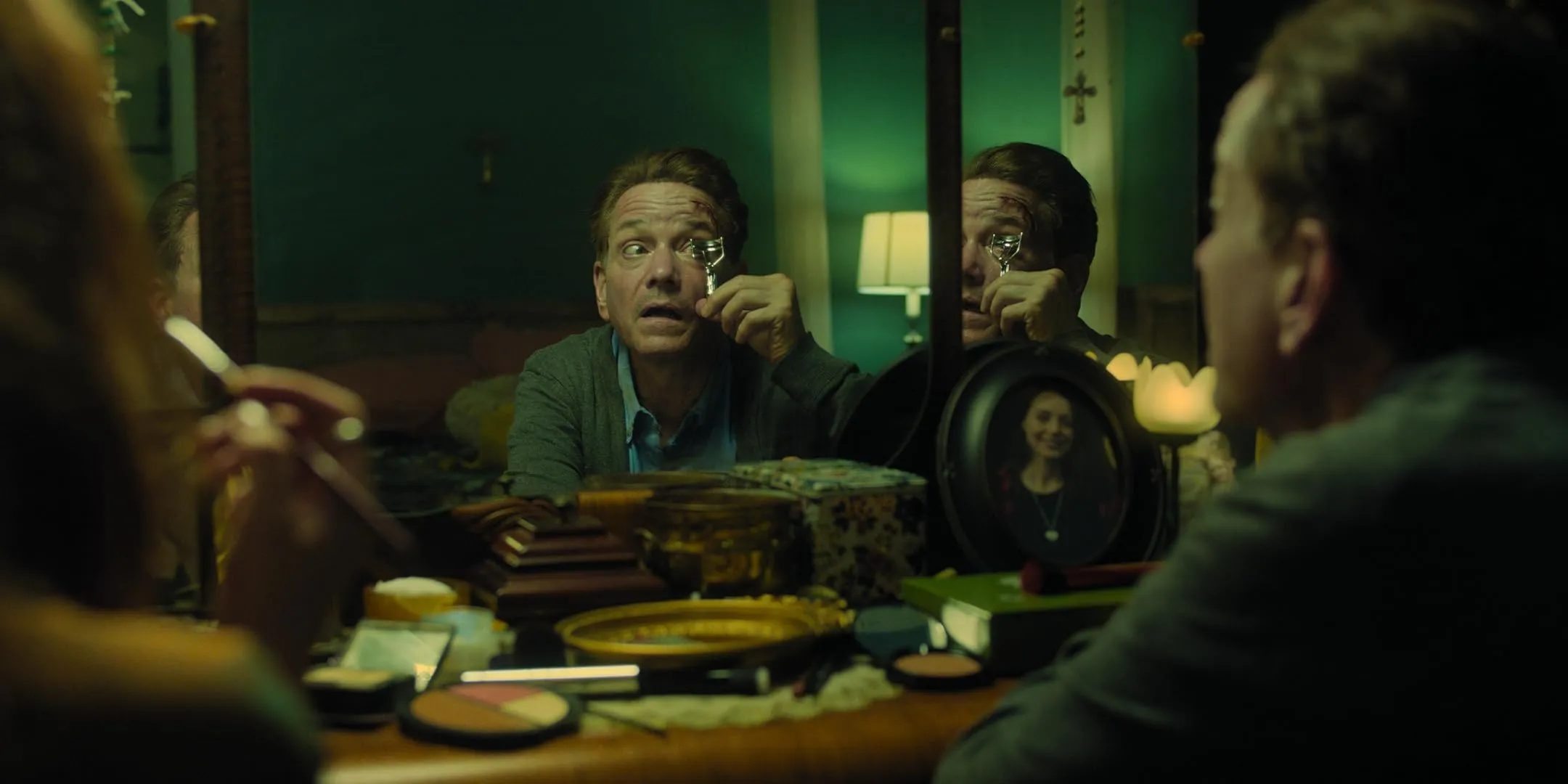
This is most evident in the film’s antagonists, who are such cartoonishly inept figures of misogyny that they present no credible intellectual or physical challenge. Her victories, therefore, feel predetermined, stripping the action of any real tension. Her supposed peril feels entirely theoretical. The exception is Rebecca De Mornay as Gigi, Clare’s grandmother.
She is the film’s repository for genuine human feeling, a heartbreaking reminder of the warmth and connection Clare herself cannot access. De Mornay carries a certain meta-textual weight, a history of playing characters who understand hidden domestic dangers, and her presence lends the film a gravity it does not earn elsewhere. Her minimal screen time is the film’s greatest fumble.
This imbalance leaves Saint Clare as a brilliant failure. It is a work of undeniable ambition and potent visual signature, a film that gestures toward profound questions about justice, psychopathy, and faith. Yet its execution is critically uneven.
The script cannot support the weight of its own ideas and ultimately retreats from its most difficult questions, opting for an abrupt resolution that feels less like a choice and more like a surrender. The final impression is that of a beautiful, hollow reliquary: fascinating to look at, but empty on the inside.
“Saint Clare” is a 2024 American thriller film based on the novel “Clare At Sixteen” by Don Roff. It premiered at the Taormina Film Festival on July 12, 2024 and was released in select theaters and on demand in the United States on July 18, 2025.
Full Credits
Director: Mitzi Peirone
Writers: Mitzi Peirone, Guinevere Turner, Don Roff (based on a novel by)
Producers: David Chackler, Arielle Elwes, Cassian Elwes, Thor Bradwell, Joel Michaely, Don Roff
Cast: Bella Thorne, Rebecca De Mornay, Ryan Phillippe, Frank Whaley, Bart Johnson, Dylan Flashner, Jan Luis Castellanos, Joel Michaely, Erica Dasher, Todd Bridges, Joy Rovaris, Erin Eva Butcher
Director of Photography: Luka Bazeli
Editors: Patrick Sanchez Smith
Composer: Zola Jesus
The Review
Saint Clare
Saint Clare is a work of immense style and audacious ideas, anchored by a mesmerizingly cold performance from Bella Thorne. Director Mitzi Peirone creates a visually stunning world, but the film's provocative exploration of a vigilante sociopath is crippled by a predictable plot and a cast of one-dimensional characters. It is a beautiful, ambitious failure that poses fascinating questions it lacks the narrative courage to answer.
PROS
- A compellingly cold lead performance by Bella Thorne.
- Bold, confident, and visually arresting direction.
- A fascinating central concept exploring psychopathy as a calling.
CONS
- The central mystery plot is predictable and uninspired.
- Supporting characters and villains are flat and underdeveloped.
- An abrupt ending that feels unsatisfying and incomplete.