
























![Kingdom Hearts Collection [I-III] Review](https://gazettely.com/wp-content/uploads/2026/10/Kingdom-Hearts-Collection-I-III-1-360x180.webp "Kingdom Hearts Collection [I-III] Review: KHII Holds Steady as Newer Entries Fluctuate 40")
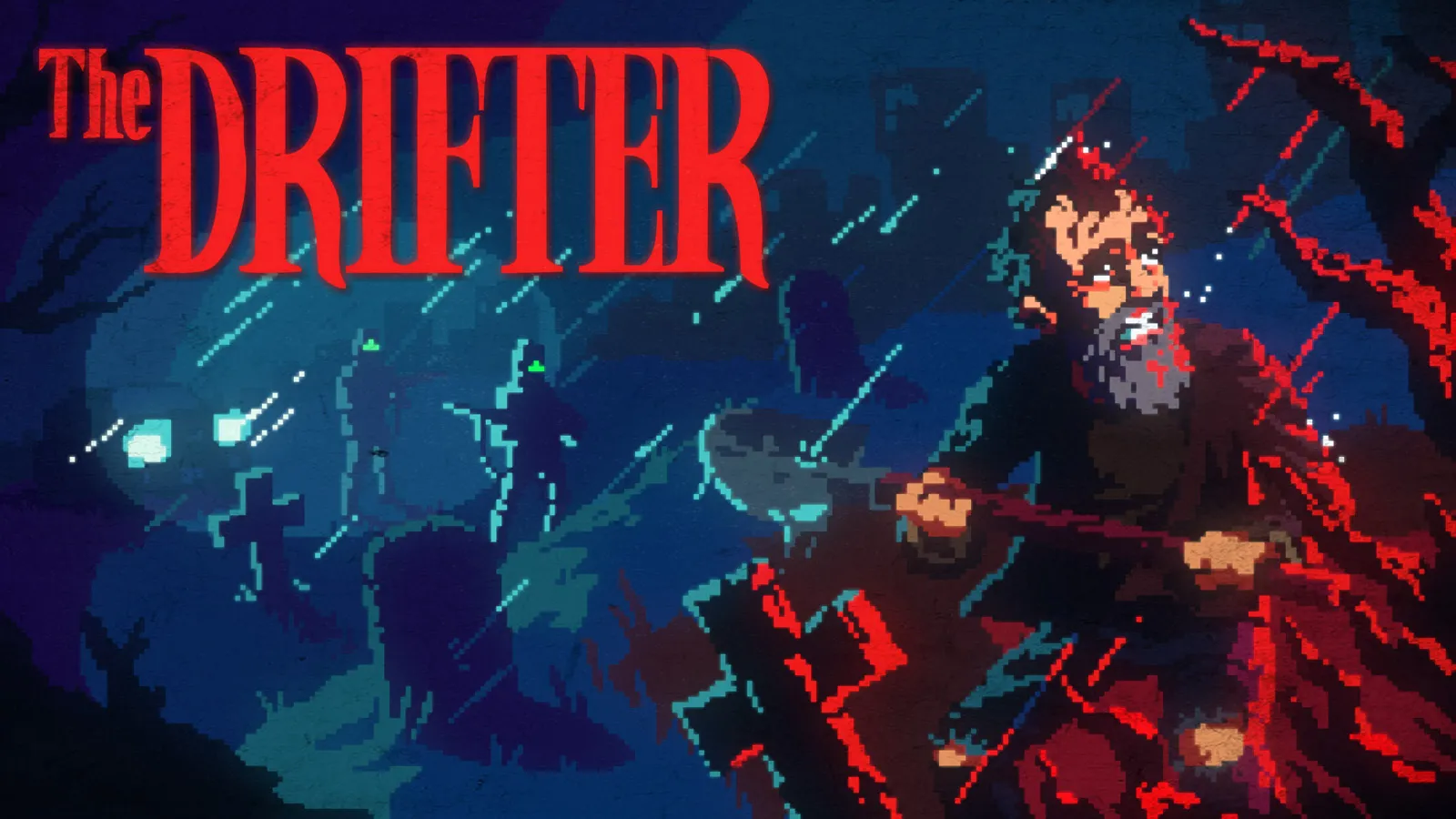

Mick Carter is a man running from his past, but the rails are carrying him right back to it. We meet the titular drifter stowed away on a freight train, a homeless man with a heavy history returning to his Australian hometown for his mother’s funeral.
The game immediately establishes a tone of profound regret, a dark character study presented as a pulp adventure thriller. Mick’s reluctant homecoming is quickly shattered. He witnesses a violent act, finds himself framed for a murder he didn’t commit, and is forced on the run from both the law and a far more sinister force. His problems are just starting, and in this city, even death refuses to be a final escape.
A World Painted in Pixels and Paranoia
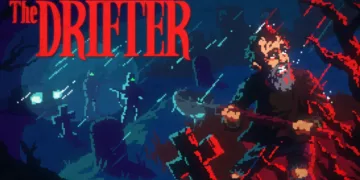
The Drifter’s presentation is a masterclass in atmospheric design. The world is rendered in a painterly pixel art style that feels both detailed and slightly surreal, with a characteristic wobble to its animation that gives it a distinct identity.
The artists use deep, oppressive shadows and pockets of rich color to build a bleak, noir-ish urban landscape. The mood is reminiscent of the systemic decay seen in John Carpenter’s films, where every alley and apartment feels soaked in grime and secrets.
This visual foundation is strengthened by exceptional sound design. Adrian Vaughan’s performance as Mick Carter is a highlight; his rough, authentic Australian growl delivers visceral prose that grounds the character in a believable reality. The rest of the cast is also fully voiced, building a genuine sense of place.
A synth-heavy main theme sets a mysterious tone from the start, while the score expertly shifts to create heart-pounding suspense during the game’s many tense encounters. These elements work together to produce a thick, forboding atmosphere you can almost feel.
Death as a Design Pillar
At its foundation, this is a point-and-click adventure. The gameplay loop will be familiar to fans of the genre, with puzzles that are primarily item-based. You will collect objects, combine them in your inventory, and use them on the environment to overcome obstacles.

The puzzle logic is refreshingly grounded, steering clear of the absurd solutions that can sometimes plague the genre. The interface is modern and streamlined, featuring a clean dialogue system with icons that clearly mark new topics of conversation. Mick also keeps a dedicated menu to track the various plot threads, a helpful tool for keeping the complex mystery organized.
The game’s signature system is its use of death and rebirth. Mick will face many lethal situations, and failure is expected. Each time he dies, he is violently brought back to life just moments before his demise. This mechanic reframes the standard video game respawn as a painful, horrifying narrative event for the protagonist.
What begins as a simple trial-and-error system for dangerous scenarios later evolves into a deliberate tool for solving certain puzzles. The game supports a classic mouse interface, but it also offers an innovative dual-stick controller scheme where the right stick is used to select interactive points in a radius around Mick, connecting the player more directly to his immediate surroundings.
A Tale of Two Stories
The narrative begins as a focused, street-level murder mystery before spiraling into a wide-ranging science fiction conspiracy that involves illicit corporate experiments and time manipulation. The initial chapters are tightly paced, driven by clear goals and a constant sense of forward momentum.

As the plot expands in the game’s latter half, the world opens up. This freedom comes at the cost of the earlier focus, introducing backtracking that can slow the pace. The personal, emotional story of Mick’s trauma sometimes sits uneasily next to the grander, high-concept plot.
This split focus touches the game’s thematic exploration of grief and regret. Mick’s desire is not to fix his past mistakes but to erase them completely, a powerful motivation that informs his character. The revival mechanic serves as a fascinating lens through which to view a man grappling with endless, grisly second chances.
While Mick is a well-realized character, some supporting figures feel underdeveloped by comparison. An investigator who becomes a key ally, for instance, lacks the same depth. The story’s ambition to connect a personal tragedy to a sprawling conspiracy is notable, though the two threads do not always feel perfectly stitched together.
The Review
The Drifter
The Drifter is a stunning achievement in atmosphere, with gorgeous pixel art and standout voice acting that create a truly gritty Australian noir. Its central death-and-rebirth mechanic is a brilliant fusion of narrative and gameplay. While the story's shift from a personal mystery to a sprawling sci-fi conspiracy can feel disjointed and causes the pacing to stumble in its second half, the experience is a powerful and memorable one.
PROS
- Incredibly atmospheric world-building and a distinct, beautiful art style.
- Exceptional voice acting, especially for the protagonist Mick Carter.
- A clever death mechanic that is woven directly into the plot and puzzle design.
- Streamlined and modern point-and-click interface.
CONS
- The narrative loses some of its tight focus in the later stages.
- Some backtracking is required as the map opens up.
- Supporting characters can feel underdeveloped compared to the protagonist.