























The legacy sequel operates as a form of cinematic séance, a ritual where studios resurrect intellectual property hoping to conjure the spirit of past success. Freakier Friday arrives two decades after its predecessor, not as a simple continuation but as a temporal echo chamber.
The original players, Tess and Anna Coleman, are back, their identities now complicated by the accumulation of years. Tess is a grandmother, Anna a single mother. This new configuration introduces a third generation, Harper, creating a triptych of womanhood primed for existential scrambling.
The film’s primary function is not to tell a new story, but to re-stage an old one with more variables, examining the fractures that appear when identity is stretched across a generational divide. Its charm is a carefully engineered apparatus, a mechanism that works by leveraging the audience’s own memories against them, proving quite effective even as the narrative architecture grows more precarious.
A Conspiracy of Selves
The narrative’s architecture is built on a foundation of managed chaos. We open on a fragile domesticity where Tess Coleman (Jamie Lee Curtis) attempts to codify human behavior through her therapy practice, a clinical pursuit that extends to a podcast. Her daughter Anna (Lindsay Lohan) wrangles the manufactured persona of a pop star, a life steeped in artifice.
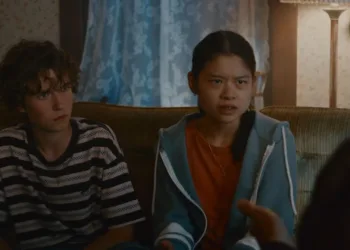
The first crack in this facade appears with a literal explosion. A high school chemistry experiment goes awry, the result of a simmering feud between Anna’s daughter, Harper (Julia Butters), and the sharp-edged British transfer, Lily (Sophia Hammons). This event is the classic noir inciting incident, forcing disparate parties into a shared space. From this collision, a romance ignites between Anna and Lily’s father, Eric (Manny Jacinto).
Their union is dangerously swift, a six-month courtship that concludes with a wedding announcement. This propels the plot’s primary tension: two rival teenagers are to become stepsisters. The true catalyst, however, is an external agent of chaos, the psychic Jen (Vanessa Bayer). She is the femme fatale of this psychological drama, a chattering oracle whose obscure pronouncements trigger a four-way schism of the self during a bachelorette party.
Anna’s consciousness is violently ejected into Harper’s body; Tess’s is swapped into Lily’s. This narrative fission creates two competing conspiracies. The teenagers, now possessing the authority and autonomy of adult bodies, plot to sabotage the wedding. The adults, stripped of their status and trapped in adolescent forms, must decode the rules of this new reality to restore the original timeline.
Inhabiting the Shell: A Study in Performance
A film predicated on identity theft demands its actors function as skilled impersonators, portraying not just a character, but a character possessed by another. Jamie Lee Curtis attacks this challenge with a ferocious physical commitment. As the vessel for the teenager Lily, her body becomes a site of rebellion.

She portrays the indignity of age with a vaudevillian flair, her joints cracking in protest, her posture a constant slump of adolescent indolence. A sequence where she struggles to rise from a floor is a piece of high comedy that also serves as a bleakly funny meditation on mortality. She is a whirlwind of misdirected energy.
Lindsay Lohan’s return carries a unique meta-textual weight. Playing her own daughter, she revisits a teenage persona, offering a strange echo of her own past stardom. Her flirtation with an old flame is a masterclass in performative awkwardness, capturing the dissonance of an adult mind fumbling with the gestures of youth. Her chemistry with Curtis remains palpable, a shared history that gives their chaotic pairing an emotional authenticity.
The younger actresses, Julia Butters and Sophia Hammons, handle the inverse challenge with remarkable subtlety. Tasked with playing the adults, they adopt a stillness and gravity that contrasts sharply with the antics of their elders. They are the film’s anchors of sanity, their quiet desperation a counterpoint to the broad comedy.
They carry the dramatic weight, their faces registering the slow-motion horror of the situation. The supporting cast effectively populates this world of fractured identities. Manny Jacinto’s Eric is the perfect handsome innocent, the unsuspecting civilian caught in a war he cannot comprehend. Vanessa Bayer’s psychic is a force of pure narrative disruption, a trickster whose motivations are delightfully opaque.
The Architecture of Memory
Director Nisha Ganatra constructs a visual landscape of relentless optimism, a choice that becomes the film’s most subtle deception. The cinematography favors a bright, high-key lighting scheme, bathing the Southern California setting in a perpetual, sun-drenched glow. This is an act of deliberate misdirection.
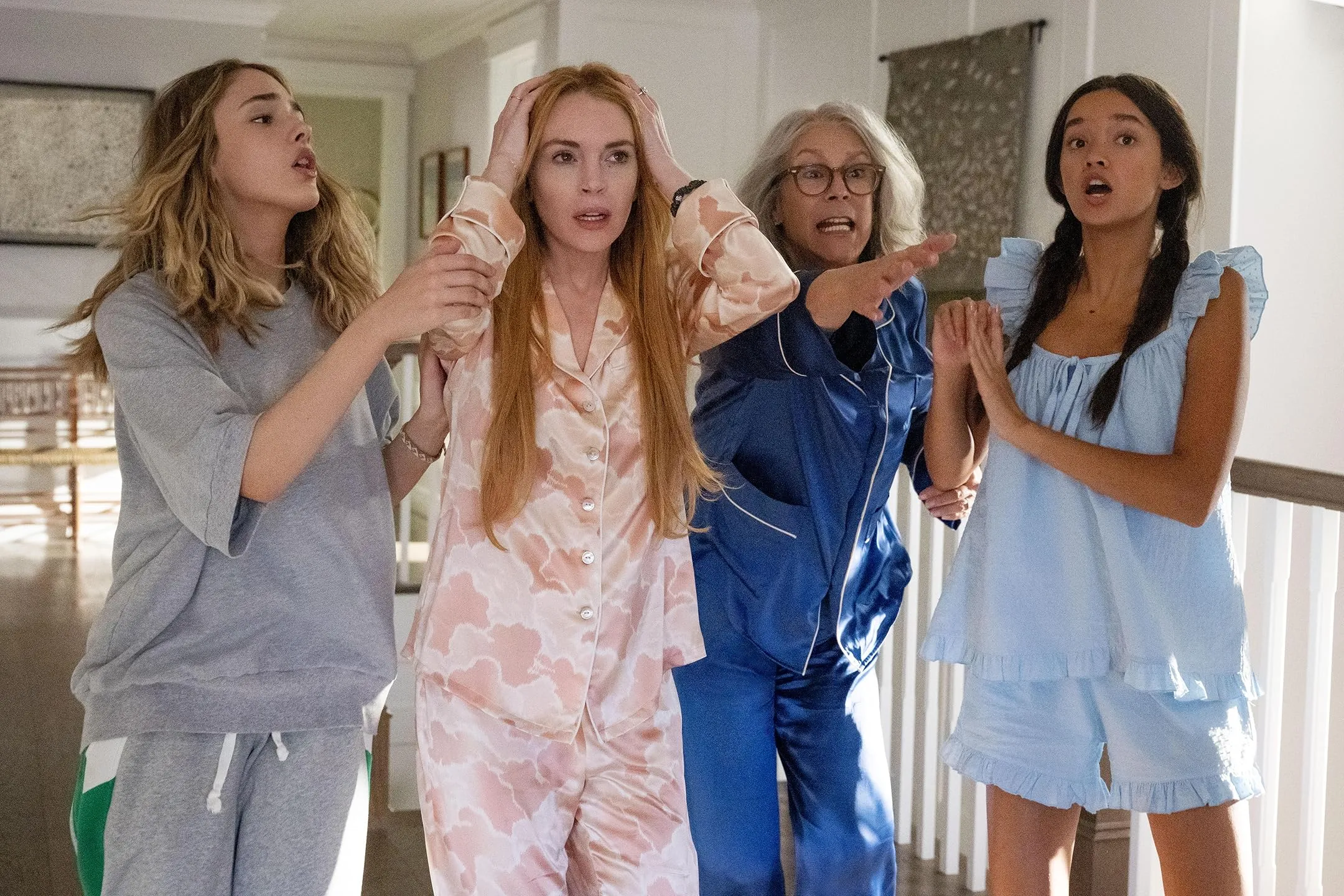
The polished, almost sterile hyperreality of the frame creates a profound dissonance with the psychological chaos unfolding within it. It is an anti-noir aesthetic; where classic thrillers use shadow and canted angles to express internal turmoil, this film uses the clean lines and saturated colors of a commercial to mask it.
The audience is disarmed by the pleasantness of the visuals, making the underlying identity crisis feel more like a diverting game than an existential threat. The editing reinforces this effect. The pace is brisk and fluid, moving the narrative forward with a momentum that discourages deep consideration of its increasingly tangled logic.
The body-swap sequence itself is likely a montage of disorienting close-ups and quick cuts, designed to simulate the psychic trauma of the event without lingering on its horror. The film’s use of sound is equally manipulative.
The soundtrack, a curated collection of early 2000s pop-rock, functions as an emotional shortcut. It is an auditory cue designed to activate nostalgia in a key demographic, creating a feeling of comfortable familiarity that papers over the story’s more unsettling implications. This is not just storytelling; it is a carefully calibrated exercise in audience management.
The Persistence of Identity
The film’s ultimate success lies in its cheerfully ruthless execution. The committed performances and warm, energetic tone make its complex machinery appear effortless. It is a finely tuned entertainment delivery system. The central theme of empathy is amplified to a near-absurdist degree.

By quadrupling the identity swap, the script poses a compelling question: does this narrative multiplication deepen the story’s moral, or does it simply represent a modern crisis of the self, a psyche fragmented across too many roles? The film suggests both may be true. The experience of “walking in another’s shoes” is rendered not just as a lesson in perspective, but as a total, terrifying dissolution of one’s own identity.
The film delivers on its promise of family fun, but it does so by packaging a complex philosophical problem in the brightest possible wrapping. It stands as a worthy successor, a rare legacy sequel that feels both emotionally genuine and intellectually stimulating, even if its deepest questions are posed with a wink.
Full Credits
Director: Nisha Ganatra
Writers: Jordan Weiss, Elyse Hollander, Mary Rodgers
Producers: Kristin Burr, Andrew Gunn, Jamie Lee Curtis
Executive Producers: Nathan Kelly, Ann Marie Sanderlin, Lindsay Lohan, Mario Iscovich
Cast: Jamie Lee Curtis, Lindsay Lohan, Julia Butters, Sophia Hammons, Manny Jacinto, Mark Harmon, Maitreyi Ramakrishnan, and others are part of the extensive cast. The full cast list can be found in the referenced documents.
Director of Photography (Cinematographer): Matthew Clark
Editors: Eleanor Infante
Composer: Amie Doherty
The Review
Freakier Friday
A surprisingly sharp legacy sequel, Freakier Friday wraps its chaotic story of identity dissolution in a bright, commercial aesthetic. Manic performances from Jamie Lee Curtis and a game Lindsay Lohan anchor the absurd premise with infectious energy. While the plot is a convoluted exercise in nostalgia, its execution is so self-aware and technically polished that it succeeds as both a clever psychological comedy and satisfying fan service. A well-oiled machine that knows exactly what it is.
PROS
- Jamie Lee Curtis’s and Lindsay Lohan’s energetic, committed, and charismatic lead performances.
- A sharp, self-aware script that balances broad humor with a surprisingly layered premise.
- Polished and clever direction that uses a bright aesthetic to contrast with the chaotic story.
- Strong supporting turns from Vanessa Bayer and the younger cast.
CONS
- The four-way swap makes the plot needlessly convoluted at times.
- Heavy reliance on nostalgia and callbacks to the 2003 original.
- Some comedic beats feel formulaic to the Disney live-action template.