





























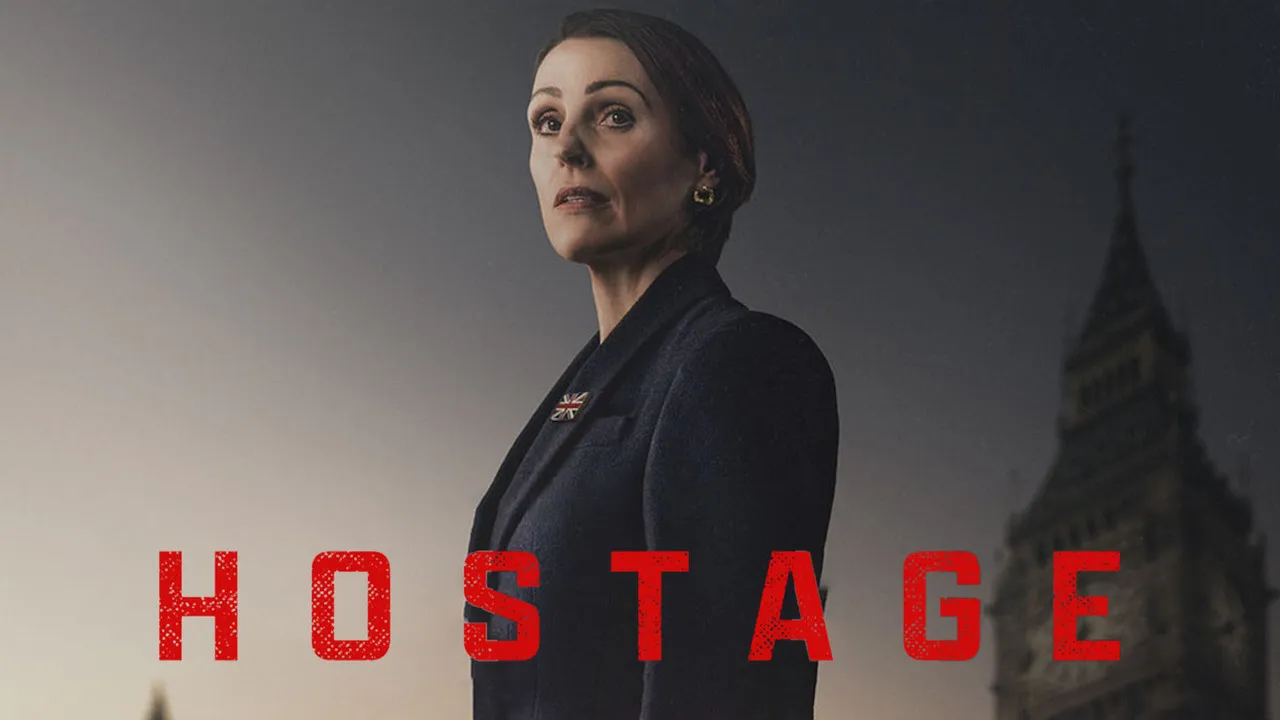

Matt Charman’s new five-part Netflix series, Hostage, constructs its political drama with the precision of a time bomb. The story opens on Britain’s new Prime Minister, Abigail Dalton, a leader whose ambitious political agenda is immediately imperiled by a crisis at home.
While she attempts to navigate a critical summit with the French President to solve a national healthcare shortage, her personal life is violently dismantled. Her husband, a doctor performing humanitarian work in French Guiana, is abducted by masked assailants. Their demand is not financial; they want her resignation.
This inciting incident fuses international political maneuvering with a raw family tragedy, creating a narrative engine built for speed and tension. The series immediately establishes that every political decision will have a deeply personal cost, and every private vulnerability will become public leverage.
A Duel of Idealism and Pragmatism
At the center of the political storm stand two formidable performances that anchor the entire series. Suranne Jones portrays Prime Minister Abigail Dalton with a fierce, almost brittle intensity, her face a constant register of contained panic and steely resolve.
Jones masterfully conveys the immense pressure of a leader forced to choose between country and family, often through small gestures: a clenched jaw during a cabinet briefing, a fleeting look of anguish before stepping into a press conference. She commits fully to Dalton’s unwavering moral code, presenting a politician driven by a genuine, almost anachronistic desire to help people.
This commitment, however, pushes the character toward the edge of believability. Dalton’s steadfast righteousness can feel less like a complex political figure and more like a fantasy of what a leader should be, an archetype of integrity in a world that rarely allows for it. Her refusal to compromise, even when pragmatism screams for it, makes her a compelling protagonist but a somewhat unconvincing Prime Minister.
Playing opposite her is Julie Delpy’s Vivienne Toussaint, the cunning and impeccably composed French President. Delpy gives Toussaint an icy pragmatism, initially presenting her as a political opportunist ready to exploit Dalton’s misfortune for her own gain in tense negotiations over medical supplies and migrant ships.
Yet, the performance reveals layers of a ruthless tactician guarding her own significant secrets. Toussaint’s political survival is threatened by a brewing family scandal, a vulnerability that Delpy communicates through subtle shifts in expression, turning a powerful world leader into a cornered individual.
This crisis functions as a narrative parallel to Dalton’s, forcing both women to operate from positions of concealed weakness. The series finds its strongest footing in the scenes between these two leaders. The chemistry between Jones and Delpy creates a captivating contest of wills, a sparring match between idealism and realpolitik. Their evolving dynamic, shifting from calculated adversaries to reluctant, wary allies, provides the story with its dramatic core and its most memorable moments.
Characters in Service of the Plot
Away from the central duel, the narrative architecture of Hostage reveals some thinner supports. The supporting characters feel less like authentic people and more like functional pieces on a chessboard, positioned to elicit specific reactions from the two queens.

Alex Anderson, the kidnapped husband played by Ashley Thomas, exists primarily as a catalyst for the plot. He is the embodiment of the life Dalton sacrificed for her career, a ghost from a simpler past whose endangerment becomes a direct assault on her present choices. He is a symbol of the personal stakes, but as a character, he is a blank slate.
Similarly, their teenage daughter, Sylvie (Isobel Akuwudike), serves a clear narrative purpose. She represents the emotional, family-first argument in Dalton’s central dilemma. Her youthful certainty that her mother should resign immediately provides a sharp contrast to the impossible grey areas her mother must inhabit.
The political aides and advisors who populate Downing Street suffer from a similar lack of depth. While capable actors like Lucian Msamati bring a welcome gravity to the role of chief of staff Kofi, the script gives them little to work with. His presence suggests a history and loyalty that are never fully explored, leaving the audience to fill in the blanks of their professional relationship.
Other aides are barely named, a narrative choice that effectively reduces the machinery of government to a one-woman show. This reinforces the series’ intense focus on its two leads, but it also makes the political world feel small and thinly populated, undermining the scale of the national crises Dalton is supposed to be managing.
Propulsion at the Expense of Plausibility
The narrative mechanics of Hostage prioritize momentum above all else. The story is a breathless, propulsive machine, moving from one crisis to the next with relentless energy. This storytelling style is clearly designed for the modern streaming era, where a constant barrage of plot developments is deployed to keep a viewer’s attention locked for the duration.

Each of the five episodes builds to a cliffhanger, a classic but effective tool that ensures engagement across the limited series format. This constant forward motion makes the series compulsively watchable, pulling the audience through a story that might otherwise collapse under the weight of its own contrivances. The show’s primary success is its refusal to slow down long enough for the viewer to question the logic of its moving parts.
This breakneck pace, however, comes at a significant cost to credibility. The plot frequently stretches logic to its breaking point, demanding a generous suspension of disbelief. A central subplot involving President Toussaint’s scandalous affair with her stepson feels particularly contrived. Its lurid, almost soapy quality seems imported from a different, less serious show, an artificial device to create a tidy parallel with Dalton’s crisis.
The core premise itself has glaring holes, most notably the almost complete lack of security for the Prime Minister’s husband on a trip to a volatile region. It is a fundamental oversight that the entire story rests upon. The story begins as a tense hostage thriller before shifting gears midway into a political whodunnit.
This transition is handled with the same brisk efficiency, but the final reveal of the conspiracy’s architects feels more convoluted than clever. The resolution is surprising, but it does not feel entirely earned, arriving as a final twist in a story that has valued surprises over coherence all along.
Politics as an Entertaining Abstraction
Hostage uses the language and imagery of contemporary politics to dress its thriller framework. The script is peppered with references to real-world issues: a National Health Service in crisis, tense negotiations over migrant boats in the English Channel, and the persistent misogyny faced by women in power.

The crucial question is whether the show has anything meaningful to say about these topics. Often, it seems these complex issues are present to provide a veneer of topicality, a backdrop of relevance for what is a conventional conspiracy story. The series is less interested in exploring the messy compromises of modern governance than it is in using them as simple plot obstacles for its hero to overcome with moral fortitude.
This approach is most evident in the portrayal of Prime Minister Dalton herself. She is presented as an impossibly heroic and competent leader, a fantasy of positive leadership who battles shadowy forces to protect her people. She is a figure of unambiguous integrity, reminiscent of idealized fictional leaders from another era of television.
This creates a form of political escapism, focusing on a character-driven mystery that offers a tidier, more righteous version of politics than reality. Hostage is a sharp and entertaining thriller, powered by the excellent performances of its two leads and a plot that never stops moving. Its underdeveloped supporting cast and implausible story turns prevent it from achieving greater depth. It succeeds as an engaging diversion, a story that relies on the strength of its stars to carry it across the finish line.
“Hostage” is a British political thriller miniseries that premiered on Netflix on August 21, 2025. It stars Suranne Jones as the fictional British Prime Minister Abigail Dalton and Julie Delpy as the French President Vivienne Toussaint. The series is written by Matt Charman, known for “Bridge of Spies”. Netflix is the platform where you can watch the five-episode miniseries.
Full Credits
Directors: Isabelle Sieb, Amy Neil
Writer: Matt Charman
Producers: Foz Allan, Matt Charman, Suranne Jones, Steve Searle, David Meanti, Annelie Simmons
Cast: Suranne Jones, Julie Delpy, Corey Mylchreest, Lucian Msamati, Ashley Thomas, James Cosmo, Jehnny Beth
Director of Photography: Catherine Derry, Matt Gray
Editors: Ben Drury, Jesse Parker
Composer: Jeff Russo
The Review
Hostage
Hostage is a propulsive and highly watchable thriller anchored by the magnetic performances of Suranne Jones and Julie Delpy. Their dynamic creates a compelling political duel that papers over the narrative's significant cracks. While the relentless pacing ensures constant engagement, the story is ultimately undermined by implausible plot developments and a cast of one-dimensional supporting characters. It succeeds as a slick piece of entertainment, a triumph of performance over a flimsy, logic-defying script.
PROS
- Exceptional lead performances from Suranne Jones and Julie Delpy.
- The dynamic between the two leads provides a strong dramatic core.
- A fast-paced, twist-filled narrative that remains engaging.
- High entertainment value suitable for binge-watching.
CONS
- The plot relies on several implausible and illogical developments.
- Supporting characters are thinly written and lack depth.
- Its engagement with real-world political themes feels superficial.
- Certain subplots descend into melodrama.