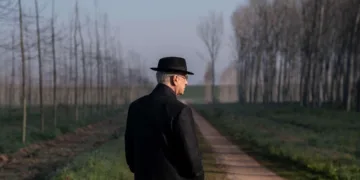





















In the final season of his power, President Mariano De Santis is less a man than a principle solidified. He haunts the vast, echoing halls of the Quirinale Palace, a figure of stoic integrity nicknamed “Reinforced Concrete” by those who observe his measured existence. A former judge, he has built a life upon the foundations of law and reason.
Now, in the twilight of his term, the architecture of that life shows its cracks. Before him lie dossiers demanding a verdict: a bill on euthanasia that questions the very definition of mercy, and two pardon requests for acts of love and desperation. Yet these public duties are but shadows of a deeper, private inquest.
He is consumed by the ghost of his late wife, Aurora, and the gnawing uncertainty of an affair she had forty years ago. Paolo Sorrentino’s La Grazia is a quiet study of this stone man, a meditation on a public figure whose carefully constructed legacy is threatened by the unresolved business of the soul.
The Geometry of Restraint
Sorrentino, a filmmaker known for baroque sensibilities, here embraces an aesthetic of subtraction, as if performing a rite of penance for past excesses. The film’s visual language is austere, its mood sober and distinctly melancholic. Cinematographer Daria D’Antonio transforms the Quirinale Palace into a mausoleum of power, its perfect compositions and cold marble dwarfing the human figures who move through its halls.

The president is a prisoner of this geometry, his profound isolation magnified by cavernous spaces that seem to absorb all sound. This visual silence is a direct reflection of his emotional state, an externalization of a lifetime of repression. Yet Sorrentino’s spirit is not entirely exorcised.
A propulsive electronic score throbs incongruously through a quiet scene, a sudden intrusion of the chaotic present. The film’s most telling flourish is a moment of pure, dreamlike absurdity: an elderly visiting head of state, stepping from his car, is undone by a sudden storm.
The wind whips the red carpet into a furious ribbon, a display of nature’s indifference to human ceremony. De Santis watches, and in the crumpled figure of the other president, he sees a vision of his own frailty, a stark memento mori. These flourishes are fractures in the film’s placid surface, acknowledgments of the unruly universe that ritual and reason can never fully contain.
The Jurisprudence of the Soul
The president’s professional obligations become a trial for his private self, forcing a man of statutes to confront the ambiguities of the human heart. The pardon cases before him are mirrors held up to his own failings. One involves a woman who murdered her abusive husband, an act where legal guilt and moral justice are in violent opposition.
The other concerns a teacher who ended his wife’s descent into Alzheimer’s, a killing that could be read as either profound love or the ultimate transgression. These are not matters for a judge but for a confessor, and they force De Santis to reckon with a world beyond his tidy legal frameworks. These dilemmas circle the central, unsolvable case of his life: his wife’s infidelity. As a jurist, he built his world on evidence and fact.
In the terrain of his own marriage, he has none, only the torment of a forty-year-old question. This lifelong failure to “solve” the mystery of his own heart has eroded his faith in the very systems of order he represents. The film’s title holds the central philosophical query.
Grazia, the Italian word for both official pardon and spiritual grace, connects his public function to his existential need. His final challenge is not to secure a political legacy, but to find what his friend the Pope calls leggerezza, a lightness of being, before the gravity of his own judgment becomes his only monument.
The Man Within the Monument
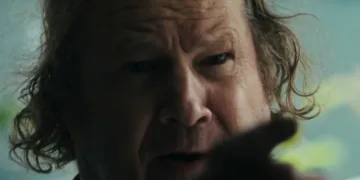
Toni Servillo’s performance is a masterful act of withholding, an inhabitation of a man who has become a living statue. As Mariano De Santis, he carries the immense weight of the republic in his shoulders, his measured walk through endless corridors a funereal procession. His stillness is an active force, a bulwark against the internal chaos he refuses to show.

It is a portrayal of a man calcified by duty and hollowed by grief, a figure who has so merged with his office that he risks becoming a void. The supporting players serve as perfect counterpoints to this monumental stillness. Anna Ferzetti gives his daughter, Dorotea, a dutiful presence that slowly curdles into her own quiet rebellion.
The true anarchic force is Milvia Marigliano as Coco Valori, a fiery art critic whose garrulous energy threatens to shatter the palace’s decorum. She is the keeper of the truth he both craves and fears, and her refusal to give him the answer he seeks is its own hard lesson in living with uncertainty. It is Servillo, however, who anchors the entire structure, his powerful, understated work giving substance to the film’s quiet, reflective core.
Full Credits
Director: Paolo Sorrentino
Writers: Paolo Sorrentino
Producers and Executive Producers: Paolo Sorrentino, Annamaria Morelli
Cast: Toni Servillo, Anna Ferzetti, Orlando Cinque, Massimo Venturiello, Milvia Marigliano, Giuseppe Gaiani, Giovanna Guida
Director of Photography (Cinematographer): Daria D’Antonio
Editors: Cristiano Travaglioli
The Review
La Grazia
Sorrentino trades his usual flourish for a profound stillness, creating a wintry, elegant meditation on the solitude of power. Anchored by Toni Servillo's monumental performance, La Grazia is a demanding yet rewarding work that explores the heavy burden of a life lived by the letter of the law, and the quiet desperation of a soul seeking a grace that no decree can grant. It is a somber, deeply human portrait of a man confronting the ghosts within his own marble halls.
PROS
- A commanding and subtle lead performance from Toni Servillo.
- A philosophically deep script exploring themes of power, regret, and mercy.
- Sorrentino’s mature, restrained direction creates a potent, melancholic atmosphere.
- Strong supporting performances, particularly from Milvia Marigliano.
CONS
- The deliberate and measured pacing may feel sluggish for some viewers.
- Its somber tone offers little in the way of conventional entertainment.
- Occasional stylistic flourishes can seem at odds with the film's dominant austerity.