










The Rooster opens not with a story, but with a psychic wound. We are plunged into a nightmarish tableau: a swinging body, a desolate road, and other surreal apparitions that suggest a film trafficking in pure horror. The feeling is liminal, a space between dream and dread.
From this emerges Dan (Phoenix Raei), a rural police officer whose quiet existence seems less a choice and more a form of self-imposed exile. He is a man already hollowed out. When his childhood friend is found dead in a shallow grave, the fragile shell of his life shatters completely. The resulting guilt is a palpable entity, a poison that drives him from his duties and into the Australian bush.
This is no mere camping trip; it is a full-scale retreat from society, an attempt to find in the vast, uncaring wilderness a silence that matches his own. The film immediately signals that the mystery of his friend’s death is secondary to the far more complex investigation into a man’s unraveling soul.
A Duet of Despair
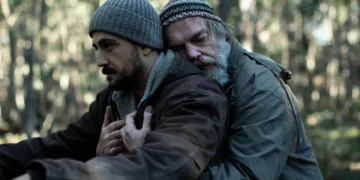
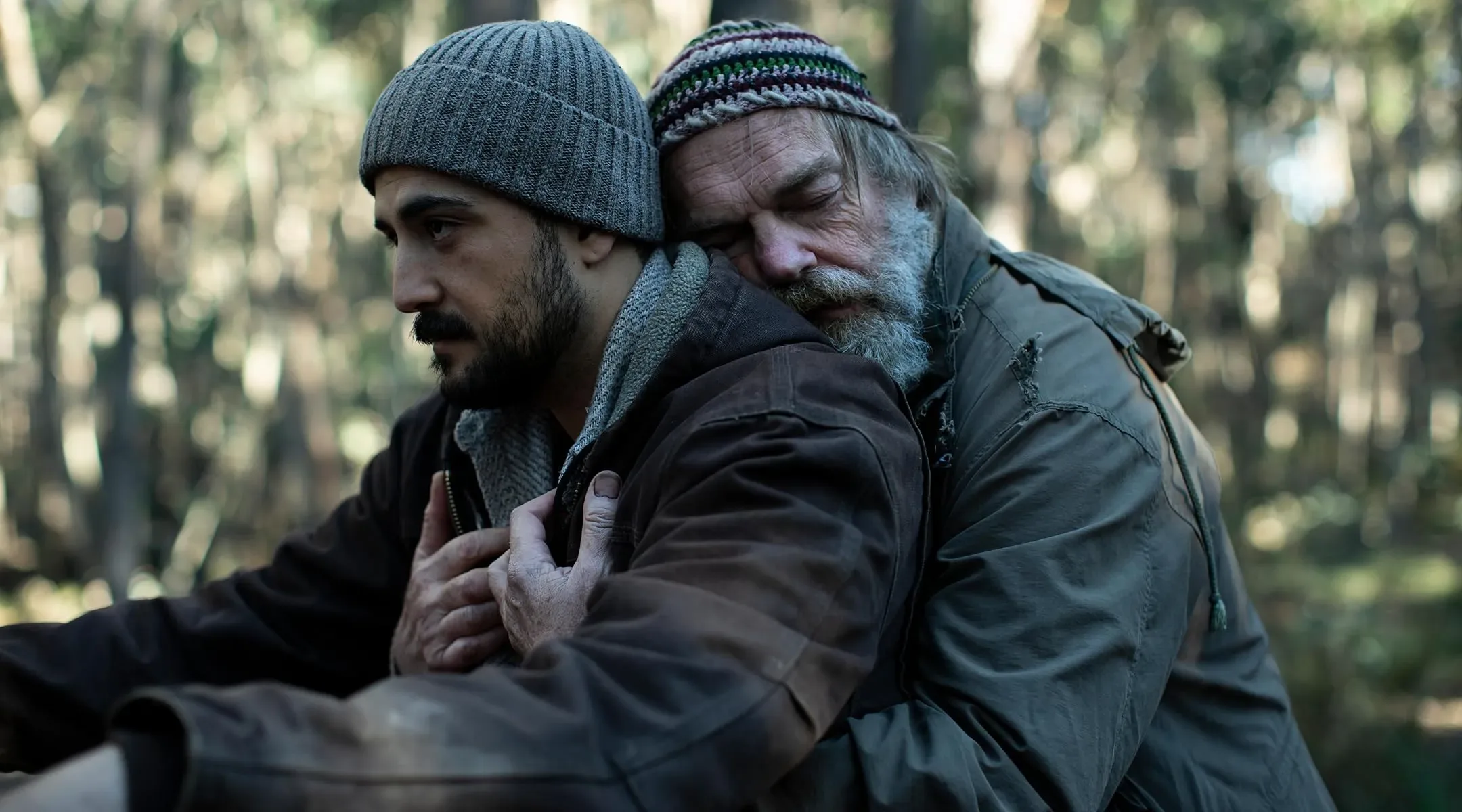
Dan’s self-flagellating pilgrimage leads him to a shack inhabited by a man credited only as The Hermit (a spectacular Hugo Weaving). If Dan is a black hole of grief, the Hermit is a supernova of rage. He is a territorial, shotgun-waving creature of pure id, spewing profanity and philosophical diatribes with equal ferocity.
Their meeting is a clash of opposing forces: the man who internalizes everything and the man who externalizes all. Phoenix Raei’s performance is a masterclass in stillness; he portrays Dan as a man so weighted by sorrow that his very presence feels like a gravitational pull. It is a difficult, reactive role, communicating deep anguish through averted glances and a slumped posture. His quietness is a necessary anchor, because Weaving’s performance is a hurricane.
The role feels Shakespearian in its scale, a King Lear raging on the heath of the Australian bush. Weaving runs half-naked through the woods, urinates on crucifixes, and blasts experimental jazz into the indifferent trees. This is a performance of such raw, feral energy it threatens to tear the film apart at its seams.
A fragile truce between them is brokered through the universal lubricant of booze, initiating a strange and fractious cohabitation built on a kind of symbiotic antagonism. Their shared scenes, often fueled by drunken monologues and even a game of naked table-tennis, become a series of dysfunctional, modern rituals where two broken men accidentally show each other their scars.
The Topography of Trauma
The film’s initial crime-procedural setup is a clever misdirection. Writer-director Mark Leonard Winter quickly abandons any pretense of a whodunit for a stark examination of masculine pain. Australia has a long cinematic tradition of exploring the stoic, sunburnt male psyche, and The Rooster uses that history as its canvas to paint something far more raw.
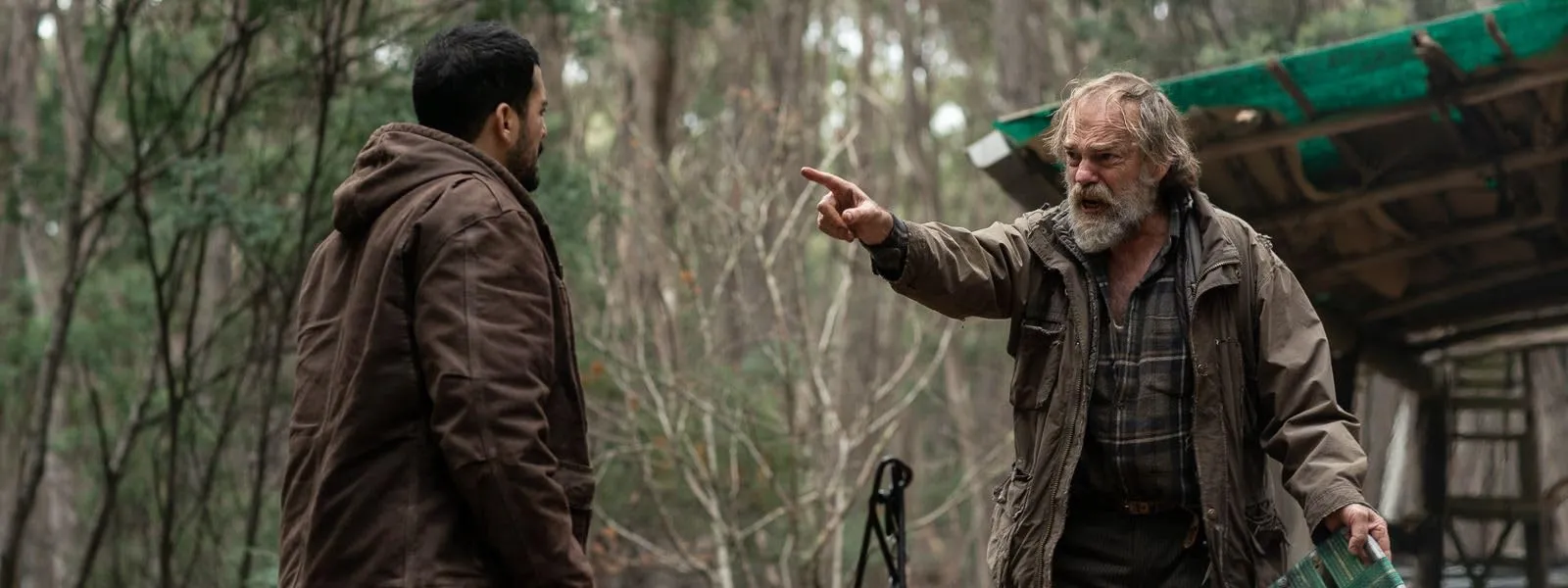
It presents two archetypes of coping with trauma, a Freudian dichotomy of a man at war with himself. Dan, the cop, embodies the repressed superego, the silent suffering so often mythologized as strength, a man bottling his agony until it corrodes him from within. The Hermit represents its inverse, the unleashed id, a man whose pain has become a weapon he wields against a world he perceives as hostile.
The film seems to ask what happens to men in a society that offers no healthy script for emotional expression. The narrative moves at a deliberate, almost meditative pace, forcing the audience into the uncomfortable quiet between outbursts.
This slowness is a philosophical choice, compelling the viewer to experience duration and confront silence, mirroring the characters’ own existential dread. It is a dialogue-heavy work that demands patience as it peels back its characters’ layers through long, soul-baring speeches, avoiding easy psychological explanations for their conditions. Their pain is not rooted in a single, neat event; it is a state of being.
An Orchestration of Isolation
For a debut feature, Winter’s command of atmosphere is remarkable. An accomplished actor himself, his direction prioritizes performance, giving his cast the time and space (often through long, unbroken takes) to fully inhabit their characters’ desolation. The film is a sensory experience, a study in texture and mood. The cinematography by Craig Barden transforms the Victorian bush into a character of its own.
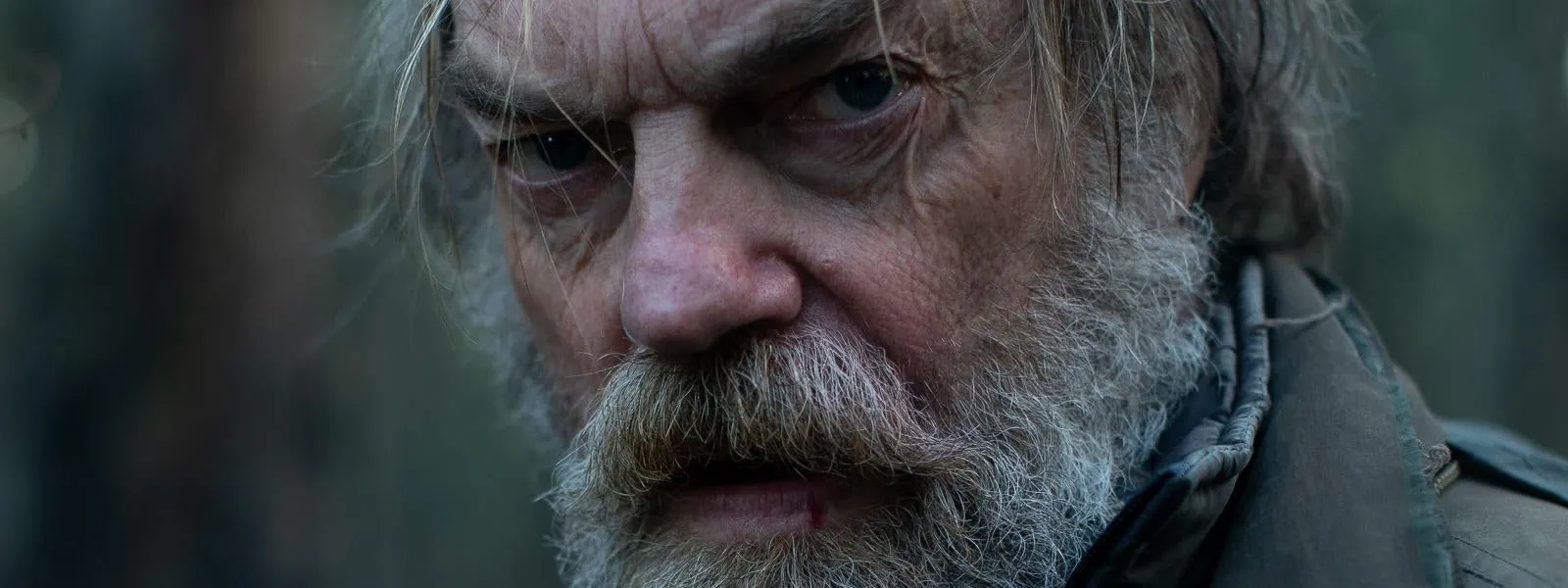
It is an active participant in the story, a landscape that shifts from beautiful sanctuary to a threatening, primordial maze that mirrors the characters’ internal states. The use of light is particularly effective, with dappled sunlight offering moments of grace before the oppressive darkness of the forest closes in again. The soundscape is just as meticulously crafted.
Stefan Gregory’s score is spare, allowing the natural sounds—the birds, the wind, the unnerving silence—to mingle with unsettling snatches of jazz and classical music. This juxtaposition creates a sense of profound dissonance, as if the characters’ internal chaos is being projected onto the world around them.
The film doesn’t offer easy answers, and its final moments are soaked in ambiguity. It rejects the neat catharsis of a typical healing narrative, suggesting instead that recovery is a messy, incomplete, ongoing process. This refusal to provide simple solutions is its most lasting statement, a challenging piece held together by the raw, unforgettable power of Hugo Weaving’s performance.
The Rooster is an Australian drama film. It premiered at the Melbourne International Film Festival on August 5, 2023. It was released in Australian cinemas on February 22, 2024. Bonsai Films distributes the film in Australia and New Zealand, and The Yellow Affair distributes it internationally. The film was written and directed by Mark Leonard Winter.
Full Credits
Director: Mark Leonard Winter
Writers: Mark Leonard Winter
Producers and Executive Producers: Geraldine Hakewill, MahVeen Shahraki, Susie Montague-Delaney, Patrick James, Michael Kantor
Cast: Hugo Weaving, Phoenix Raei, John Waters, Rhys Mitchell, Robert Menzies, Jane Montgomery Smith, Deidre Rubenstein
Director of Photography (Cinematographer): Craig Barden
Editors: Cameron Ford
Composer: Stefan Gregory
The Review
The Rooster
The Rooster is a demanding, atmospheric descent into the male psyche, forgoing conventional narrative for a raw, theatrical exploration of grief. Its deliberate pacing and unrelenting somberness will prove challenging for many. The film is an undeniable artistic achievement, anchored by a monumental, feral performance from Hugo Weaving and Mark Leonard Winter’s confident direction. It is a powerful, unsettling meditation on pain that lingers long after the credits roll.
PROS
- A phenomenal, commanding performance from Hugo Weaving.
- Superb direction that creates a thick, immersive atmosphere.
- Stunning cinematography of the Australian bush.
- A deep and unflinching exploration of grief, masculinity, and mental health.
- Meticulous and effective sound design.
CONS
- The deliberately slow, meditative pacing may alienate viewers seeking more plot.
- Its heavy, somber tone makes for a difficult and uncomfortable watch.
- The restrained character of Dan can feel overshadowed by the Hermit.
- The narrative is thin, prioritizing mood and character study over events.