







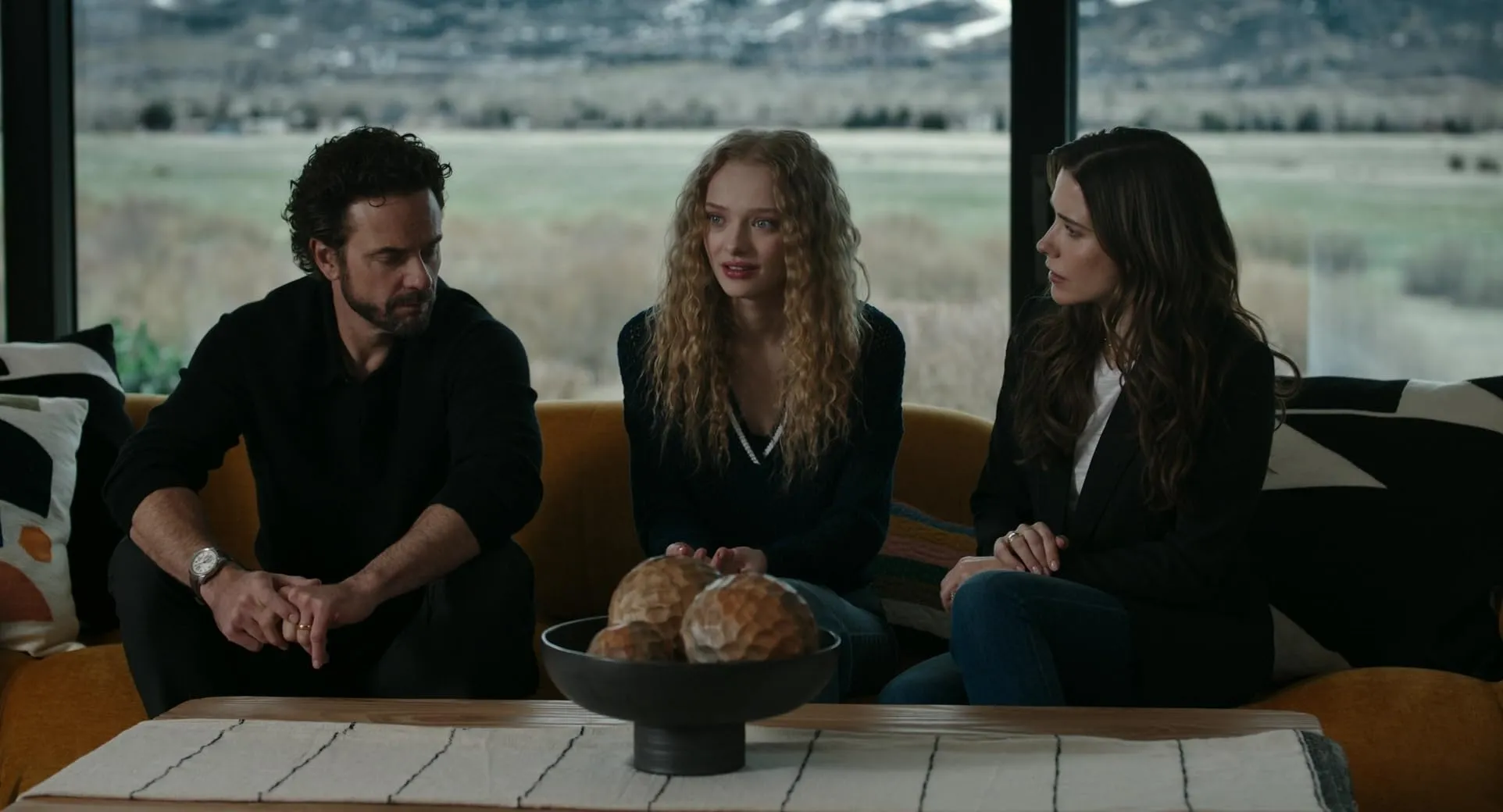

The film descends from its precipice of initial shock into a fever dream of multiplying secrets. The characters’ strangely muted reactions to the foundational crisis feel less like a flaw in the script and a quiet symptom of existential paralysis, a defense mechanism against a truth too vast to emotionally process.
Ali and Jeff absorb the blow with a stillness that borders on the surreal, a psychological state of shock that allows the foreign element, Tom, to seep into the cracks of their broken home. Their passivity is the stillness of a world holding its breath before collapse.
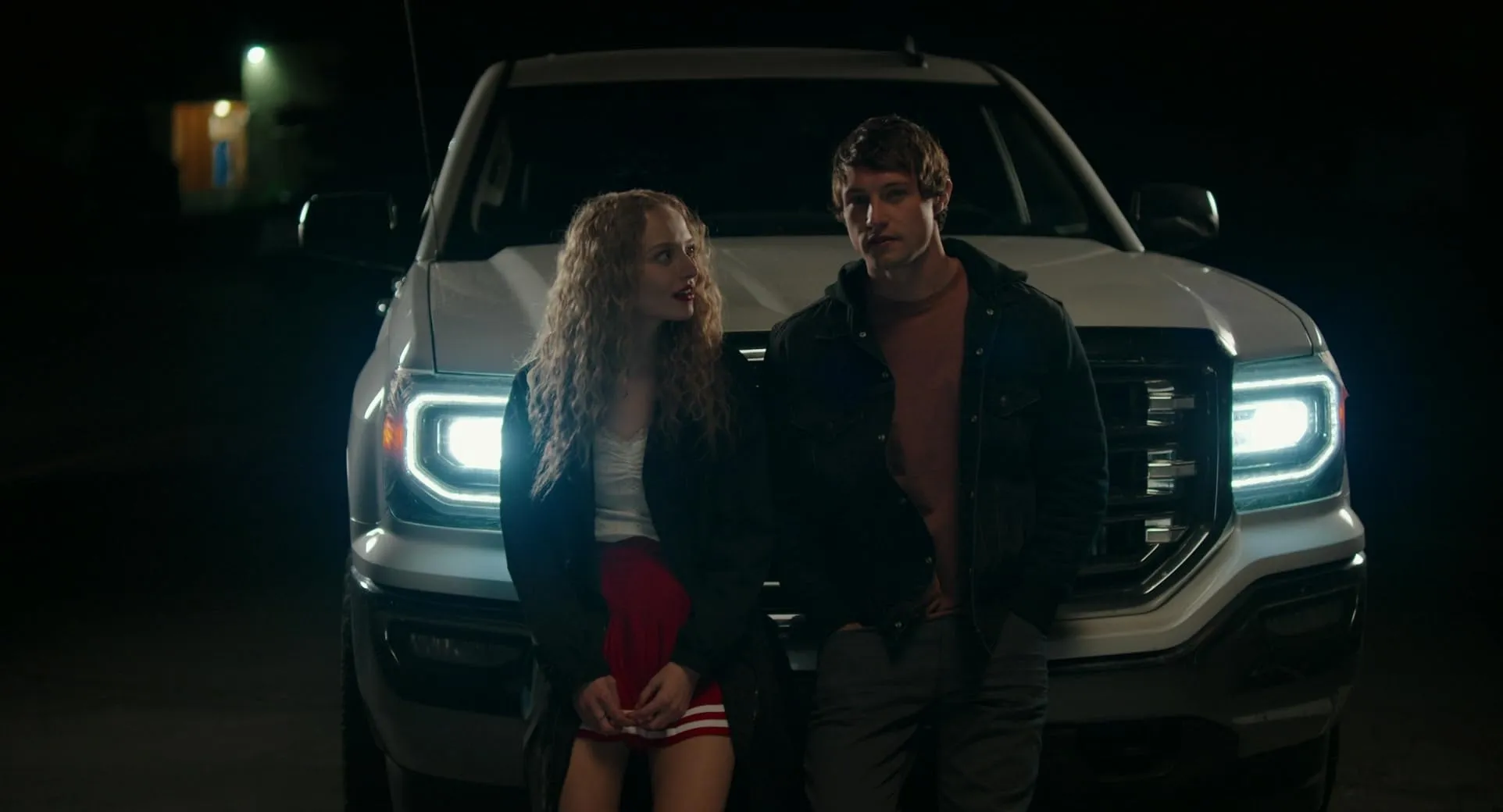
Young Katie, now a stranger in her own life, is set adrift on a sea of uncertainty, and she finds a fleeting anchor in the handyman, Jordan. Their connection, presented initially as simple teenage solace, reveals itself to be another knot in a tangled lineage, a deeper, older secret lying dormant.
Jordan is Peter, the son Ali surrendered to adoption in her youth, a ghost from a past she thought was sealed, returning to the stage at the moment of its greatest upheaval. His presence suggests the family’s foundation was never solid; it was already built over a hidden chamber of secrets. Tom’s intrusion did not create the fracture, it merely exposed it.
Tom himself deteriorates from a man with a strange story into a figure of pure manipulation. The narrative peels back his layers, revealing his entire story to be a fabrication born from the wreckage of his own life. His wife, Bella, is not a memory but a living person.
His motives are not paternal concern but a desperate obsession rooted in the loss of his own family. He becomes a menacing void, a man so hollowed out by his own pain that he must construct a new reality from lies, attempting to script a new life with Ali and Katie as his unwilling cast.
A Human Heart in a House of Mirrors
In a film that embraces its own artifice, Sophia Bush provides a raw and human center, a locus of authenticity in a world of polished surfaces. Her performance as Ali is the emotional anchor in a sea of melodrama, a desperate pulse of humanity within the film’s cold, artificial frame.
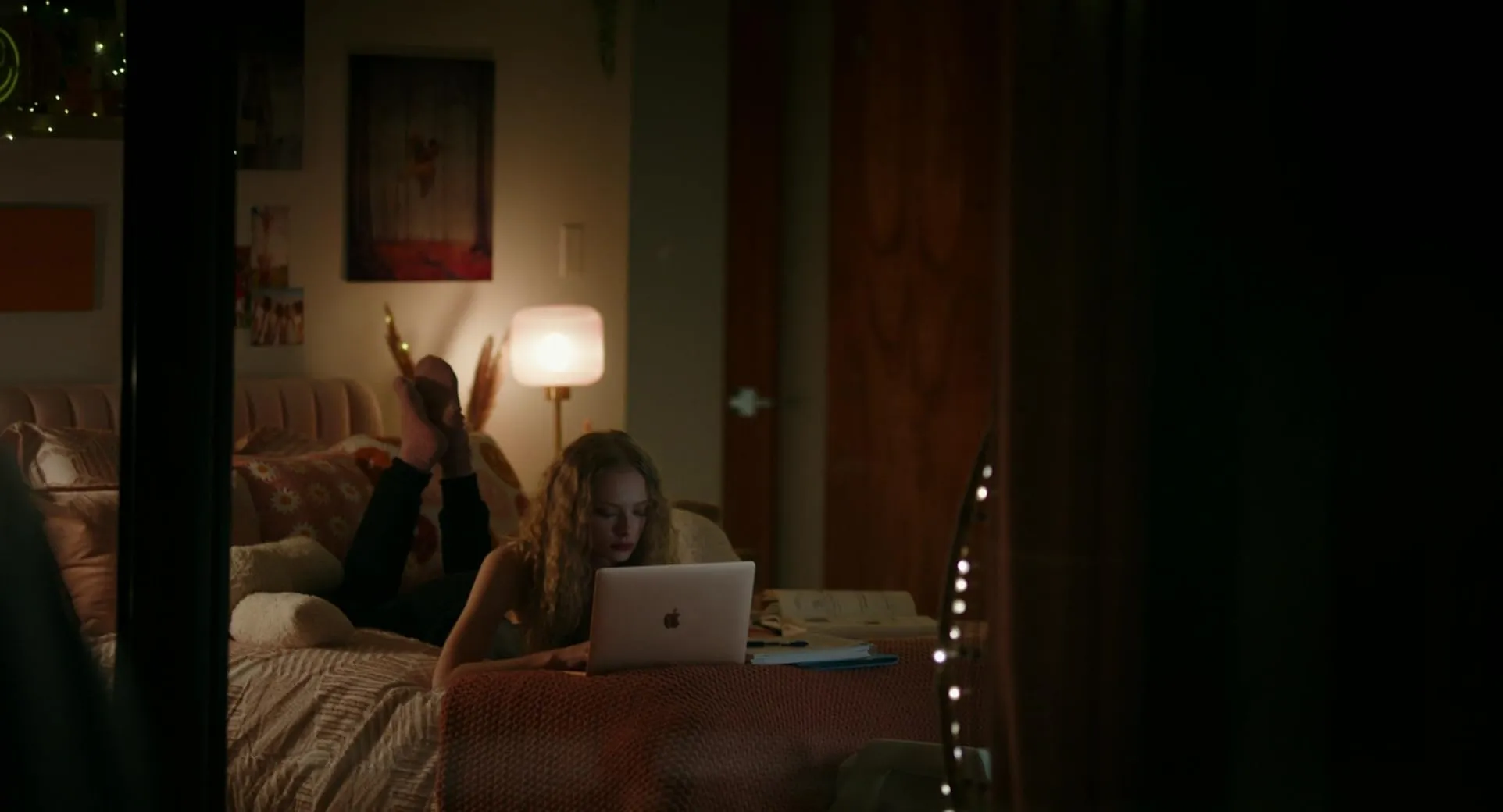
She gives a portrait of maternal resolve that feels authentic, tracing the journey from stunned disbelief to a fierce, protective instinct. Her expressions map a silent war between the desire for denial and the dawning horror of her new reality. This palpable struggle keeps the narrative grounded.
Against this, Chris Carmack’s Tom is a study in the terror of the mask. His initial charm is a carefully constructed persona, and the performance excels in showing the subtle cracks that appear long before the mask shatters completely.
His smile does not reach his eyes; his generosity feels predatory. He embodies the uncanny dread of a thing that is almost human but is hollowed out by obsession. Amiah Miller’s Katie captures the specific existential terror of youth, the horror of discovering that the very ground beneath your feet, your family and your name, is not solid.
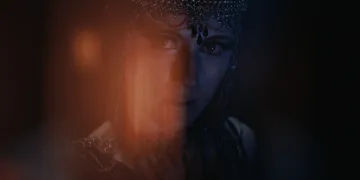
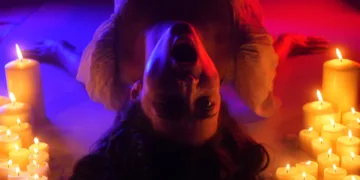
The film’s aesthetic reinforces this sense of dislocation. Director Jeff Fisher employs a visual language of fractured identity. The use of split screens and oppressively moody lighting are not mere flourishes; they are a visual representation of the characters’ splintering psyches. The world is a house of mirrors, trapping the figures in a visual cage that reflects their psychological imprisonment. The idyllic Utah setting, with its wide-open spaces and beautiful mountains, becomes an agoraphobic void, its beauty masking a terrifying and inescapable isolation.
Blood Ties, Forged and Severed
The final act transpires in the requisite remote cabin, a primal space outside of society where its polite fictions are violently stripped away. It is a crucible, and here, all that is left are the elemental forces of survival and obsession. Tom’s kidnapping of Katie is the desperate, final move of a man attempting to impose his narrative onto the world, to force his broken fantasy into being. He has written a story and needs his characters to play their parts, but Ali refuses her role.
Her calculated rescue mission is a descent into this raw, dangerous world. She meets him on his own terms, entering the heart of his delusion to retrieve her daughter. The ensuing struggle is a physical manifestation of the film’s psychological warfare. The conflict reaches its apex with the arrival of Jeff and Liv, a moment that brings the film’s central question to a head.
It is Liv, the girl displaced by fate, who performs the story’s defining act. Seeing her biological father, a man she barely knows, near death, she raises Tom’s own weapon against him. With a single shot, she severs one bond of blood to violently forge another through choice. It is a terrifying, creative act of destruction.
The family that emerges is a new entity, born from trauma and bonded by this shared, violent history. Katie’s final words on her lost innocence are not a simple closing thought; they are the first lines of this new family’s foundational myth, a necessary story they will tell themselves to impose order on the chaos they endured. Their peace is a fragile thing, built on the ashes of what came before.
The Stranger in My Home is a thriller film directed by Jeff Fisher. It was released on Digital platforms on June 24, 2025. The film is based on the novel by Adele Parks and was filmed in and around Salt Lake, Summit, and Wasatch counties, Utah.
Full Credits
Director: Jeff Fisher
Writers: Chris Sivertson, Adele Parks (novel)
Producers: Brad Krevoy, Adele Parks (executive producer), Jim Parks (executive producer)
Executive Producers: Vince Balzano, Kaan Karahan, Adele Parks, Jim Parks, Amanda Phillips, Andrew Riach, Jennifer Ricci, Garrett VanDusen, Jennifer Ricci
Cast: Sophia Bush, Chris Carmack, Monica Lacy, Amiah Miller, Chris Johnson, Kate Rachesky, Jamison Belushi
Director of Photography (Cinematographer): Nathan Wilson
Editors: Marissa Mueller, Kaan Karahan
Composer: Matthew Rogers
The Review
The Stranger in My Home
The Stranger in My Home operates as a fascinating paradox: a self-aware, melodramatic thriller that accidentally stumbles into profound questions about identity and connection. While its plot mechanics strain credulity and its aesthetic is pure television gloss, the film is anchored by a genuinely compelling performance from Sophia Bush. She provides a human heart to its cold, artificial world. It is a film that is more interesting for the existential anxieties it unearths than for the story it explicitly tells, a compelling, if flawed, examination of a reality built on lies.
PROS
- Sophia Bush delivers a strong, grounding performance that serves as the film's emotional core.
- The relentless series of plot twists, while outlandish, keeps the narrative engaging.
- A stylized direction that effectively creates a mood of polished, suburban dread.
- It touches upon deeper themes of identity, memory, and the nature of family.
CONS
- Character reactions to catastrophic events are often unbelievable.
- The plot relies heavily on soap opera conventions and contrivances.
- Its resolution feels rushed, neatly tying up complex emotional trauma too quickly.
- The overall "made-for-TV" quality can detract from the film's dramatic weight.