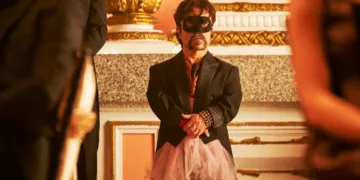











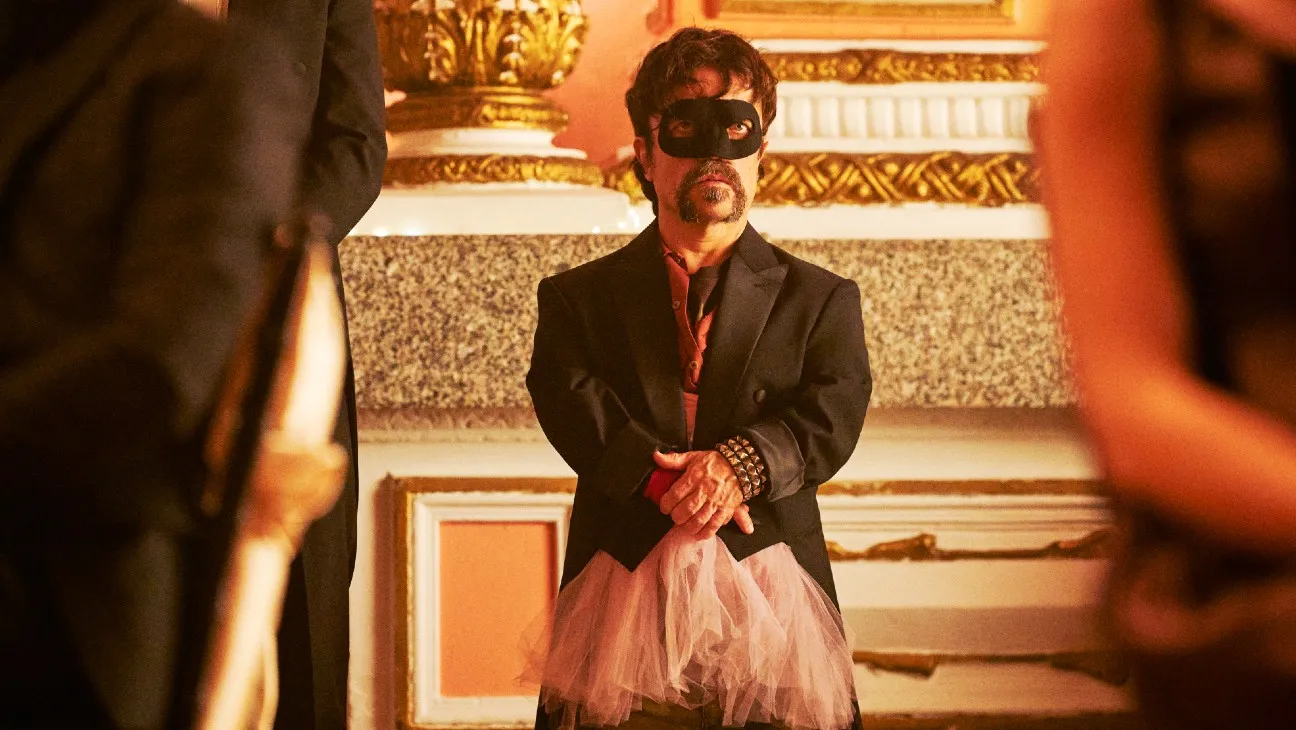

We begin with Winston Gooze, a man so thoroughly defeated by the 21st century that he has become almost translucent. As portrayed by Peter Dinklage, Winston is the quiet heart of a world screaming with decay. He is a janitor, a proletarian spectre haunting the halls of the BTH corporation in St. Roma’s Village, a town that seems to be actively rotting from the ground up.
He is also a stepfather, tending to a son with the dutiful resignation of someone long past expecting joy. When a doctor diagnoses him with a terminal illness (the specifics are blotted out by the indifferent noise of construction), it is less a tragedy and more a formal confirmation of his condition.
Winston was already fading. The system had already consumed him. His subsequent tumble into a vat of glowing chemical waste is not an accident. It is a baptism, a grotesque apotheosis for the powerless modern man. He is reborn, not as a hero, but as a symptom.
The Anarchy of Everything
The film directs its comedic rage with the precision of a firehose. Its primary targets are the obvious monsters of our age: the soulless corporation poisoning the earth for profit and the labyrinthine healthcare system designed to confound rather than heal.
The sequence where Winston pleads with an insurance algorithm over the phone is a moment of pure Kafkaesque horror. It is a masterclass in depicting the circular, dehumanizing logic of bureaucracy, where language itself is weaponized to ensure submission. This is a bureaucratic nightmare more chilling than any physical threat.
Yet the film’s critique is not limited to these institutional pillars. It spews a kind of satirical shrapnel, hitting everything in its blast radius with a cheerful nihilism. This scattershot method feels less like a flaw and more like a diagnosis of our cultural moment, reflecting the fragmentation of media where no single, coherent critique seems possible anymore.
We see preppy thugs who represent privileged cruelty, a gang of assassins styled after nü-metal archetypes (a curious form of cultural archaeology for a dead-end subculture), and gun-obsessed men’s rights activists. The film treats them all with equal disdain. This approach risks incoherence, presenting a world where every single thing is corrupt, absurd, or malicious.
The effect is less a focused political statement and more a cinematic panic attack, mirroring the frantic, omnidirectional anger of an endlessly scrolling social media feed. It’s a mess. A deliberate, perhaps even necessary, mess. The Ghost in the Grime
Amid the chaos, Dinklage provides a startlingly human anchor. Before his transformation, his performance is a study in quiet desperation, a portrait of ontological exhaustion. He carries the immense weight of a life without agency, and his fatherly warmth feels less like a choice and more like a final, flickering instinct of a man running on fumes. This sincerity makes the film’s cartoonish world feel all the more hostile. It is a brilliant, and cruel, juxtaposition, grounding the absurdity in something tragically familiar.
Then the suit happens.
Encased in latex, the physical performance is outsourced to a body double, yet the character remains Dinklage’s. Winston’s soft, defeated voice emanates from the hulking, mutated creature. This is the film’s cleverest trick. The voice is the ghost of the man he was, a constant audio reminder of the tragedy within the farce, a signal of the wounded soul trapped within its powerful new prison.

We are always aware of the sad human inside the silly monster suit. The physical limitations of the costume become thematic; Winston is still a prisoner, albeit one with the power to tear people in half. His new body is a more powerful cage. His performance is reduced to that voice and a single, expressive eye peering out from the muck, a tiny window into the shrinking space of his former self.
A Rogues’ Gallery of the Damned (and the Underwritten) The film surrounds its tragic hero with figures of pure caricature, each representing a different flavour of societal sickness. Kevin Bacon’s Bob Garbinger is less a character and more a collection of tics borrowed from the zeitgeist of billionaire eccentricity.
He is a panto villain for the bio-hacking era, a hollow man whose obsession with cheating death is an extension of his narcissistic need to consume everything, even time itself. Bacon’s performance is entirely unhinged, a frantic piece of performative grotesquerie that serves as a perfect foil to Dinklage’s restraint.
Then there is Elijah Wood as Fritz Garbinger, the villain’s bizarre, Gollum-like brother. He appears for brief, wonderful flashes of inexplicable strangeness (mournfully playing a pan flute on a darkened stage, for instance) before vanishing again. He is a delightful non-sequitur, absurdity for absurdity’s sake, a flicker of pure id that the film wisely never tries to explain.
Taylour Paige’s J.J. Doherty, a corporate whistleblower, is not so lucky. She exists for purely functional reasons, a human plot device whose presence feels like a half-hearted nod to conventional storytelling in a film that openly despises it. Her character’s thinness highlights the film’s true priorities, showing its deep preference for gags over narrative cohesion.
An Aesthetic of Decay
To call the film’s visual style a B-movie pastiche would be accurate but incomplete. It is a purposeful embrace of the ugly, the garish, and the cheap, a political choice to reject the slick, clean aesthetic of corporate cinema. This is an aesthetic of beautiful garbage. The screen is saturated with neon greens and sickly yellows, a visual reflection of the toxic sludge that created our hero.
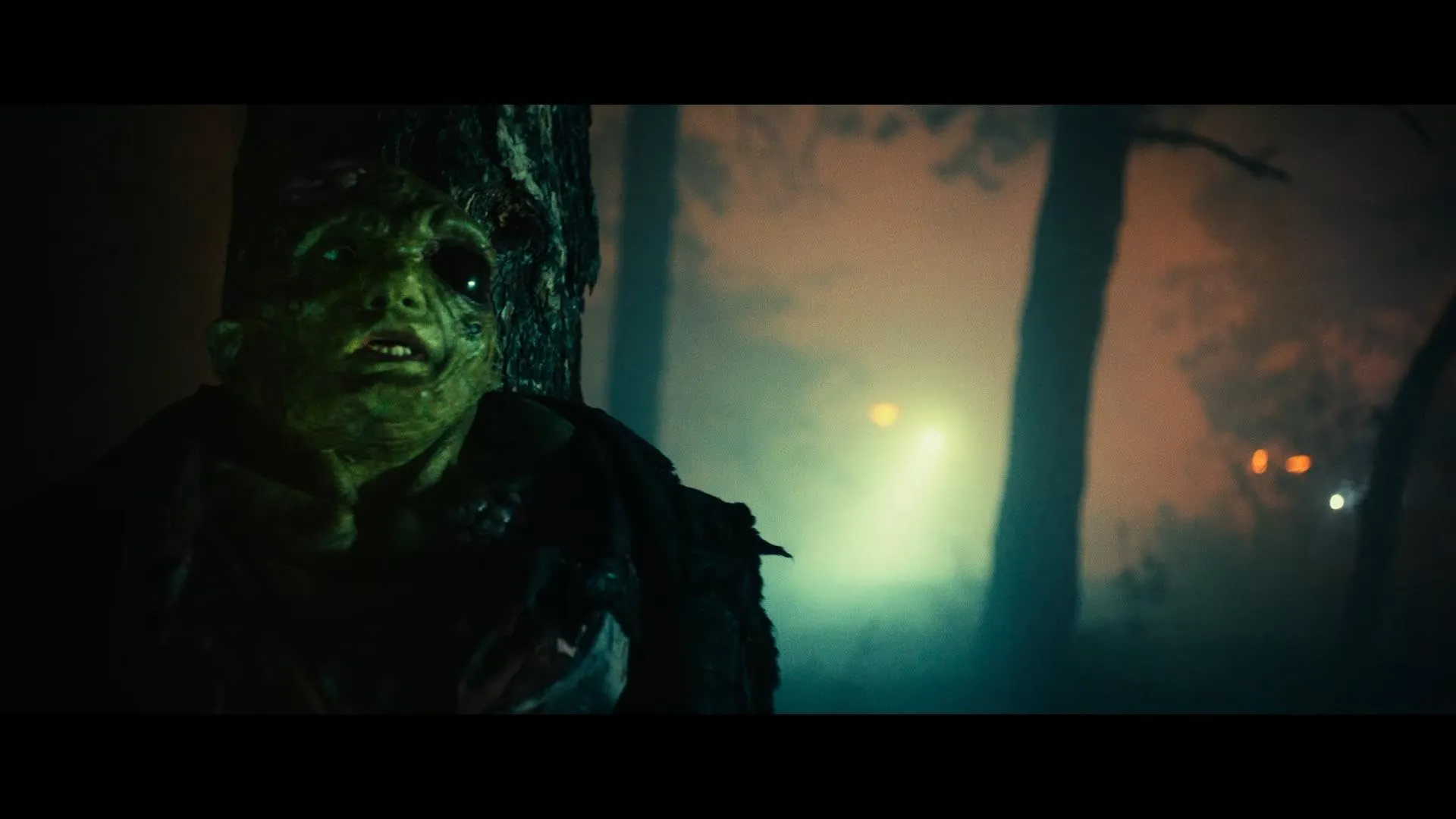
The commitment to splatter is absolute, a festival of dismemberment and creative evisceration. Toxie’s weapon, a mop steeped in caustic chemicals, becomes a paintbrush for a ballet of viscera. The gore is a punchline, a cathartic release of pent-up frustration rendered with such comical excess it becomes abstract.
Some of this is achieved with gloriously practical effects, though the illusion is occasionally broken by weightless CGI blood, a small concession to modernity in an otherwise proudly analog vision of mayhem. The production design itself is a key player. The costumes of the Killer Nuts and the general filth of St. Roma’s Village are not just background details. They build a world that is a sentient landfill, a place where decades of neglect have made the environment itself a hostile entity.
The Joke Is the Point
One must understand that the plot is not the point. The film’s narrative momentum is constantly, deliberately sacrificed for a throwaway line or a bizarre background gag. The story does not move forward so much as it lurches from one absurd set piece to another, like a series of sketches stitched together with sinew.
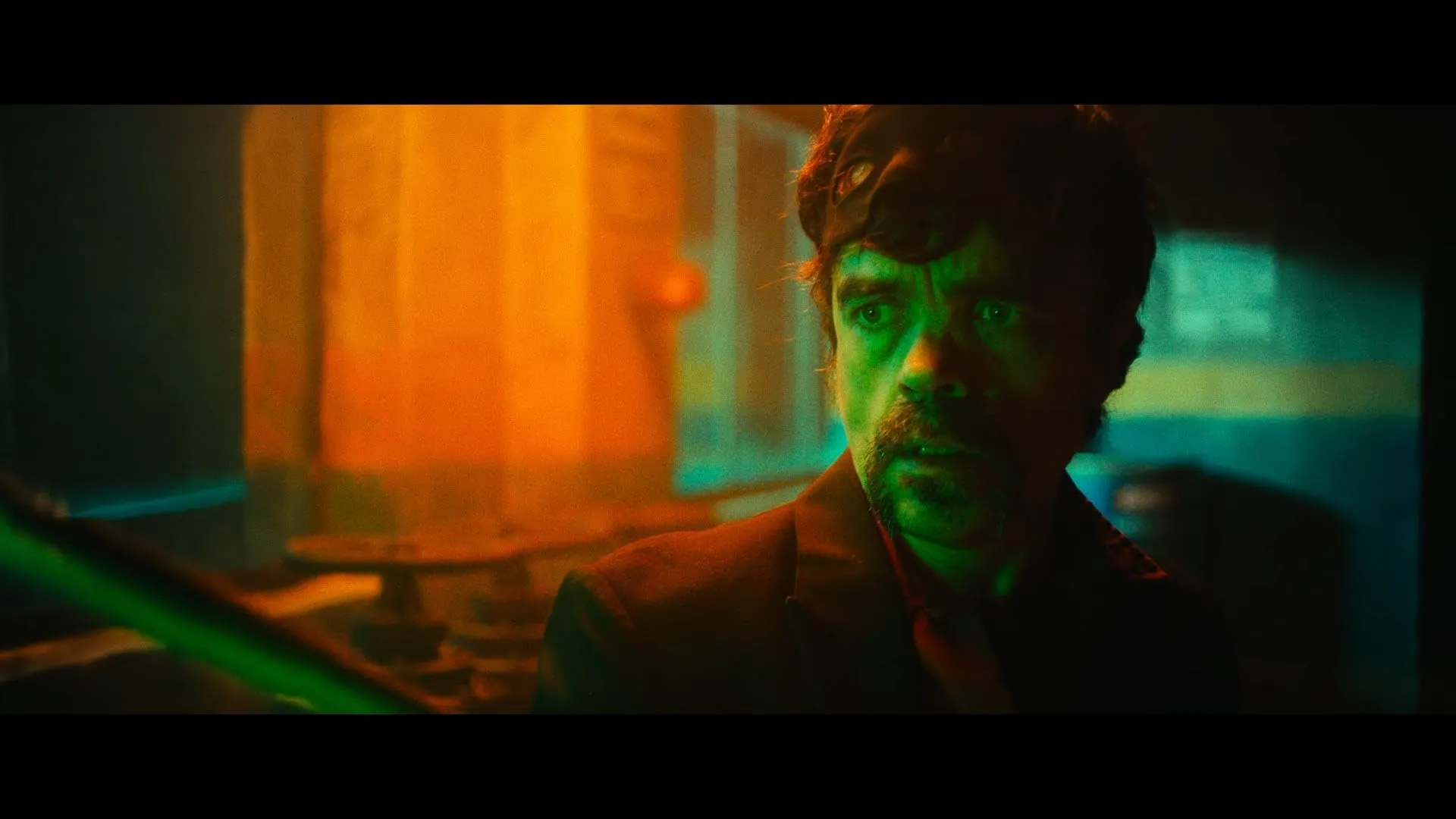
Its humor is an acquired taste, a self-aware and often juvenile sensibility aimed squarely at a niche viewership weaned on VHS horror and late-night animation. This is a movie as an inside joke.
It is structured not as a story but as a delivery system for its own peculiar tone. Any search for deep emotional connection or narrative tension will be fruitless. The film does not want your empathy. It wants you to appreciate its anarchic spirit. It is a cinematic dare, a test of the viewer’s tolerance for its brand of calculated chaos. The side gags are the film; the rest is just filler.
The film, a reboot of the 1984 cult classic, premiered as the opening film of Fantastic Fest on September 21, 2023. It had its international debut at the 56th Sitges Film Festival on October 13, 2023. The film faced distribution challenges due to its gore and graphic content, being described as “unreleasable” in July 2024. However, in January 2025, Cineverse acquired distribution rights and plans to release it unrated theatrically on August 29, 2025 in the United States and United Kingdom.
Full Credits
Director: Macon Blair
Writers: Macon Blair
Producers: Mary Parent, Alex Garcia, Lloyd Kaufman, Michael Herz
Cast: Peter Dinklage, Jacob Tremblay, Taylour Paige, Julia Davis, Jonny Coyne, Elijah Wood, Kevin Bacon, Sarah Niles, Julian Kostov, David Yow, Macon Blair, Rebecca O’Mara, Jane Levy
Director of Photography (Cinematographer): Dana Gonzales
Editors: Brett W. Bachman, James Thomas
Composer: Will Blair, Brooke Blair
The Review
The Toxic Avenger
The Toxic Avenger is less a movie and more a cinematic dare. It is a meticulously crafted mess, a glorious piece of beautiful garbage that weaponizes its own incoherence. While Dinklage provides a tragic soul and the institutional satire is scalpel-sharp, the film's true purpose is to be a self-aware, aggressively niche spectacle. It is a brilliant success if you are in on the joke, and an insufferable exercise in style if you are not. It doesn’t ask to be liked; it only asks that you witness its madness.
PROS
- Sharp, effective satire of the healthcare system and corporate greed.
- Peter Dinklage's grounded and tragic central performance.
- A committed and wonderfully grimy B-movie aesthetic.
- Hilariously unhinged supporting roles from Kevin Bacon and Elijah Wood.
- Inventive and comical practical gore effects.
CONS
- The plot is intentionally underdeveloped and lacks momentum.
- Key supporting characters feel like functional afterthoughts.
- Its scattershot humor is extremely niche and will not land for many.
- The overall style is deliberately alienating to a mainstream audience.
- Occasional reliance on unconvincing CGI blood undercuts the practical effects.