
























![Kingdom Hearts Collection [I-III] Review](https://gazettely.com/wp-content/uploads/2026/10/Kingdom-Hearts-Collection-I-III-1-360x180.webp "Kingdom Hearts Collection [I-III] Review: KHII Holds Steady as Newer Entries Fluctuate 37")



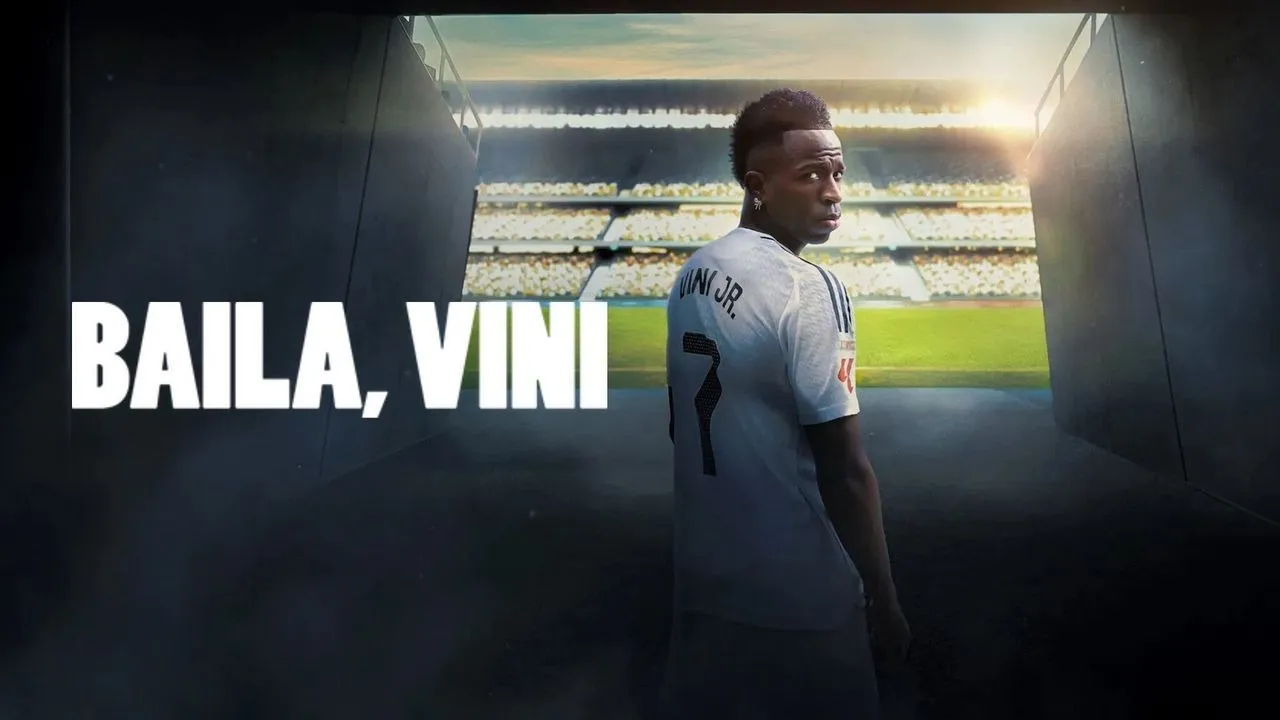

There are players who are good at football, and then there are figures who define an era of the sport. The documentary Vini Jr. argues that its subject, Vinícius Júnior, belongs in the second category. It charts his rise from the neighborhoods of São Gonçalo, Brazil, to the world stage at Real Madrid.
The film positions itself around two powerful narratives running in parallel: the story of an electrifying athlete with rare talent, and the story of a young Black man confronting the ugly racism embedded in the culture of European football. The film sets out to capture the essence of a player whose career has become a testament to both extraordinary ability and a required, unyielding resilience.
The Path to Glory
The film follows a familiar playbook for sports documentaries, a structure I’ve seen many times in the age of streaming content where every major athlete seems to get a polished biographical film. It moves in a straight line, tracing Vinícius’s life chronologically from his beginnings at Flamengo, where his talent shone brightly against the backdrop of his community.
The documentary uses his record-breaking €45 million transfer fee as a constant narrative anchor, a number that effectively communicates the immense pressure placed on his young shoulders. We then watch his difficult adjustment period at Real Madrid, a sequence framed through standard talking-head interviews with family and teammates.
Goalkeeper Thibaut Courtois notes his talent needed to be “polished,” a classic trope that these films often use to build a satisfying arc of growth. The narrative builds predictably towards his eventual triumphs, with a Champions League-winning goal presented as the story’s climax.
While it’s nice to see football legends like Ronaldo and Neymar offering praise, their soundbites are brief and generic, lacking the specific anecdotes that would give their commentary weight. The film competently assembles the key moments of his career, yet it offers little that feels new, feeling less like a documentary and more like a high-production-value YouTube compilation.
The Center of the Storm
The documentary’s focus pivots to become a cultural artifact of our time, using Vinícius’s experience as a lens on racism in modern European society. This is the section where the film had a chance to say something vital and lasting. It does not shy away from the ugliness, showing the visceral footage of entire stadium sections chanting “monkey” and other slurs.
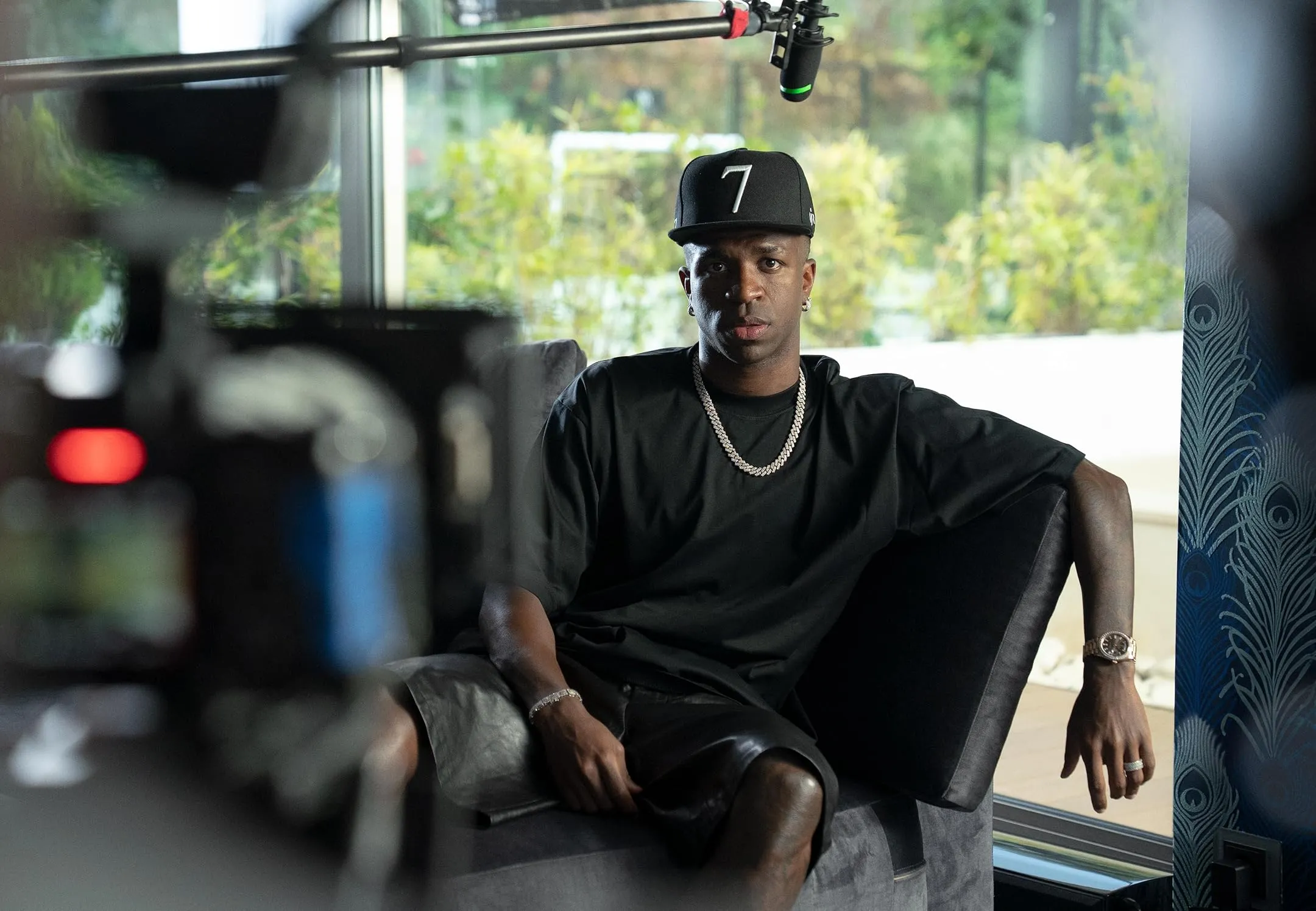
Through tight close-ups and somber music, the film attempts to convey the emotional weight of these moments, documenting his evolution from a targeted player into a global advocate against prejudice. The problem is that the exploration feels disappointingly superficial. Instead of creating a space for Vinícius to offer a deep, personal reflection on these experiences, the film relies heavily on repackaging the same viral social media posts and public statements that were already part of the news cycle.
The narrative presented is also strikingly one-sided, a choice that undermines its power. By painting Vinícius as a simple, flawless hero, the documentary steadfastly ignores any examination of his own on-field provocations or confrontational style that often precedes these incidents. This omission is a significant narrative failure.
It misses a critical opportunity for a more honest and complex character study, one that acknowledges how a person can be both a victim of profound injustice and a complicated, sometimes agitating, figure in their own right. The film chooses the easier path, presenting a clean story of good versus evil which feels more like brand management than truthful filmmaking.
A Polished but Hollow Portrait
From a technical perspective, Vini Jr. is competent but uninspired, feeling more like a television special than a cinematic work. I recall my excitement watching Asif Kapadia’s Senna, a film that used archival footage to create a breathtaking and immersive experience.

This film attempts no such artistry. The game footage is often flat and repetitive, at times even featuring distracting sponsor watermarks that shatter any sense of cinematic immersion. The narrative rhythm stalls in the second half, replaying incidents and goals we’ve already seen, a choice that feels less like thematic reinforcement and more like padding to reach a feature-length runtime.
The filmmakers had a chance to use the Brazilian setting to create a vibrant visual language, but the landscapes of his home are reduced to a generic backdrop. Ultimately, the film feels less like an authentic exploration and more like a carefully constructed piece of public relations.
I always hope a documentary will leave me with a new, complex understanding of its subject. With Vini Jr., there is little to debate; the film has already decided exactly what you should think, a disservice to the complex man at its center and the intelligent audience it could have reached.
Vini Jr., also known by its Portuguese title, Baila, Vini, is a Brazilian documentary film released on May 15, 2025. The film centers on the life and career of Brazilian soccer player Vinícius Júnior, highlighting his journey from his early days in Brazil to becoming a star player for Real Madrid. The documentary also delves into the challenges he’s encountered, including experiencing racist abuse during matches. Vini Jr. is available to watch on Netflix.
Full Credits
Director: Emílio Domingos, Andrucha Waddington
Writers: Emílio Domingos, Sérgio Mekler, Carolina Albuquerque, Guilherme Ferraz
Producers & Executive Producers: Andrucha Waddington, Renata Netto, Luisa Barbosa, Renata Brandão, Tatá Soares, Eduardo Peixoto, Conspiração Filmes
Director of Photography (Cinematographer): João Faissal
Editors: Itauana Coquet, Sérgio Mekler
Composer: Papatinho, Patrícia Portaro
The Review
Vini Jr.
While Vini Jr. serves as a competent introduction to the footballer's career and effectively highlights the important issue of racism in the sport, it fails as a documentary. The film's polished surface, one-sided narrative, and lack of genuine insight make it feel more like a public relations piece than an honest exploration of its complex subject. It tells a story you already know, just with better production values.
PROS
- It brings necessary attention to the racist abuse players face in European football.
- The film offers a straightforward, accessible summary of Vinícius Júnior's career for casual fans.
- It gathers commentary from major figures in the football world, like Neymar and Ronaldo.
CONS
- The narrative is superficial and lacks any deep or new insights into its subject.
- It presents a completely one-sided story, avoiding any character complexity or accountability.
- The filmmaking is uninspired, with generic visuals and pacing that often drags.