


















To watch With Hasan In Gaza is to uncover a time capsule. It feels like finding a box of old miniDV tapes in a forgotten corner of a closet, their magnetic hum holding ghosts of a world that no longer exists in the same way. Director Kamal Aljafari unearthed his own such box, containing footage he shot in 2001 while traveling through Gaza.
His original goal was a personal one: to find a man he had shared a prison cell with back in 1989. His guide on this quest was a local named Hasan Elboubou. The film they started was never finished. Instead, what we have is this raw, unfiltered document of life during the Second Intifada, a portrait made profoundly heavy by the two decades of history that stand between its creation and our viewing.
The Texture of an Unfinished Film
The film’s aesthetic immediately took me back to the early 2000s, to the look of home videos shot on the first wave of consumer digital cameras. Aljafari’s handheld camerawork is unpolished and constantly in motion, giving the visuals a raw, authentic texture that a more polished production could never replicate. The image quality itself, with its soft focus and occasional pixelation, becomes a historical marker.
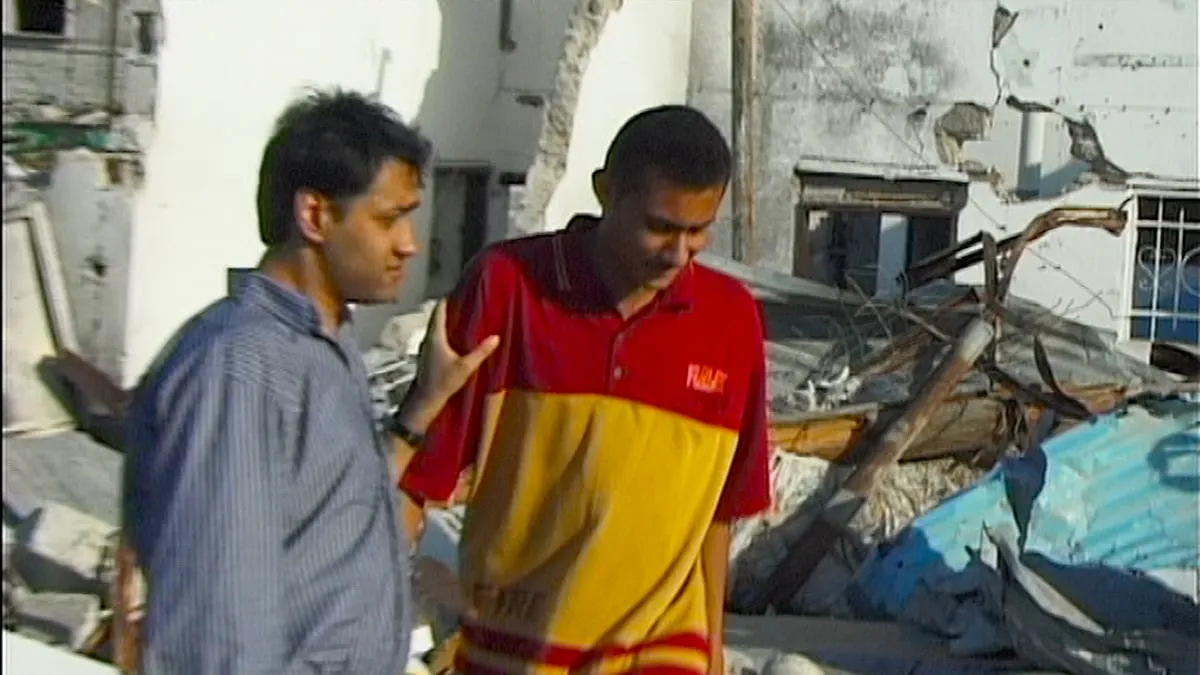
This visual language is central to the film’s purpose. The project is presented as “the first film I never made,” a declaration that deliberately subverts the conventions of documentary filmmaking. It rejects a clean narrative arc for something more honest and unsettling. The story has no neat resolution because the reality it depicts has none. Its fragmented structure mirrors the broken reality of its subjects.
The sound design follows this principle, relying almost entirely on the sounds of the environment. We hear the chatter of markets and the music from a car radio, creating a vivid sense of place. This auditory peace is shattered by the sudden crack of gunfire or the boom of a distant explosion.
The casual expertise of the guide, who can identify munitions simply by their sound, is one ofthe film’s most chilling details. That knowledge speaks volumes about the grim normality of life there. The sparse, dissonant score whispers underneath, enhancing the atmosphere of deep unease without overpowering the raw truth of the scenes.
The Same Story, A Different Decade
The film’s greatest contribution is its powerful illustration of a perpetual crisis. It stands as a cultural artifact that quietly dismantles the idea that the devastation in Gaza is a recent phenomenon. Aljafari layers timelines of suffering: his search for a friend from the First Intifada of 1989 takes place during the Second Intifada of 2001, all viewed from the vantage point of today.

The film argues that this is a cycle, a long story of attrition. We see this in the small details of life. A scene in a barber’s shop becomes a small theater of resilience. Men gather and joke with a sense of grim acceptance about being unemployed, their humor a clear coping mechanism. One man asks the director to film his bald head and make it look good, a moment of levity that underscores the profound lack of control they have over their larger circumstances.
Another poignant scene unfolds on a beach, where a father, recently released from prison, tries to reclaim lost years with his children. His effort to provide a moment of normal childhood joy is a small act of defiance against the surrounding conflict. These moments are woven into a landscape of economic decay, seen in the shuttered shops and talk of financial hardship.
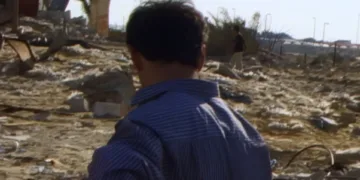
This pressure exists alongside the more overt violence. We are shown a home torn apart by shelling and walk through the rubble of other destroyed buildings. The fear is palpable; some residents worry Aljafari’s camera might be mistaken for a weapon, a detail that reveals the psychological weight of constant surveillance and suspicion. One man’s statement that “this is not a life” hangs in the air, capturing a decades-long state of exhaustion and entrapment.
What the Camera Cannot See
The film’s emotional weight comes from what remains unseen and unsaid. Its power accumulates in these absences. Late in the runtime, Aljafari shares a memory of his imprisonment, not through a reflective voice-over, but through stark white text on a black screen.

The choice is significant. The silence denies the viewer the comfort of a storyteller’s emotional tone and instead presents the trauma as an unadorned fact, a piece of hard data from the past. This refusal to narrate makes the experience more intense. The film’s central quest, the search for the director’s friend, is ultimately abandoned, left unresolved. This choice shifts our focus to all the other unanswered questions. What happened to Hasan, the good-natured guide who anchors the entire journey?
What became of the many children who mug for the camera, their faces bright with an excitement the viewer cannot share? Seeing their innocent, smiling faces, frozen in the year 2001, is deeply affecting. It is impossible not to wonder about their fate in the turbulent years that followed.
The unfinished film transforms into an accidental memorial. It began as a personal search for one person but becomes a document of a place and a people on the brink. Its power is in forcing us to confront the vast, silent space of the years that have passed since the camera was put away.
With Hasan In Gaza is a 2025 Palestinian documentary directed by Kamal Aljafari. It premiered in the International Competition section at the 78th Locarno Film Festival on August 7, 2025.
Full Credits
Director: Kamal Aljafari
Writers: Kamal Aljafari
Producers and Executive Producers: Kamal Aljafari (Producer), Flavia Mazzarino (Executive Producer)
Cast: Hasan Elboubou (local guide)
Director of Photography (Cinematographer): Kamal Aljafari
Editors: Kamal Aljafari
Composer: Simon Fisher-Turner, Attila Faravelli
The Review
With Hasan In Gaza
Kamal Aljafari's rediscovered footage is more than a simple document; it's a haunting piece of cinematic archaeology. With Hasan In Gaza uses its raw, unfinished form to powerful effect, arguing that the hardships of Gaza are part of a long, repeating history. The film's true strength lies in the questions it leaves behind about the people who filled its frames two decades ago. It's a challenging, essential film that serves as both a historical record and a poignant memorial, defined as much by what is shown as by what is now lost.
PROS
- A powerful and authentic use of raw, archival footage.
- Effectively illustrates the long-standing, cyclical nature of the conflict.
- The "unfinished" structure is a bold and meaningful narrative choice.
- Creates a profound emotional impact through its focus on the unknown fates of its subjects.
- Serves as a vital historical document of a specific time and place.
CONS
- The unpolished, handheld camerawork may be disorienting for some viewers.
- Its fragmented, non-linear style could be challenging for those expecting a conventional story.
- The subject matter is emotionally taxing and relentlessly bleak.