


























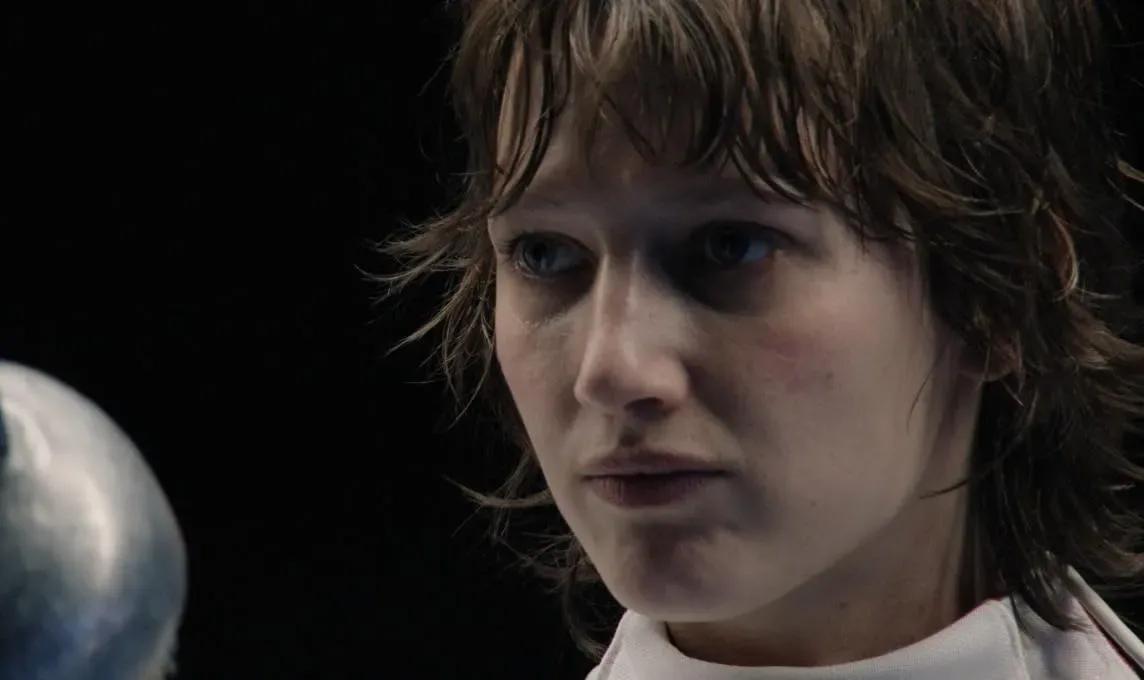

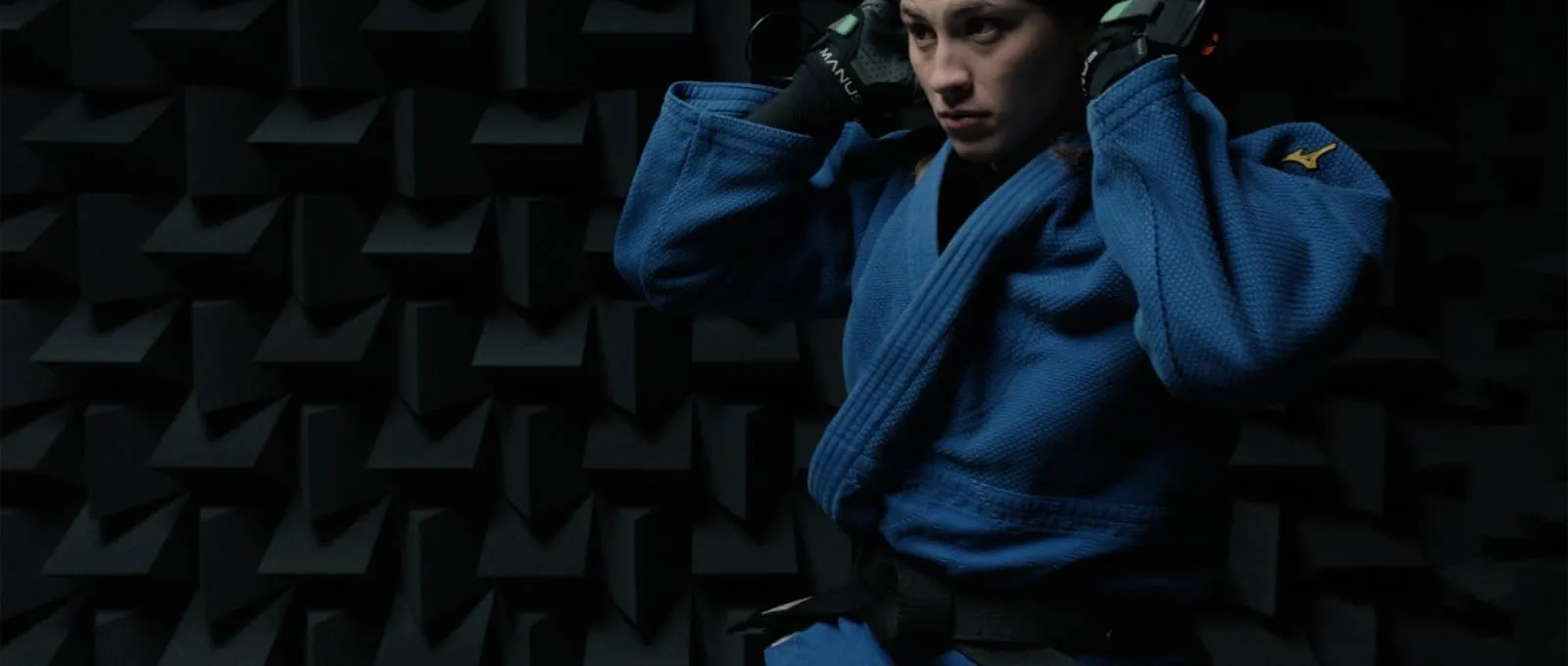
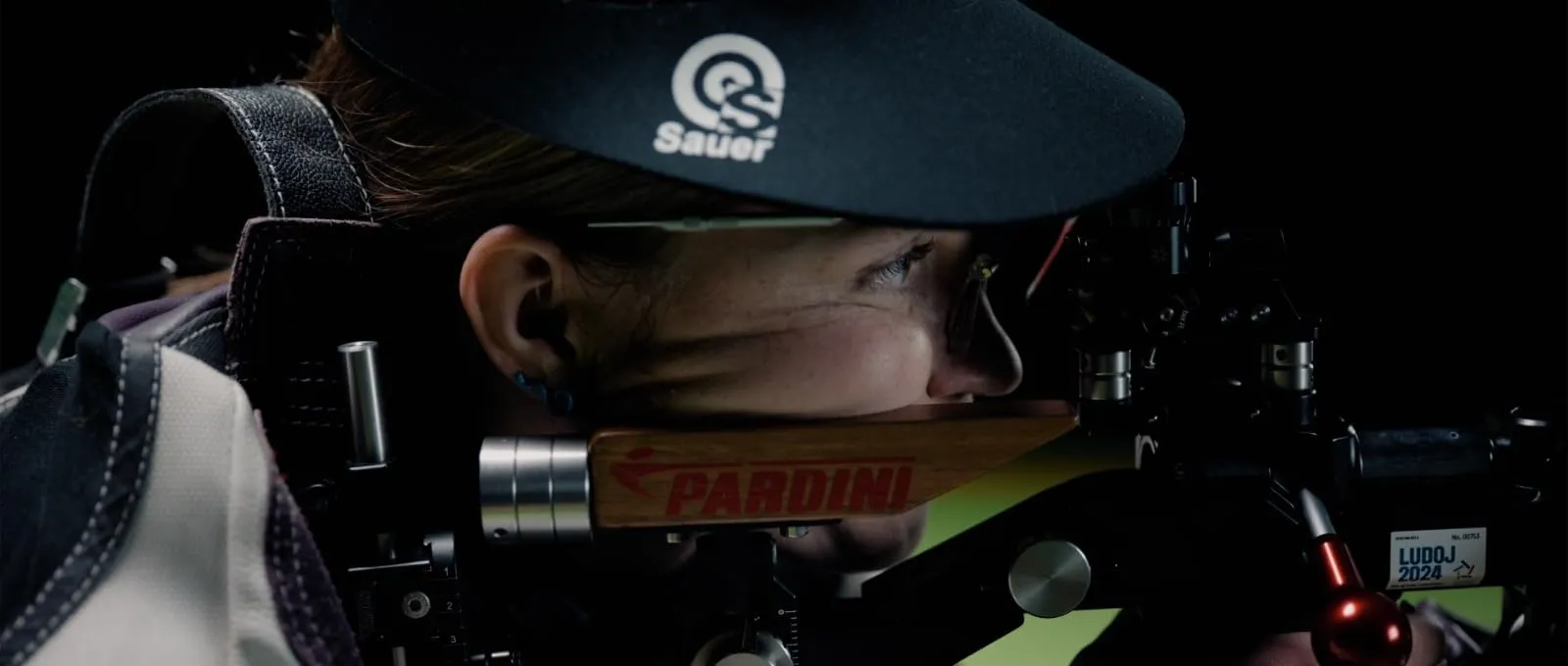
Giulio Bertelli’s debut feature, Agon, is a sports drama that strips away the genre’s familiar triumphalism. The film follows three athletes competing at a fictional global tournament, Ludoj 2024: the fencer Giovanna Falconetti, judoka Alice Bellandi, and rifle shooter Alex Sokolov. Their chosen disciplines are rooted in the violence of dueling, self-defense, and war, a history that hangs over their sterile, futuristic competition.
The title itself comes from the Ancient Greek for contest or struggle, signaling the film’s true focus. It is not about winning medals but about the perpetual internal and external battle that defines the life of a modern elite athlete. Bertelli presents a cerebral and unflinching examination of the immense psychological weight of competition, offering a perspective that feels both alien and intensely immediate.
A Symphony of Alienation
The film’s power comes from its distinctive technical construction. Bertelli and cinematographer Mauro Chiarello create an unsettling mood through a visual and auditory landscape of profound isolation. The color palette is dominated by cold blues, blacks, and institutional greys, rendering arenas and hotel rooms as clinical, soulless spaces where human warmth seems to have been systematically removed.
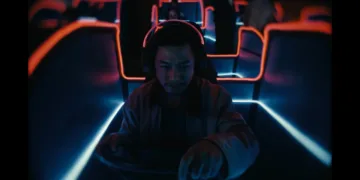
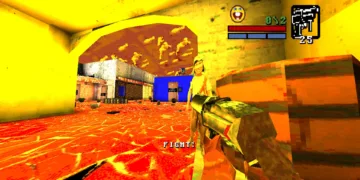
The visual language is intentionally fragmented, weaving together disparate formats to mirror a fractured modern consciousness. Sharply composed, almost painterly cinematic shots give way to the raw immediacy of blurry smartphone videos and the detached, procedural logic of first-person shooter games.
This hybrid aesthetic is not merely a stylistic flourish; it communicates the disjointed reality of the athletes, whose lives are mediated through countless screens. The contrast between a meticulously framed shot of a fencer’s form and a pixelated clip of a viral video suggests a consciousness split between the physical self and the digital ghost.
The editing reinforces this disorientation with its non-linear cuts, preventing any sense of narrative comfort or flow. We are thrown between moments of intense focus and numb distraction, forced into the same dislocated headspace as the protagonists.
Tom Wheatley’s sound design completes the effect. Dialogue is sparse and often submerged beneath an oppressive quiet. The familiar sounds of a sporting event are replaced by a menacing, low-pitched score that acts as a constant, oppressive weight—the sonic equivalent of pure anxiety. This intentional hollowness creates a vacuum where the internal pressure on the athletes becomes the loudest thing in the film.
The Depleted Self
Agon moves beyond the spectacle of sport to deconstruct the identity of the athlete. The narrative prioritizes moments of failure and private struggle, showing how these women handle personal shortcomings within a system that only recognizes victory.
The film suggests that athletes exist in a kind of “fugue state,” a psychological condition where their hyper-focus on performance renders the rest of their world unreal and indistinct. This is not simple distraction but a necessary disassociation required to endure the extreme repetition and physical pain of their training.
We see them move through their lives with a profound detachment, whether consuming fast food with mechanical efficiency or finding fleeting stimulation in violent video games and anonymous online pornography. These are not signs of character flaws but symptoms of a life stripped of normal sensation. This theme of exploitation is made explicit through the tournament’s name.
“Ludoj,” the Esperanto word for “goafs,” refers to the empty sections of a mine after the mineral has been extracted. The film presents its athletes in a similar light: their youth, bodies, and talent are resources being mined by a system, overseen by menacing male authority figures, that will leave them depleted.
The power dynamic is clear in the quiet, controlling gestures of coaches and officials, who treat the women’s bodies as instruments to be fine-tuned, medicated, and pushed past their limits. Technology amplifies this process, as their identities become blurred by viral videos and virtual avatars, turning the body into a machine to be optimized, injured, and repaired without sentiment.
The Unknowable Champion
The film’s impact is cemented by its emotionally reserved tone and unconventional performances. The three leads are deliberately muted, their portrayals defined by suppression. They communicate years of discipline and sacrifice through a deep-seated restraint that makes small gestures feel monumental.
Real-world judo champion Alice Bellandi is particularly effective, playing a fictionalized version of herself. Her authenticity is undeniable; she does not act the part of an athlete so much as she embodies the physical and mental toll of that existence. The exhaustion in her eyes and the tension in her posture carry a history that a trained actor could only imitate.
This creates a fascinating dynamic, placing her lived-in reality alongside the more polished, melancholic performances of Yile Vianello and Sofija Zobina. Bertelli maintains a deliberate distance from his subjects, asking the audience to observe them as specimens within a pressurized system rather than as characters to root for.
This apparent coldness is a form of artistic respect, refusing to reduce their complex lives to a simple, sentimental story. The fragmented structure and abrupt ending deny any easy resolution. There is no final victory or defeat, only the continuation of the struggle. Agon is an ambitious and aesthetically precise work that offers a demanding look at sports, valuing intellectual inquiry over emotional release.
Full Credits
Director: Giulio Bertelli
Writers: Giulio Bertelli
Producers and Executive Producers: Giulio Bertelli, Max Brun, Jules Daly, Joe Anton, Stella Rossa Savino
Cast: Yile Yara Vianello, Alice Bellandi, Sofjia Zobina, Michela Cescon, Francesco Acquaroli, Chiara Caselli
Director of Photography: Mauro Chiarello
Editors: Tommaso Gallone, Francesco Roma, Giulio Bertelli
Composer: Tom Wheatley
The Review
Agon
Agon is a challenging and aesthetically precise film that forgoes emotional catharsis for a cold, intellectual examination of the modern athlete. Its fragmented style and emotional distance are deliberate choices that create a powerful, alienating experience. This is a demanding piece of cinema that offers a haunting look at the psychological cost of competition.
PROS
- The film's technical construction creates a unique and immersive atmosphere.
- It offers a deep, critical perspective on failure, exploitation, and the psychology of elite sports.
- Real-life champion Alice Bellandi brings a raw, undeniable authenticity to her role.
- It provides a refreshing, unconventional alternative to the standard sports drama.
CONS
- The film's cerebral and aloof approach may prevent some viewers from connecting with the characters.
- Its fragmented, non-linear narrative can be disorienting and challenging to follow.
- The lack of a conventional resolution may leave some feeling the story is incomplete.