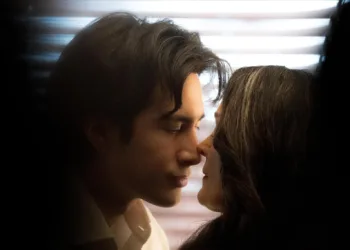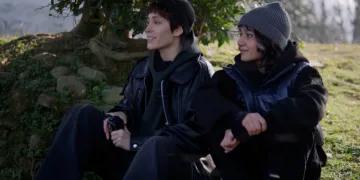























Between Dreams and Hope introduces us to Azad and Nora, a couple whose love is the quiet center of their life in Tehran. Their small apartment, filled with books and warm light, serves as a sanctuary from a world that doesn’t fully accept them. The film quickly establishes its central, heart-wrenching conflict.
Azad is a trans man who needs his estranged father’s signature to complete his gender-affirming surgery. This single piece of paper is the barrier between the life he has and the future he needs. His father represents a traditional, rural world Azad has worked hard to escape.
The story presents Azad with a difficult choice. He can either wait indefinitely in a painful limbo or return to the source of his trauma to confront the man who cast him out. This decision hangs over every tender moment he shares with Nora, setting the stage for a story about the high price of authenticity.
When a Love Story Becomes a Thriller
The film’s first act unspools with the patient, observational rhythm of European independent cinema, asking the audience to simply exist with its characters. For nearly 40 minutes, it operates as a “hangout” film, building its foundation on small, authentic moments: Azad and Nora rehearsing a dramatic reading of “Romeo & Juliet” with friends, a gathering that subtly doubles as Azad’s proposal to Nora.
This deliberate pacing is a significant investment. It grounds their relationship in a reality so tangible that their love becomes the film’s undeniable center of gravity. When Azad finally makes the trip to his family’s village, the movie executes a stunning tonal pivot. The intimate drama abruptly gives way to a suspense thriller.
The warm, supportive atmosphere of their Tehran community is replaced by the cold, judgmental silence of the countryside. The hostility from his father is a stone wall of tradition, while his older brother’s aggression is a constant physical threat. After Azad vanishes during a solo visit to the farm, the film’s structure completely transforms.
The narrative lens shifts to Nora, trapping us inside her frantic search and rising panic. The back half is a tense, suffocating mystery, with Nora’s repeated questions met with dismissive answers and veiled threats, making the personal stakes feel immediate and terrifying.
A Camera That Never Blinks
The film’s emotional core is anchored by the tremendous, naturalistic performances from Fereshteh Hosseini (Azad) and Sadaf Asgari (Nora). Their on-screen chemistry feels less like acting and more like a private world we’ve been allowed to witness. Hosseini carries the weight of Azad’s exhaustion and quiet determination in his posture, while Asgari’s portrayal of Nora moves from gentle support to a fierce, protective resolve that is captivating to watch.
Director Farnoosh Samadi makes bold stylistic choices that amplify this realism. Her prevalent use of long, uninterrupted takes is a challenging but effective technique. It refuses to let the viewer or the characters off the hook, forcing us to remain present in moments of extreme discomfort or profound intimacy.
There’s no escape through a quick cut. This approach can test an audience’s patience, but here it serves to heighten the tension, especially during Nora’s agonizing wait for information. Instead of conventional shot-reverse-shot coverage, the camera often pans sharply between speakers, creating a frantic, whiplash effect during arguments that mirrors the characters’ emotional state.
This, combined with the use of deep, naturalistic lighting that often lets shadows swallow the frame, cultivates an atmosphere of genuine claustrophobia and makes the film a visceral, immersive experience.
The Quiet Politics of Survival
At its heart, Between Dreams and Hope explores the potent friction between progress and tradition, a theme crystallized in the film’s urban-versus-rural divide. The accepting, vibrant queer community in Tehran is a stark contrast to the rigid patriarchy of Azad’s family home. This is more than a geographical difference; it is a conflict of ideologies.

The film presents Azad and Nora’s fight for their future not just as a personal struggle but as an act of quiet defiance. Their decision to remain in Iran, to carve out a space for their love in a place that is hostile to it, is a powerful statement. It refutes the idea that escape is the only path to freedom.
The scenes with their friends are crucial, showcasing queer joy as a form of resistance and solidarity as a tool for survival. This found family provides the emotional sustenance needed to face an unforgiving world. The film’s final act lands with a profound emotional weight, especially for anyone who has known the specific pain of familial rejection.
Its closing image, of the couple floating in the sea, is not a simple, happy ending. It’s a beautifully rendered portrait of endurance, a moment of hard-won peace that suggests hope is not about the absence of struggle, but the ability to stay afloat.
Between Dreams and Hope premiered in September 2025 at the Toronto International Film Festival (TIFF) as part of its Platform program. It does not appear to have a wider release or be available for streaming at this time.
Full Credits
Director: Farnoosh Samadi
Writers: Farnoosh Samadi
Producers: Ebrahim Amerian, Navid Mohammadzadeh
Executive Producer: Hanif Soroori
Cast: Fereshteh Hosseini, Sadaf Asgari, Hooman Rahnemoon, Amirreza Ranjbaran, Reza Amoozad, Kiarash Rezaei, Amirreza Jokar
Director of Photography: Salar Ardestani
Editors: Farnoosh Samadi
The Review
Between Dreams and Hope
Between Dreams and Hope is a masterfully crafted film that blends a tender love story with a high-stakes thriller. Anchored by two stunning lead performances, its power lies in the raw intimacy created by director Farnoosh Samadi’s bold, unflinching long takes. While its deliberate pacing may challenge some, the emotional payoff is immense. This is a deeply affecting and important story about the fight for one's identity and the quiet politics of survival.
PROS
- Powerful lead performances with authentic, deeply felt chemistry.
- A successful and impactful shift in tone from intimate drama to suspenseful thriller.
- Bold, immersive direction and camerawork that create a raw sense of realism.
- A meaningful and emotionally resonant story about queer resilience and defiance.
CONS
- The deliberate pacing of the first act may feel slow to some viewers.
- The long-take, observational cinematic style can be challenging.
- The thriller elements, while tense, could have been developed even further for a sharper impact.