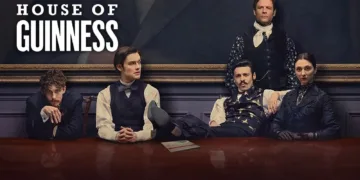


























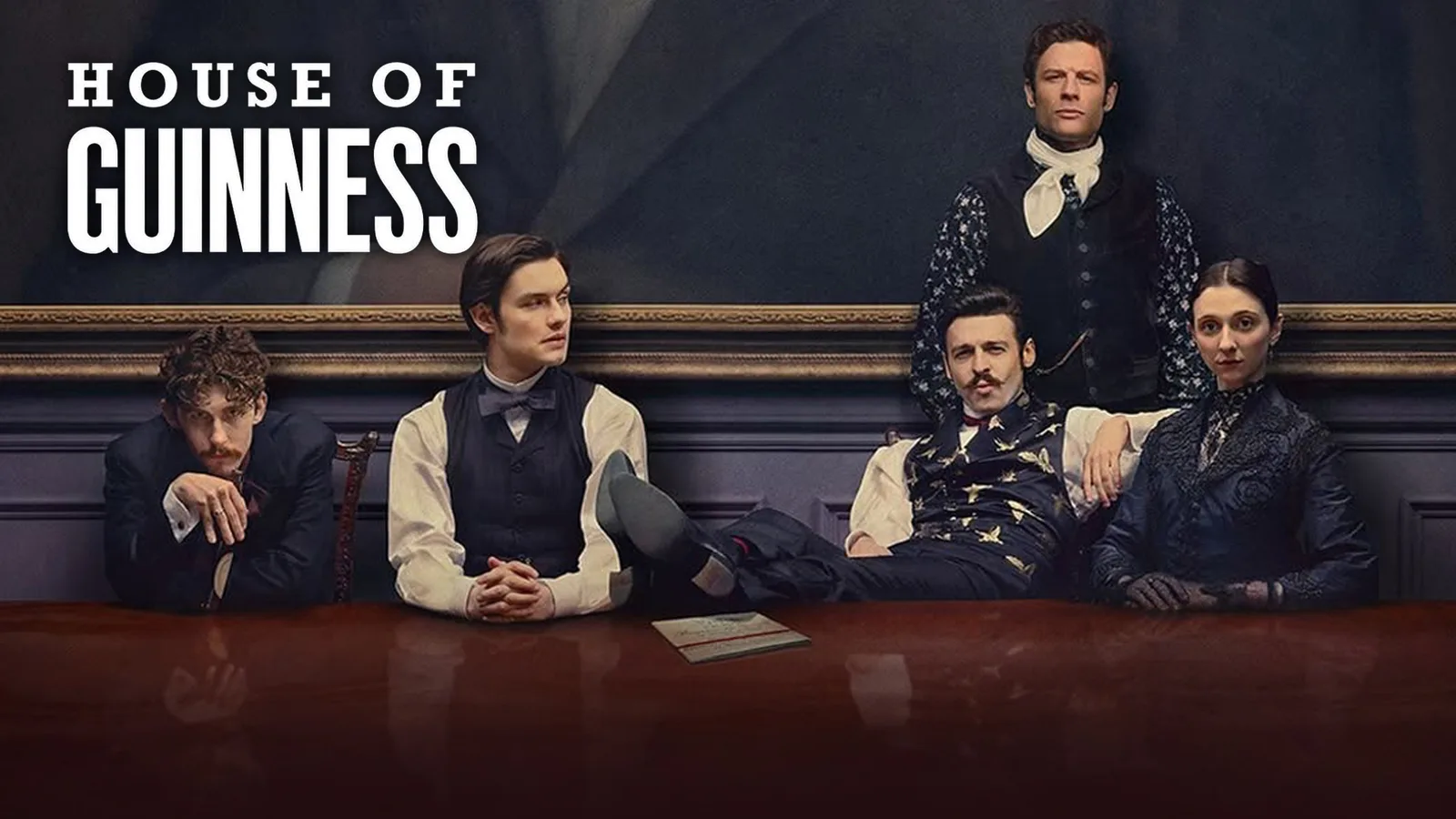

The funeral of a great man often marks the end of an era. For Sir Benjamin Guinness in the Dublin of 1868, his somber procession through streets simmering with resentment is something else entirely. It is the gunshot that starts a race. As bottles fly and hired muscle swings back, we witness not a conclusion but the volatile ignition of a new chapter for a family and its empire of black stout.
Creator Steven Knight’s House of Guinness chronicles the fortunes of the heirs left in the wake of this patriarchal titan. It presents a fictionalized saga of ambition and secrets set against the historical canvas of post-famine Ireland’s yearning for independence.
The narrative is lit by the fuse of the patriarch’s will, a document that forces an uneasy alliance between his sons while casting his other children aside. This inheritance (perhaps the cruelest form of family therapy) becomes the catalyst for power struggles within the family and conflicts with a society that views the Guinness name with a toxic mix of awe and animosity.
Heirs Apparent and Transparent
The architecture of the Guinness family conflict rests on the two brothers contractually bound to one another. Arthur Guinness, played by Anthony Boyle with a nerve-wracked defiance, is the poet-prince trapped in the body of a future CEO. As the eldest son, he is the designated heir, yet his entire being rebels against the crude mechanics of commerce and the suffocating mantle of public life. His time in London has cultivated an aesthetic sensibility that finds Dublin’s industrial grime and rigid piety unbearable.
His homosexuality is the narrative’s most potent symbol of this alienation. It is not just a personal secret creating plot tension; it is a metaphor for the profound hypocrisy required to maintain the respectable facade of the family name. He must project an image of unimpeachable Protestant virility while his true self lives in the shadows. His torment is the system’s cruelty made flesh.
In the other corner stands Edward (Louis Partridge), the pragmatist. He is the younger brother blessed with the ambition and business acumen his older sibling so conspicuously lacks. Edward’s story is a study in the moral calculus of the sensible man. He wants to modernize, to expand, to secure the future, but his every rational decision is a small compromise with a world built on exploitation. His ambition is a hunger for legitimacy, a deep-seated need to prove he is more than the spare part. His perilous romance with a revolutionary firebrand serves as the story’s central dialectic, pitting his controlled, ordered world of assets and ledgers against the chaotic, passionate force of ideology.
The siblings sidelined by the will provide the story with its moral texture. Anne (Emily Fairn) is more than the family’s pious heart; her philanthropy is a complex performance of power. It is an act of genuine compassion, yet it is also the only way a woman of her station can exert control, shaping the city in a way her brothers do with capital. Her charity work functions as a form of reputational laundering, absolving the family’s name with one hand while the other continues to profit from the system creating the squalor.
Her brother Benjamin (Fionn O’Shea) is the family’s living memento mori. He is the void at the center of the opulence, a man for whom wealth without struggle has created a vacuum that alcohol and gambling rush in to fill. He is the embodiment of the hereditary curse, proof that a legacy can be a poison as much as a gift. This is the show’s core thesis on privilege: a gilded tragedy where the characters are prisoners of the very inheritance they are meant to protect. They are a 19th-century case study in the psychological burden of being born at the finish line.
History Through a Hip-Hop Lens
The series distinguishes itself not through its plot, which follows the familiar beats of the dynastic saga, but through its aggressive presentation. Knight’s direction has a signature swagger, a kind of aesthetic bravado that refuses the dusty reverence of typical period pieces. He employs slow-motion not just for stylistic effect but as a tool of mythologization. A brutal fistfight is rendered as a grotesque ballet; a character’s entrance through smoke and fire becomes a form of visual canonization.

The editing is often frenetic, with sharp cuts and jarring transitions that mirror the turbulent energy of the era and the fractured psyches of its characters. This is history presented with the restless energy of a modern thriller. The production design grounds this kinetic style, meticulously crafting a Dublin of breathtaking manors and oppressive slums, a world of both beauty and decay.
The most potent element of this stylistic cocktail is the anachronistic soundtrack. Deploying the searing protest music of modern Irish artists like Kneapcap is a deliberate act of historical re-contextualization. It shatters the viewer’s sense of safe historical distance, forcing a connection between the 19th-century Fenian and the 21st-century rapper. This sonic choice collapses time, suggesting that the struggles against power, the assertion of cultural identity, and the righteous anger of the marginalized are a constant, repeating rhythm. It makes the past feel immediate, dangerous, and alive.
The show essentially manufactures a version of the 19th century that is meant to be felt viscerally rather than passively observed. Its opening disclaimer about being a work of fiction is a declaration of intent. It seeks to create an atmosphere, a sensory experience. It is history as a mood, a high-end theme park where the attractions are emotional turmoil and political intrigue.
The Supporting Pillars and Political Fires
The personal squabbles of the Guinnesses are perpetually inflamed by the wider world. The family business operates as an island of Protestant, unionist power within a raging sea of Irish Catholic nationalism. The Fenian movement, gaining momentum in the show’s timeline, views the brewery as a potent symbol of the Anglo-Irish ascendancy. The company is both a massive employer and a representation of the economic forces propping up British rule, a paradox that places the family in a precarious position. They are simultaneously the city’s benefactors and its antagonists.

This external pressure is personified by a constellation of supporting characters. Sean Rafferty (James Norton) is the physical manifestation of the family’s will, the brutal id that handles the dirty work, allowing the genteel ego of the Guinness siblings to remain pristine. His loyalty is not to a person but to the institution, the brand.
Ellen Cochrane (Niamh McCormack) represents the opposite pole: pure ideology. She is a dedicated revolutionary whose ideals are tested and complicated when she forms a human connection with the very symbol of her opposition. Her arc is a microcosm of the fraught relationship between the Irish populace and the ruling class.
Two other figures are particularly effective at disrupting the family’s hermetic world. Lady Olivia Hedges (Danielle Galligan), Arthur’s wife by arrangement, is a brilliant pragmatist. She approaches her marriage as a business merger, carving out her own sphere of freedom and influence within its rigid constraints. She represents a strikingly modern form of agency. In contrast, Byron Hedges (Jack Gleeson) is an agent of pure chaos. As an illegitimate cousin, he is the family’s repressed history returning to the surface, a grinning trickster determined to connive his way into a fortune he feels he is owed.
A Fine Vintage with a Flat Finish
The series succeeds most when it fully embraces its operatic sensibilities, staging powerful confrontations in boardrooms and clandestine passions in back alleys. Its early episodes move with a thrilling momentum, efficiently setting the table for the sprawling conflict. The lead performances are uniformly excellent, providing a crucial human anchor when the script itself occasionally falters. The actors find the pain and pathos beneath the swagger and the silk.
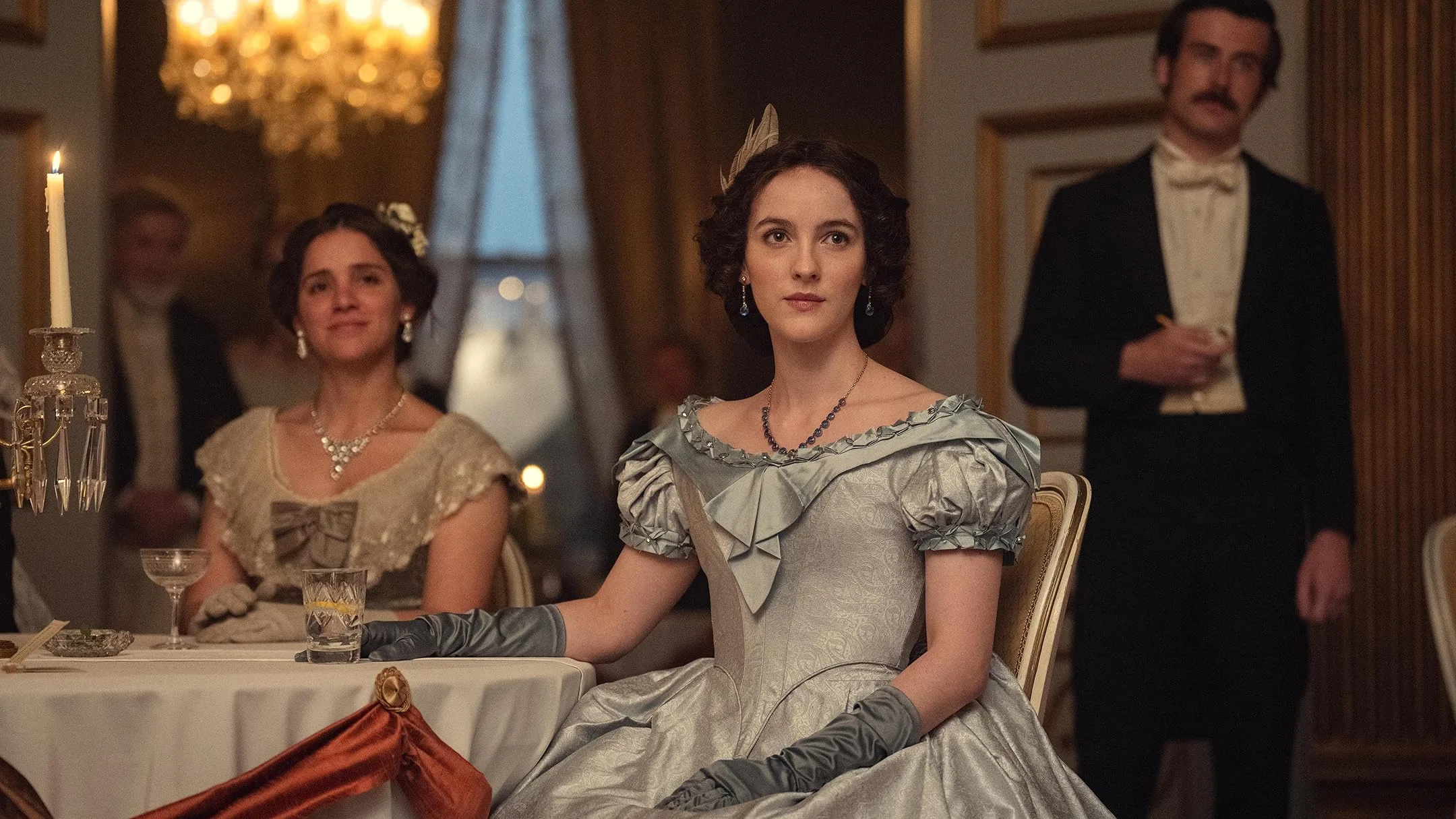
Yet for all its intoxicating energy, the narrative begins to sputter in its second half. The pacing grows uneven, and certain plotlines circle back on themselves, becoming repetitive. The character arcs for Anne and Benjamin, so promising at the start, are serviced inconsistently, with major developments seemingly taking place off-screen between episodes.
There is a sense of a missed opportunity, too, in the way the show gradually softens its protagonists. It shies away from a more severe critique of their complicity in a system of profound inequality, opting for sympathetic melodrama over a sharper social commentary. It remains an addictive watch, a testament to its style and the strength of its core conflicts. But like a pint poured too slowly, it loses some of its head by the end.
House of Guinness is a period drama created by Steven Knight. Set in 19th-century Dublin and New York, the story begins immediately after the death of Sir Benjamin Guinness, the patriarch responsible for the immense success of the Guinness brewery. The eight-part series premiered on September 25, 2025, and is available to stream exclusively on Netflix.
Full Credits
Director: Tom Shankland, Mounia Akl
Writers: Steven Knight
Producers and Executive Producers: Steven Knight, Tom Shankland, Karen Wilson, Elinor Day, Martin Haines, Ivana Lowell, Cahal Bannon, Howard Burch
Cast: Anthony Boyle, Louis Partridge, Emily Fairn, Fionn O’Shea, James Norton, Niamh McCormack, Seamus O’Hara, Michael McElhatton, Dervla Kirwan, Jack Gleeson, Ann Skelly, Danielle Galligan, David Wilmot
Director of Photography (Cinematographer): Joe Saade, Nicolai Brüel
Editors: Sarah Peczek, Ben Yeates, Malcolm Crowe, Vicky Tooms
Composer: Ilan Eshkeri
The Review
House of Guinness
House of Guinness is a visually arresting and stylishly executed saga, powered by strong performances and a potent modern energy. While its initial episodes are potent, the narrative momentum wanes, hampered by uneven pacing and a reluctance to explore the grittier implications of its characters' immense privilege. It’s a beautifully crafted drama that chooses entertaining melodrama over a more profound critique, making for a rich, if ultimately frothy, historical brew.
PROS
- Distinctive, modern visual style and direction.
- An energetic soundtrack that re-contextualizes the historical setting.
- Strong, committed performances from the entire ensemble cast.
- A potent and well-established premise in its opening episodes.
CONS
- Narrative pacing becomes repetitive and sluggish in the season’s second half.
- Key secondary character arcs feel inconsistent or underdeveloped.
- Pulls its punches, softening its critique of wealth and power.
- Some romantic subplots feel driven by plot mechanics.