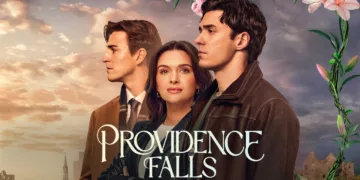















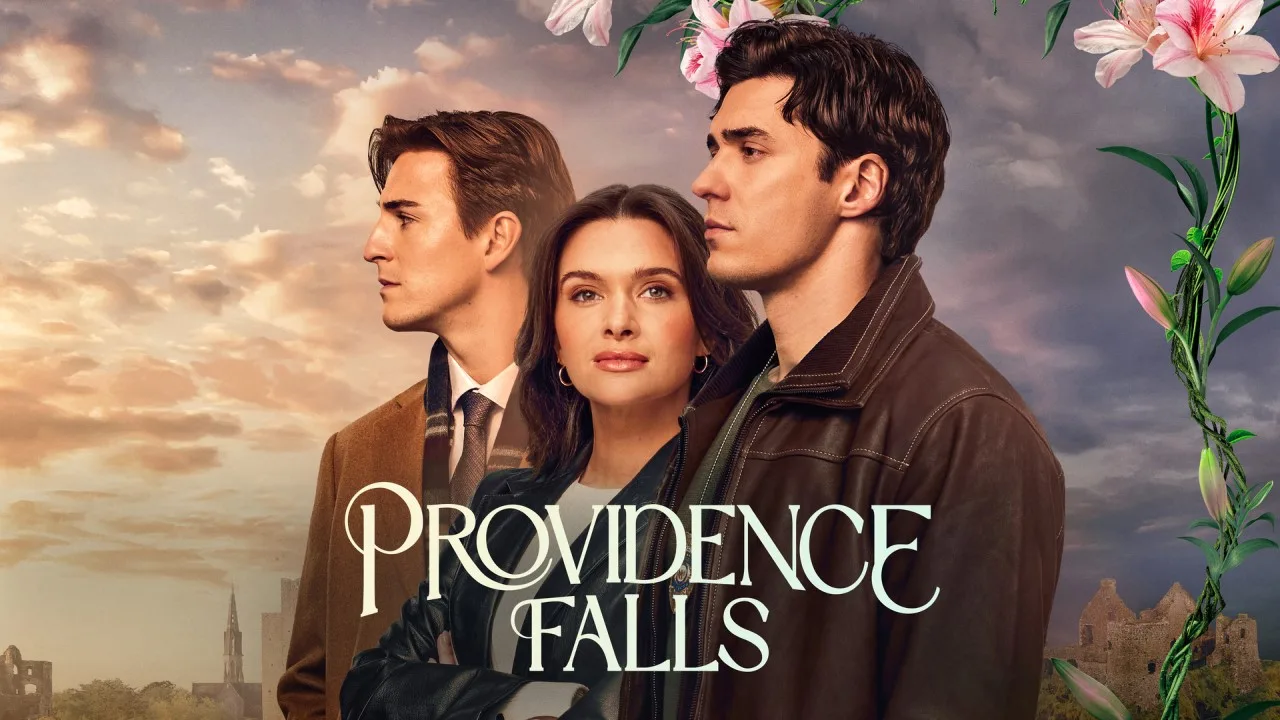

Narratives of American identity are often built upon imported histories, retooling the romanticism of an older world to explore modern anxieties. The pastoral tragedy of 19th-century Ireland, in particular, serves as a potent cultural backdrop for tales of fated love and inescapable loss. Providence Falls uses this very tradition as its foundational myth. The story begins with Liam O’Connor, a charming Irish thief whose life, and love for the aristocratic Cora McLeod, ended in disaster.
Two hundred years later, he is pulled from a state of celestial limbo and given a directive from the universe’s overseers. He must return to the mortal world, where Cora has been reincarnated as a police detective in a small Oregon town. His task is not to reunite with her, but to orchestrate her romance with Finn Walsh, the man designated as her true soulmate.
Liam’s own salvation hangs in the balance; success promises heavenly peace, while failure to suppress his old affections means eternal ruin for both him and Cora. The mission’s design becomes almost cruel when he is placed directly in her path as her new partner on the force, forcing a daily confrontation with a love he is forbidden to acknowledge.
The Transatlantic Mirror
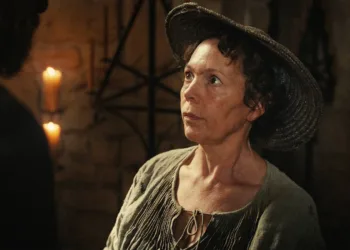
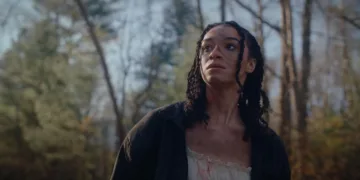
The film’s structure is a constant dialogue between two culturally and aesthetically distinct worlds. The flashbacks to 1844 Ireland present a specific vision of the past, one defined by misty landscapes, the harsh realities of class division, and a love affair made intense by its forbidden nature. This is a world governed by rigid social codes, where Cora is an object of patriarchal ownership, and Liam is a figure of romantic rebellion.
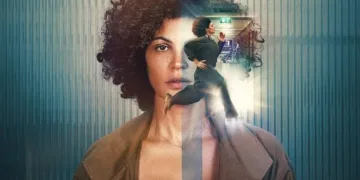
It is this historical context that creates the initial tragedy. In sharp contrast, the present-day setting of Providence Falls, Oregon, operates within the clean, logical confines of an American police procedural. Life here is ordered by case files, evidence, and the rule of law. The contemporary Cora is a figure of agency, a professional defined by her competence.
The narrative cleverly links these two realities; the modern murder investigation Liam and Cora undertake is riddled with echoes of their past, suggesting that history is not a static memory but a recurring pattern. This connection is underscored by the visual storytelling. The soft, natural light and richly layered costumes of the Irish past are set against the sterile, fluorescent interiors of the police station, visually separating the world of myth from the world of modern reason.
Archetypes Reincarnated
The characters function as cultural archetypes given new life by a committed cast. Lachlan Quarmby’s Liam O’Connor embodies the figure of the charming Irish rogue, an archetype long present in Anglo-American fiction. Here, he is a man burdened by that history, his roguishness tempered by two centuries of regret.
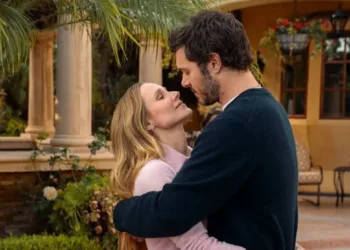
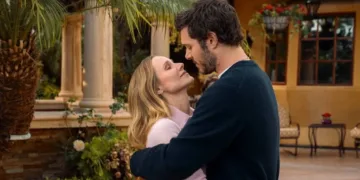
Quarmby effectively portrays this internal battle, letting deep sorrow show through a carefully maintained exterior. His palpable connection with his co-star fuels the central romantic conflict. Katie Stevens, as Cora McLeod, skillfully bridges the gap between two very different women who share one soul. Her 19th-century Cora is passionate but constrained, while her modern detective is sharp and independent.
Stevens makes the subconscious flicker of recognition Cora feels for Liam feel earned and deeply unsettling for the character. Evan Roderick portrays Finn Walsh not as a simple rival but as the embodiment of a safe, prescribed destiny. He represents the life Cora is supposed to want, a stable existence that conflicts with the chaotic pull Liam represents.
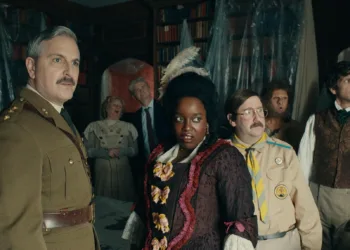
The supporting cast adds a unique bureaucratic texture to the film’s fantasy. The angel Agon (Amitai Marmorstein) and the demon Bael (Niall Matter) are less divine beings and more like cosmic case workers, agents of opposing celestial firms vying for control over human outcomes, a distinctly modern interpretation of the forces of good and evil.
Weaving Generic Threads
The trilogy’s strength lies in its confident synthesis of multiple genres. At its center is a romance, which supplies the story’s emotional power and primary stakes. Layered over this is a police procedural, a narrative engine that creates suspense and propels the plot forward through a methodical investigation.
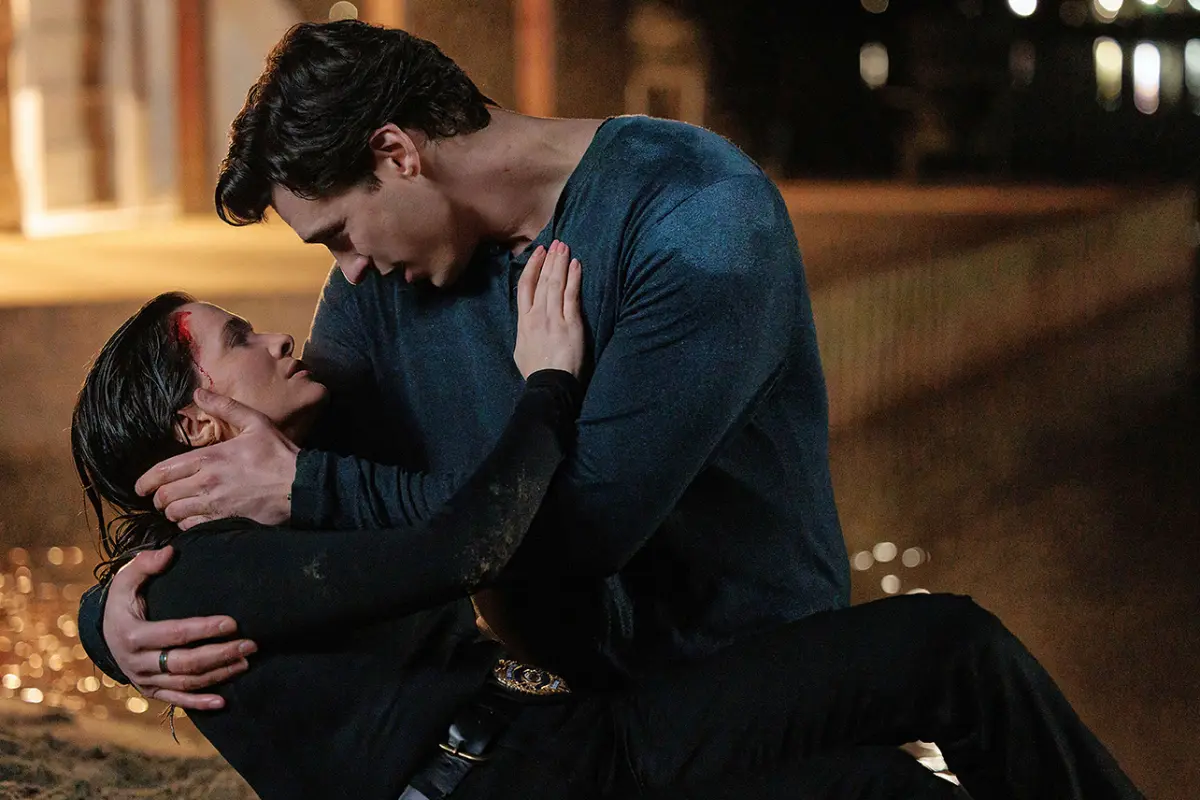
The fantasy elements, including the entire concept of reincarnation and the intervention of celestial agents, elevate the personal conflict to a cosmic scale. Finally, the period drama of the flashbacks provides an origin myth, giving the modern events a sense of historical depth and inevitability.
This combination creates a viewing experience that is varied and tonally complex. The story uses this framework to examine the tension between a predetermined fate and an individual’s free will. Is destiny an unchangeable path, or is it a script that allows for improvisation? The film leans toward the latter, framing Liam’s mission as a test of sacrifice, a core theme throughout his character arc.
The very idea of giving these souls a second chance speaks to a cultural belief in reinvention. The trilogy’s satisfying resolution does not discard its supernatural rules; instead, it finds a solution born from character choice, suggesting that true love does not break destiny but rather becomes its most authentic expression.
Providence Falls is a three-part special event mini-series that premiered on the Hallmark Channel on Saturday, August 2, 2025, as part of its “Summer Nights” programming. The series, which blends romance, mystery, and time travel, is an adaptation of the popular book trilogy by authors Jude Deveraux and Tara Sheets. It tells the story of Liam O’Conner (Lachlan Quarmby), a man whose soul has been sent back to the present day to ensure his reincarnated love, The series is available to watch on the Hallmark Channel and streams the following day on Hallmark+.
Full Credits
Director: Lucie Guest, Siobhan Devine
Writers: Jude Deveraux, Tara Sheets
Producers and Executive Producers: Alexandre Coscas, Michael R. Goldstein, JoAnna Garcia Swisher, Kate Gordon, Aidan Heatley, Matthew Santoro, Ronny Kurland, Mackenna Davies, Bob Merrick, Connor Sharpe
Cast: Katie Stevens, Lachlan Quarmby, Evan Roderick, Felicia Simone, Matty Finochio, Paul McGillion, Amitai Marmorstein, Keegan Connor Tracy, Niall Matter, Samer Salem, Fulvio Cecere, Jessica Sipos, Glen Gordon, Charlie Cavill, Shafin Karim, Benjamin Arcé, Maya O’Shea, Michelle Choi-Lee, Bola Omodara, Darcy Laurie, Mike Kovac, Bobby Stewart, EaeMya ThynGi, Jorden Birch, Suge Blanco
Director of Photography (Cinematographer): Justin Sebastian
Editors: Morgan Giroux, Cameron Sadler
The Review
Providence Falls
Anchored by strong lead performances and a script that intelligently questions destiny, the trilogy is a memorable, genre-crossing effort. Its ambitious fusion of period romance and modern procedural mostly succeeds, creating a story with emotional depth that rises above its occasional contrivances and cheesy moments. Providence Falls stands as a thoughtful exploration of love’s power to shape its own path across time.
PROS
- Strong romantic chemistry between the lead actors, Lachlan Quarmby and Katie Stevens.
- Ambitious and effective blending of romance, fantasy, and police procedural genres.
- Engaging dual-timeline structure that connects past events to the present-day mystery.
- High production values with authentic-feeling historical settings and costumes.
- A thoughtful exploration of themes like fate, free will, and sacrifice.
CONS
- Some dialogue and dramatic moments can feel cheesy or overly sentimental.
- The plot resolution in the final installment feels somewhat rushed.
- Supporting characters outside the main trio can feel underdeveloped.
- The Irish accents in the historical flashback scenes are occasionally inconsistent.