
























![Kingdom Hearts Collection [I-III] Review](https://gazettely.com/wp-content/uploads/2026/10/Kingdom-Hearts-Collection-I-III-1-360x180.webp "Kingdom Hearts Collection [I-III] Review: KHII Holds Steady as Newer Entries Fluctuate 37")




A river does not possess memory, but it is a repository of it. The silt carries the story of mountains; the currents trace the paths of least resistance carved over millennia. To film a river, then, is to engage in a form of archaeology, sifting through layers of geological time and, more recently, human consequence. Ben Masters’ The American Southwest approaches the Colorado River not as a subject for a landscape portrait but as the scene of a crime.
A slow, sprawling, continent-sized crime whose evidence is written in dry deltas and concrete monoliths. The film’s structure is that of an autopsy. It begins at the source, the moment of life in the alpine heights of the Rockies, and meticulously follows the body downstream for 1,500 miles to its man-made death near the sea. This is not the passive, observational work of a naturalist.
It is the urgent, methodical report of a coroner, presenting a case of ecocide with a funereal grandeur. The visual testimony is often overwhelmingly beautiful, yet this beauty is rendered with the cold, clear light of a procedural, making the desecration it documents all the more chilling.
A Symphony of Sight and Sound
The film’s visual syntax is built on a tense, rhythmic interplay between the colossal and the minuscule. Masters’ camera achieves a kind of omniscience, employing sweeping, god-like aerials that glide over the vast, sculptural emptiness of canyons, rendering the landscape as a form of abstract expressionism. These moments of sublime detachment are then abruptly cut with extreme macro photography that plunges the viewer into the chaotic, intricate world of the riverbed.
The effect is deliberately disorienting, manipulating our sense of scale and importance. One minute, we are giants surveying a map; the next, we are dwarfed by the percussive clicks and rustles of insect life. This visual dialectic is mirrored in the sound design, a meticulously constructed auditory field that favors verisimilitude over a musical score. The soundscape is almost confrontational in its intimacy, amplifying the textures of the wild until they become tactile.
The gurgle of water over stone, the rasp of wind on rock, the low-frequency drone of the desert—these sounds build a world that is both immersive and deeply unsettling. Anchoring this sensory experience is Quannah Chasinghorse’s narration. It is a radical departure from the patriarchal “voice of God” tradition. Her delivery is quiet, breathy, and imbued with a profound sense of personal history. It is the voice of someone speaking not about the land, but from it, transforming the film’s ecological warning into an intimate lament.
The Inhabitants: Wildlife as Storytellers
The film’s most cunning device is its transformation of wildlife into unwilling existential actors. It eschews simple biology for a kind of zoological theater, framing animal life within distinctly human narrative structures. The result is both illuminating and wryly absurd. A standout sequence follows a juvenile California condor, a creature from the brink of extinction, as it tumbles from its nest.
The ensuing struggle to climb a sheer cliff face is a masterpiece of tension, the camera isolating the clumsy bird against an indifferent vertical world. It is Sisyphus with feathers, a raw depiction of instinct battling against gravity and entropy that serves as a potent metaphor for the species’ broader plight. The film finds a different kind of drama in the courtship of Mojave rattlesnakes, which it mischievously frames as a romantic comedy, complete with a character named “Scooter.”
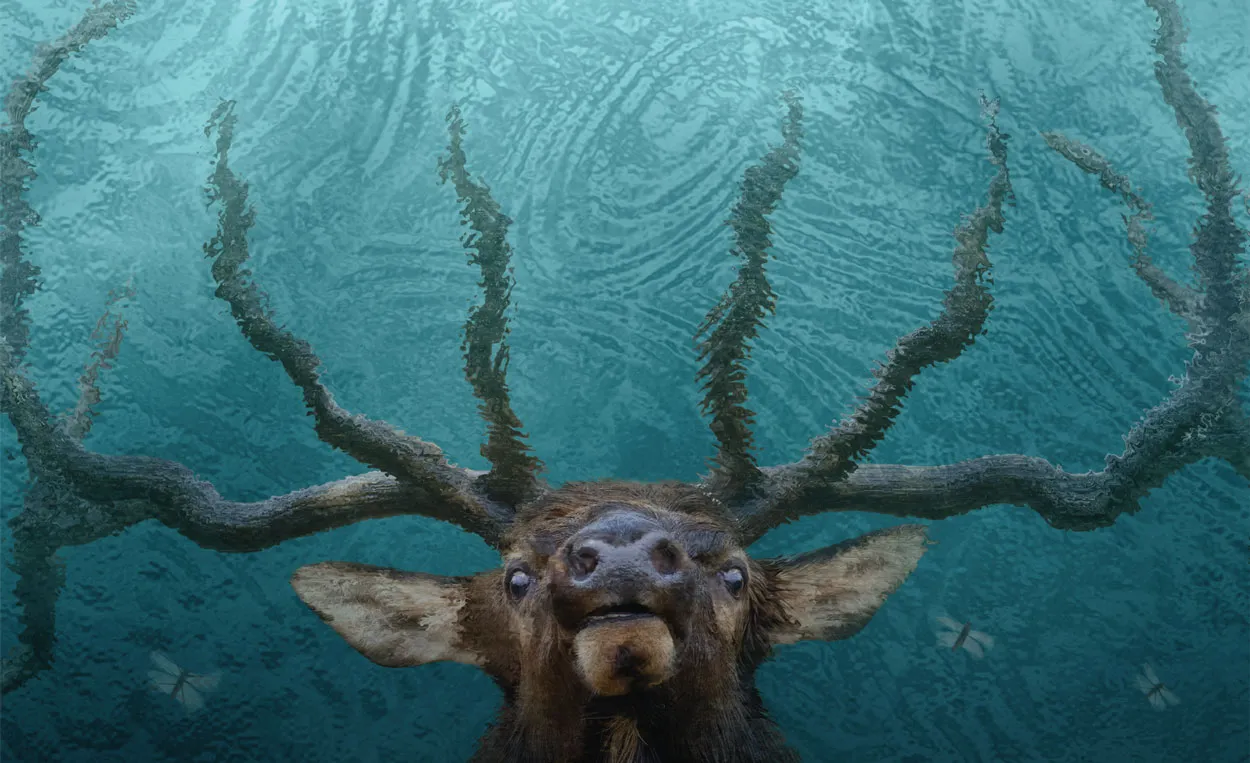
This projection of a mundane human genre onto a primal ritual is a piece of dry wit that underscores our own compulsion to domesticate the wild. Elsewhere, a territorial clash between bull elk is captured not with scientific detachment but with the chaotic choreography of a street fight. By turning these creatures into protagonists, Masters makes the stakes of their survival palpable. Their dramas are the granular, lived expression of the river’s fading life force.
The Human Imprint and a Call for Change
The film’s final movement shifts its gaze from the victims to the perpetrators, cataloging the varied brutalities of the human imprint on the land. The great dams are not presented as marvels of engineering but as monuments to hubris, concrete plugs in the continent’s arteries.
The southern border wall is rendered as an act of brute-force geographical revisionism, a steel curtain dropped with clinical indifference to the deep time of animal migration. The camera lingers on the desecrated walls of Indigenous sacred sites, their ancient petroglyphs scarred by bullet holes. This is not just vandalism; it is a violence against memory itself, an attempt to erase a history that predates the conqueror.
Masters’ project is transparently a work of cinematic jurisprudence. It refuses the comfort of neutral observation, functioning instead as an “impact campaign” that presents its case directly to the court of public opinion. The film’s argument is timed with prosecutorial precision, arriving just before the 2026 renegotiation of the byzantine “Law of the River.” It is a closing statement, an eloquent and visually irrefutable appeal for an ecosystem on trial, demanding that the verdict be life.
The American Southwest had its domestic release on September 5, 2025. Distributed by Fin & Fur Films, the film is narrated by land protector and fashion model Quannah Chasinghorse and chronicles an adventurous journey down the Colorado River. It highlights the region’s abundant wildlife and cultural history while confronting the critical ecological impacts of dams and river depletion across the American Southwest. Details on where it can be streamed or rented after its theatrical release are not yet available.
Full Credits
Director: Ben Masters
Writers: Ben Masters
Producers and Executive Producers: Katy Baldock, Len Necefer, Ryan Olinger
Cast: Quannah Chasinghorse, Jim Enote, Mary Kelly, Peter McBride, Weston McCool, Jody Potts-Joseph, Wes Sechrest
Director of Photography (Cinematographer): Austin Alvarado, Isaiah Branch-Boyle, Alan Clampitt, Skip Hobbie, Len Necefer, Ryan Olinger, Patrick Thrash
Editors: Sam Klatt, Izzy AbuHamad, Will Clark, Falcon Keller, Chet Stefan, Alex Winker
Composer: Noah Sorota
The Review
The American Southwest
The American Southwest is a work of staggering beauty and profound disturbance. It functions less as a nature documentary and more as a meticulously crafted eulogy for a dying ecosystem. Through its breathtaking cinematography and hauntingly intimate narration, the film presents an irrefutable case against human hubris. It is a visually magnificent, emotionally unsettling, and essential piece of cinematic advocacy that captures both the sublime grandeur of a landscape and the chilling finality of its destruction. This is urgent, vital filmmaking.
PROS
- Visually stunning cinematography that masterfully captures both epic scale and intimate detail.
- Immersive and hyper-realistic sound design that connects the viewer directly to the environment.
- A powerful, unconventional narrative that frames the story as an urgent ecological investigation.
- Compelling wildlife vignettes that create personal, character-driven stakes.
- An unapologetic and timely call to action that gives the film profound relevance.
CONS
- The relentlessly somber and elegiac tone may prove emotionally taxing for some viewers.
- Its explicit advocacy eschews journalistic neutrality, which might not appeal to all.
- A deliberate, meditative pacing could feel slow for those accustomed to more conventional documentaries.







