






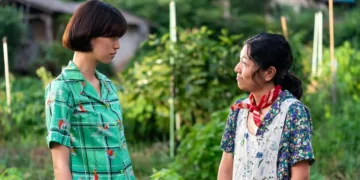
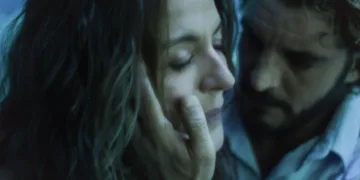
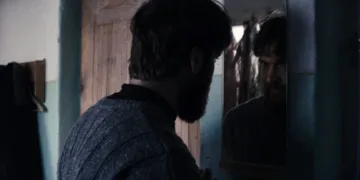












“The Dead Girls” situates itself in 1960s Mexico, presenting a world where institutional decay is the accepted state of affairs. The series is a fictionalized retelling of Jorge Ibargüengoitia’s novel, which itself was inspired by the true story of two sisters who built a criminal operation on sex and violence.
At the story’s center are Arcángela and Serafina Baladro, ambitious siblings who construct a network of brothels, accumulating significant power through bribery and intimidation. The show’s construction is immediately clever. It begins not with the empire, but with the fallout of a turbulent romance involving the younger sister, Serafina, and a local baker named Simón Corona.
This personal conflict serves as a narrative feint, a seemingly small story of passion and revenge that pries open the door to a much wider history of systemic corruption, calculated greed, and murder. What starts as a lovers’ quarrel soon reveals its roots in a sprawling criminal enterprise, setting the stage for the sisters’ spectacular rise and their inevitable, violent collapse.
A Fractured Narrative of Truth and Deceit
The series rejects a straightforward chronological account of the Baladros’ activities. Its plot unfolds in a non-linear fashion, assembling its sordid history by jumping between different time periods. This structural choice is more than a stylistic flourish; it is essential to the show’s purpose.
By fragmenting the timeline, the show prevents the audience from forming easy judgments, forcing a continuous reevaluation of characters as new information about their pasts is revealed. This disorientation is intentional, mirroring the messy, contradictory nature of memory and official records within a failed state. The storytelling is further complicated by its use of multiple, unreliable narrators.
Key figures recount events directly to authorities or an unseen interviewer, each testimony carefully shaped to minimize guilt or shift blame. This technique produces a quasi-documentary effect, casting the viewer as an investigator tasked with finding a stable truth in a sea of self-serving statements. The visual language reinforces these themes.
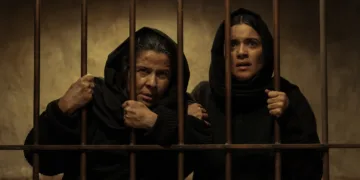
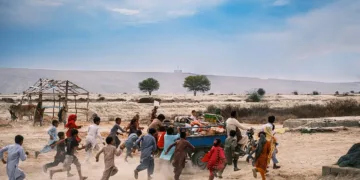
The cinematography’s desaturated, yellow-brown palette suggests not just a historical setting but also a moral sickness and decay. Elaborate production design presents the brothels as islands of gaudy luxury, a facade hiding the profound rot within, a perfect metaphor for the sisters’ entire operation.
The Blend of Satire and Brutality
The most defining quality of “The Dead Girls” is its carefully managed tone, which walks a fine line between dark satire and grim realism. The series uses humor as a scalpel for its social critique, targeting the machismo, clerical hypocrisy, and political posturing of the era. Upbeat folk music plays over scenes of quiet menace, and corrupt officials are depicted as incompetent, self-important caricatures.
This cynical comedy is set against the show’s unflinching depiction of brutality. The violence is graphic, and the numerous sexual sequences portray the cold, transactional nature of the exploitation at the heart of the Baladro empire. The juxtaposition is deliberate and challenging. The humor does not exist to soften the horror but to sharpen the critique of the rotten system that allows such atrocities to flourish by becoming mundane.
The effect can be jarring, as the tone shifts abruptly from cynical comedy to outright horror, intentionally keeping the viewer off balance. The risk with such a strategy is that the humor could be misread as trivializing the suffering. Yet the show’s intent appears to be the opposite: it uses the absurdity of the circumstances to magnify the horror of the reality. It refuses to let the audience look away from the human cost of the sisters’ ambition.
The Sisters at the Center of the Rot
The machinery of the story is powered by the two sisters and their toxic sororal bond. Arcángela is the cold, shrewd architect of the business, a pragmatist whose ruthlessness is matched only by her hypocrisy. Serafina is the passionate, volatile force, whose fiery personal attachments often act as the catalyst for chaos.

One supplies the strategy, the other the chaotic energy. The performances from Arcelia Ramírez and Paulina Gaitan are formidable. Ramírez conveys Arcángela’s calculating nature through a controlled stillness and a measured gaze, while Gaitan embodies Serafina’s instability with explosive gestures and rapid emotional shifts.
They make the sisters monstrous yet strangely understandable figures, suggesting they are as much a product of their corrupt environment as they are its agents. The story poses an uncomfortable question about their villainy: in a world offering few legitimate paths to power for women, they simply adapted the brutal patriarchal tools for their own use. If there is a shortcoming in the character work, it is that the women the sisters exploit are not afforded the same depth.
Their suffering is a constant and necessary presence, but they often remain a collective group of victims. This narrative choice, while perhaps reflecting their real-life powerlessness, also risks reinforcing their marginalization. Their individual stories remain underdeveloped, making them feel at times like instruments in the sisters’ downfall instead of fully realized people.
The Dead Girls, also known by its original title Las Muertas, is a six-episode limited series that premiered on Netflix on September 10, 2025. The show is based on the novel of the same name by Jorge Ibargüengoitia, which fictionalizes the true story of the Baladro sisters. Directed by Luis Estrada, the Mexican crime drama follows the Baladro sisters as they build a criminal empire and become infamous as some of the most feared serial killers in the country. The entire series is available to stream on Netflix.
Full Credits
Director: Luis Estrada
Writers: Luis Estrada, Jaime Sampietro
Producers and Executive Producers: Luis Estrada, Sandra Solares
Cast: Arcelia Ramírez, Paulina Gaitán, Joaquín Cosío, Alfonso Herrera, Mauricio Isaac, Tenoch Huerta Mejía, Salvador Sánchez, Dagoberto Gama
The Review
The Dead Girls
"The Dead Girls" is a structurally ambitious and tonally audacious series. Its non-linear, multi-perspective narrative creates a compelling, if unsettling, viewing experience. Anchored by two powerful lead performances, the show functions as a sharp satire of systemic corruption, using dark humor to underscore its grim reality. While the victims' stories remain underdeveloped, the series succeeds as a challenging and intelligent piece of television for those who appreciate complex, morally ambiguous storytelling.
PROS
- Intelligent, non-linear storytelling that challenges the viewer.
- Exceptional lead performances by Arcelia Ramírez and Paulina Gaitan.
- A unique and effective blend of dark humor and biting satire.
- Sharp and insightful social commentary on systemic corruption.
- Strong visual direction and period-appropriate production design.
CONS
- The exploited female characters lack depth and individual agency.
- Abrupt tonal shifts can be jarring for some viewers.
- The deliberate pacing and long episode runtimes may feel slow at times.