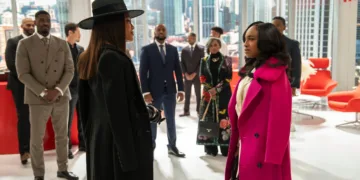























In the vast and chaotic landscape of streaming content, the television soap opera persists, a genre of heightened emotion and unapologetic melodrama. Beauty in Black is a prime specimen, and its second season begins not with a whisper, but with a grand, theatrical explosion of conflict. The story resumes with the Bellarie family patriarch, Horace, delivering a final, posthumous blow to his greedy heirs.
From his deathbed, he marries Kimmie, a stripper, an act that functions as a calculated detonation of his family’s dynastic ambitions. This is not a love story; it is a strategic maneuver, a transfer of power designed to create maximum chaos. Kimmie’s world is inverted overnight. She is lifted from a life of financial precarity into the opulent, sterile halls of a mansion, now the acting head of a haircare empire.
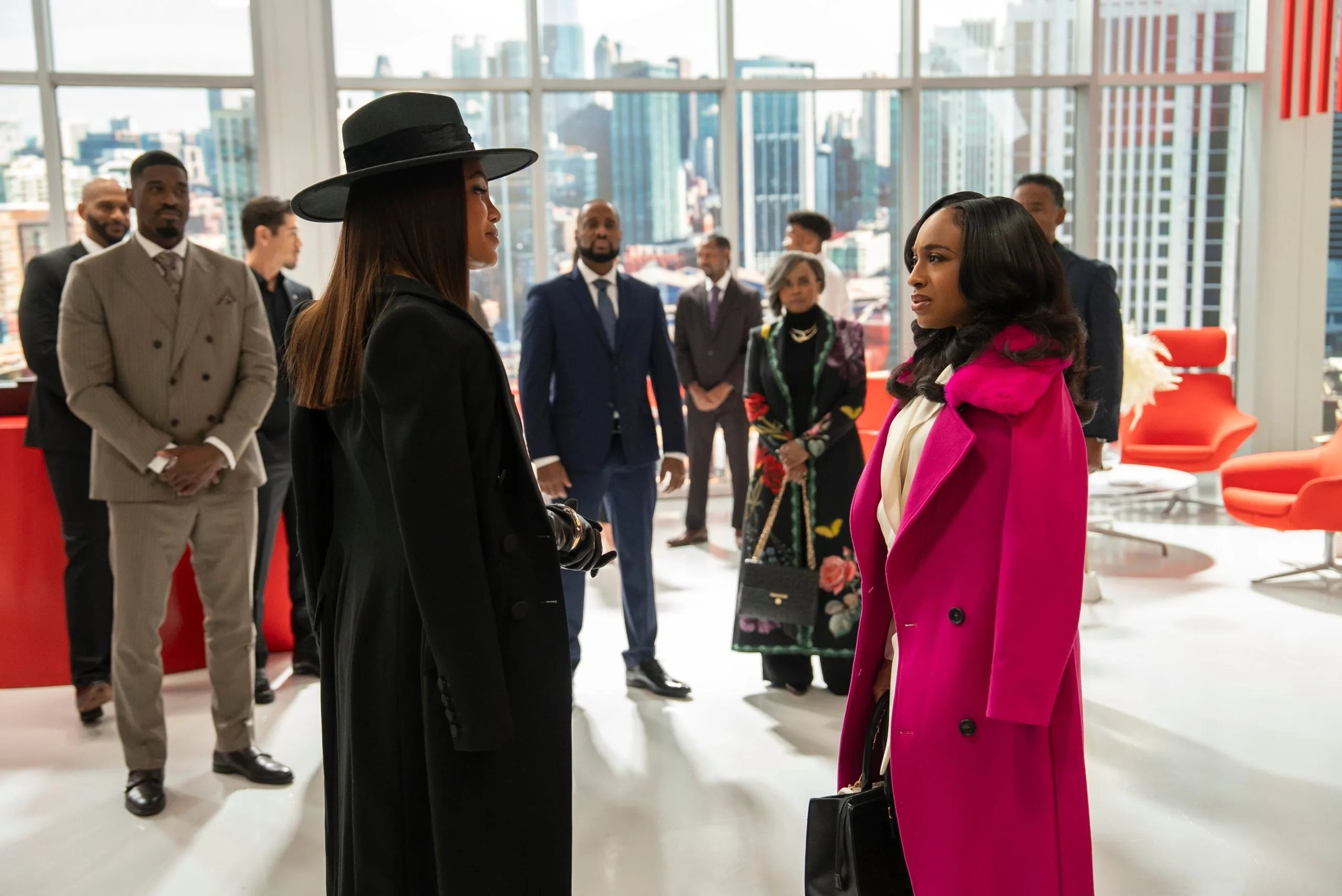
She holds immense authority on paper, yet she is a queen in a kingdom of enemies. The Bellarie clan, a venomous collective united only by their avarice, immediately begins plotting her downfall. The battle lines are drawn, promising a brutal war fought with money, secrets, and sabotage.
The Idle Queen: A Stalled Central Narrative
The premiere establishes a premise with immense energetic potential: a fierce, immediate war for control. What follows, however, is a curious exercise in narrative decompression, a trend where streaming shows stretch thin plots across an entire season. The expected struggle for power is deferred.
For a significant portion of the season’s opening episodes, Kimmie’s character arc is strangely inert. Her transformation from protagonist to passive observer is the season’s most glaring flaw. Instead of storming the boardroom, she is shown acclimating to her new wealth, her actions largely confined to shopping sprees and tentative steps within her gilded cage.
This is more than a pacing issue; it is a thematic one. By sidelining a Black woman just as she acquires institutional power, the show seems more interested in her as a catalyst for the Bellarie family’s drama than as the agent of her own story.
This lack of forward momentum is a puzzling choice in the age of binge-watching, where audience attention is a precious commodity. The sharp, personal Kimmie-versus-Mallory conflict that defined parts of the first season is diluted here into a wider, yet less active, family feud. It takes a majority of the season’s run for Kimmie to have a direct, significant showdown with her antagonists.
This prolonged stasis makes the season feel less like a self-contained story and more like a long, drawn-out prologue for a future conflict, a structural decision that misjudges the patience of a modern audience. The central plot is left in a state of suspended animation, a bold promise of action left unfulfilled for far too long.
A Constellation of Subplots
With Kimmie’s narrative largely idling, the show’s dramatic weight shifts to the orbiting subplots of the dysfunctional Bellarie family. The narrative vacuum is filled with a collection of secrets, simmering rivalries, and clandestine affairs, a common strategy for ensemble dramas that can risk making no single storyline feel substantial.
The most prominent of these side stories involves the family attorney, Varney, and his secret relationship with one of the Bellarie sons, Charles. The show’s handling of this romance feels like a relic from a different era of television. The family’s reaction to their relationship is one of open, cartoonish disdain, a portrayal that lacks any modern nuance or psychological depth.
In 2025, presenting such overt homophobia without any meaningful challenge or complex character motivation is a strange choice for a global streaming platform. It feels less like a thoughtful examination of intolerance and more like a tired, unimaginative trope imported from a network drama made two decades ago.
Other storylines attempt to fill the void. The volatile outbursts of the other brother, Roy, serve as a study in entitled masculinity, while a lingering carjacking plot tethers Kimmie’s circle to a world of street-level danger, creating a persistent class tension. These secondary dramas, however, rarely generate enough substance to compensate for the inertia at the story’s center. They keep the screen busy with movement, but they do little to advance the overarching narrative, resulting in a collection of scattered episodes that feel disconnected from the season’s powerful initial premise.
Execution and Entertainment Value
Ultimately, Beauty in Black must be judged on its own terms, as a self-aware soap opera designed for escapism. It is part of a specific brand of television that boasts a large and loyal audience, even as it baffles critics. The writing is often theatrical, with dialogue that favors pronouncements over conversation, and the performances are calibrated to a heightened reality of gasps, glares, and dramatic entrances.

For some viewers, this is precisely the appeal. The show’s nonsensical plot turns and over-the-top conflicts can offer a certain kind of “guilty pleasure” entertainment, a retreat from the subtleties of prestige television. Its continued popularity signals to streaming services that a significant market exists for glossy, high-stakes melodramas.
For others, the experience will likely be a frustrating one. The weak narrative momentum and the underdeveloped central conflict may prove too tedious to endure. The season’s primary failure is not its genre, but its execution within that genre. It is less propulsive and far less satisfying than its own setup promises, a cardinal sin for a show built on pure entertainment.
It feels caught between two possibilities: it could have been a sharp, fast-paced story of power and revenge, or it could have been a satisfyingly messy ensemble drama. By failing to fully commit to either path, it leaves its audience with a story that has all the ingredients for a spectacular fire but never quite manages to strike a match.
Beauty in Black is an American drama television series created by Tyler Perry. The second season, which follows an exotic dancer whose life becomes intertwined with a wealthy and dysfunctional family, premiered on Netflix on September 11, 2025.
Full Credits
Director: Tyler Perry
Writers: Tyler Perry
Producers and Executive Producers: Tyler Perry, Angi Bones, Tony Strickland
Cast: Taylor Polidore Williams, Crystle Stewart, Amber Reign Smith, Xavier Smalls, Julian Horton, Steven G. Norfleet, Richard Lawson, Terrell Carter, Shannon Wallace, Charles Malik Whitfield, Debbi Morgan, Ricco Ross, Bryan Tanaka, Joy Rovaris, George Middlebrook, Bailey Tippen, Tamera Kissen, Ursula O. Robinson
Editors: Laura Harris Atkinson, Jordan Aldinger, Erik Reimers, Brittany Myers
Composer: Wow Jones & JimiJame$
The Review
Beauty in Black Season 2
While Beauty in Black Season 2 launches with a magnificently spiteful premise, the season squanders its potential on a stalled central narrative. The protagonist is frustratingly sidelined, leaving a collection of underdeveloped subplots and dated tropes to fill the void. This is a show that promises a delicious war of ambition and revenge but delivers a protracted, unsatisfying ceasefire. Though it may satisfy dedicated fans of the genre, its sluggish execution makes it a tedious watch for most, feeling more like a placeholder than a complete season.
PROS
- An explosive, high-stakes premise that establishes a compelling initial conflict.
- Successfully creates a heightened, melodramatic tone that will appeal to fans of the soap opera genre.
- Maintains a glossy, opulent aesthetic suitable for a story about a wealthy dynasty.
CONS
- The narrative pacing is extremely slow, with the central plot remaining static for long stretches.
- The protagonist is rendered passive for much of the season, lacking agency in her own story.
- Subplots feel like filler and feature dated, simplistic portrayals of complex social issues.
- Fails to deliver on its promise of dramatic confrontation, resulting in an unfulfilling viewing experience.