

























![Kingdom Hearts Collection [I-III] Review](https://gazettely.com/wp-content/uploads/2026/10/Kingdom-Hearts-Collection-I-III-1-360x180.webp "Kingdom Hearts Collection [I-III] Review: KHII Holds Steady as Newer Entries Fluctuate 37")




The 1990s were a fertile ground for animal mascots with attitude. For every success story, there were a dozen forgotten contenders vying for a piece of the platforming pie. Among them was Bubsy the Bobcat, a character armed with endless puns and a signature exclamation mark shirt.
He was designed for stardom, yet his legacy is cemented by a series of notoriously difficult and clumsily designed games. Now, Bubsy in: The Purrfect Collection arrives as a comprehensive anthology, gathering these classic titles for a modern audience. It presents a chance to look back at this peculiar piece of gaming history and examine the mechanics behind the reputation.
A Museum for Mediocrity
The care put into this collection’s framework is immediately apparent, presenting a stark contrast to the content it holds. This is not a simple port of old software. It is a carefully curated digital exhibit. Upon launching the game, the player is greeted with a bright, animated frontend. Each title is presented with its original box art and a short, often humorously self-deprecating, description that acknowledges the game’s reputation.
This tone of reverence mixed with irony sets the stage perfectly. The menus are responsive and easy to use, allowing access to the different games, their various versions, and a wealth of supplemental material without any friction. It is a user experience designed with respect for the player and the subject matter, a quality rarely afforded to titles of this caliber.
The suite of quality-of-life features goes beyond the current standard for retro compilations. While save states are expected, their utility here is amplified by the brutal difficulty of the source material. The rewind function, however, feels less like a modern convenience and more like a necessary design correction. The ability to instantly undo a death caused by a blind jump or an enemy appearing with no warning transforms the experience from an exercise in pure frustration into something more manageable.
It allows the player to see the later stages of these games without dedicating hours to rote memorization. The visual options are also extensive. The CRT filters authentically replicate the scanlines and screen curvature of old televisions, while the special dot matrix filter for the Game Boy version of Bubsy II is a particularly thoughtful touch. Players can also enable built-in cheats for things like invincibility or infinite lives, a direct acknowledgment from the developers that playing these games as originally intended is a severe challenge.
The collection’s commitment to preservation is most evident in the sheer number of game versions included. Players can directly compare the SNES and Mega Drive ports of the first two games. The differences are representative of that console generation: the SNES versions feature richer color palettes and clearer audio, while the Mega Drive counterparts run noticeably faster, which further complicates the already difficult controls.
The inclusion of the Japanese Super Famicom version of the first game, complete with different voice acting, is another detail that will appeal to historians. The centerpiece of this preservation effort is the “Meowseum.” This is not a simple gallery of concept art. It is a deep archive containing high-resolution scans of game manuals, a music player for each soundtrack, and extensive promotional materials from the 90s, including magazine advertisements and photos of rare merchandise.
The most valuable additions are the video interviews with the character’s creator and the inclusion of the complete, infamous 1993 animated television pilot. This collection of artifacts paints a complete picture of the ambition behind the Bubsy property, showing a brand that was intended to be a multimedia force.
The Mechanics of Frustration
Playing the games themselves provides a harsh lesson in platformer design. The first title, Bubsy in: Claws Encounters of the Furred Kind, establishes the mechanical problems that would haunt the series. The character’s movement is governed by a dreadful inertia. From a standstill, Bubsy is slow to respond. Once he gains momentum, he rockets forward with the grace of a runaway minecart, becoming nearly uncontrollable.
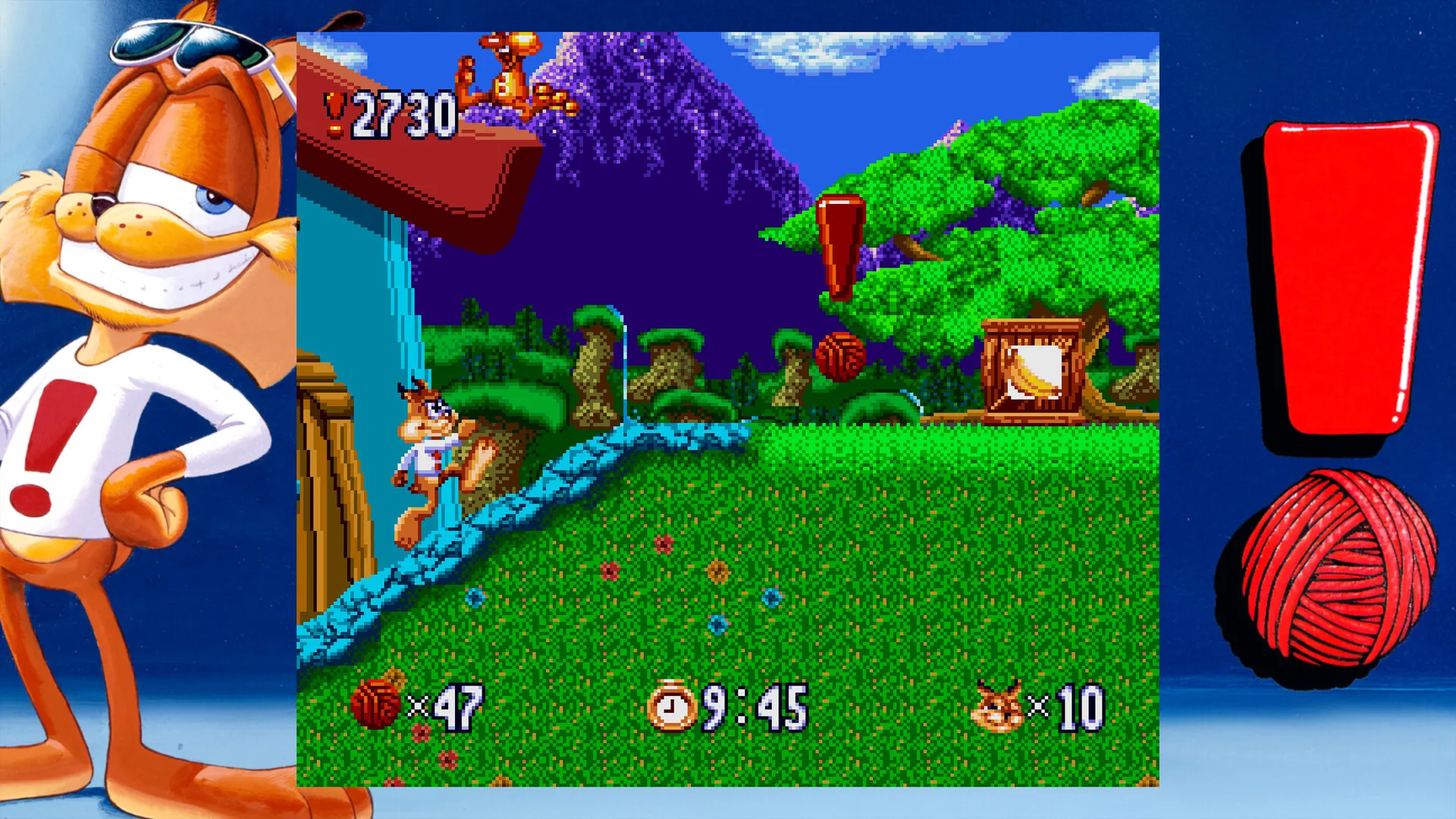
This single flaw is catastrophic because the level design is built in direct opposition to this speed. Stages are packed with enemies that appear suddenly at the edge of the screen, bottomless pits hidden just beyond a small ledge, and traps like rollercoasters that provide a two-second ride before launching you into an obstacle. Skillful play is impossible; survival depends on cautious, slow-moving memorization, which betrays the game’s Sonic-inspired marketing.
The jumping mechanic is equally problematic, offering minimal mid-air control and making precise landings a matter of luck. This is compounded by a one-hit-kill system and, most bizarrely, fall damage. A character built for leaping can die from a modest drop, a design choice that feels utterly alien to the genre.
Its sequel, Bubsy II, attempts to address some of these issues but introduces new ones. The one-hit-kill system is replaced by a three-hit health bar, a welcome change that reduces some of the tension. The game falters, however, in its level design. It trades the more linear paths of its predecessor for sprawling, maze-like stages set in a theme park. These areas are confusing to get through, filled with identical-looking corridors and doors that teleport the player around without clear logic.
In some zones, like the Egyptian area, it is difficult to distinguish the platforms from the background art, leading to many accidental deaths. The game’s soundtrack is an assault on the ears, a cacophony of grating tunes that challenges the worst the 16-bit era had to offer. The included Game Boy version of Bubsy II is even worse, a nearly unplayable title with a slideshow frame rate that the collection itself humorously warns the player to avoid.
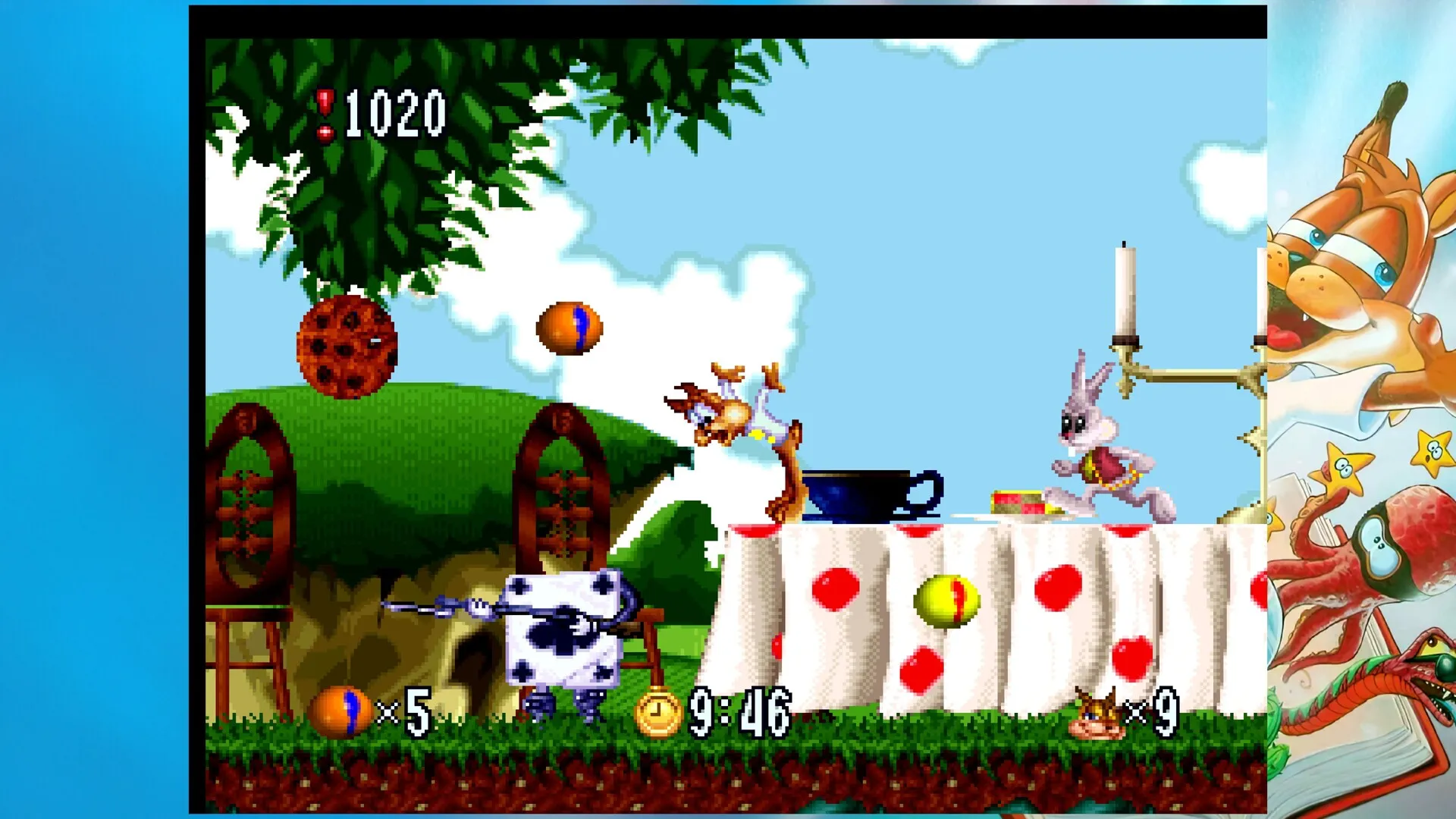
The third 2D entry, Bubsy in: Fractured Furry Tales, was an exclusive for the Atari Jaguar. It fails to demonstrate the power of the supposed 64-bit hardware, with visuals that look no better than its 16-bit cousins and parallax scrolling that is arguably worse. It represents a step backward by reinstating the one-hit-kill rule.
Its only small improvement is a return to more streamlined level design, offering a clearer sense of direction than the confusing maps of its predecessor. Even so, the core control issues of terrible inertia and imprecise jumping remain, making the experience just as frustrating as the others.
The collection’s main event for many will be Bubsy 3D, a title frequently cited as one of the worst video games ever made. Its reputation is well-deserved. The original game, included here, is a disaster of early 3D design. Movement is handled with clunky tank controls, the camera is an unruly mess that actively hides platforms, and the levels are vast, empty, and ugly spaces. The draw distance is shockingly poor, with fog obscuring objects only a few feet away. Bubsy’s constant, repetitive voice clips add an layer of auditory irritation to the clumsy gameplay.
The developers have included a “Refurbished Edition” in an attempt to salvage the experience. This version implements a modern, dual-analog control scheme, allowing for direct character movement with one stick and camera control with the other. While this makes the game technically more approachable, it is a superficial solution.
The new controls cannot fix the game’s rotten foundation. There is still significant input delay, the physics feel broken, and the level design remains nonsensical. The modern controls only give you a clearer view of just how broken the game truly is.
An Artifact, Not an Adventure
The existence of this collection raises an interesting point about the purpose of game preservation. While many compilations focus on celebrating the classics, The Purrfect Collection serves a different function. It preserves a cautionary tale. These games are a masterclass in what can go wrong in game design, from a fundamental misunderstanding of physics and momentum to a failure to build a world that complements the character’s abilities.
By packaging them so thoroughly, the developers have created a valuable historical and educational tool, allowing a new generation of players and designers to study these failures firsthand. The collection is a testament to the idea that all games, not just the great ones, deserve to be remembered and accessible. They form a complete record of the art form’s evolution, showing the dead ends and missteps that occurred along the way.
This understanding is key to identifying the product’s true audience. This is not a purchase for someone looking for a fun weekend of retro platforming. Players seeking that experience will find nothing but frustration here. Instead, this collection is for a very specific type of consumer. The video game historian will find a perfectly preserved specimen of 90s mascot-era ambition gone wrong.
The nostalgic fan who grew up with these games may find a comforting, if difficult, trip back in time, though it might also be a harsh reality check that shatters their rose-tinted memories. A third group, the enthusiast of “bad” games, will find a treasure trove of content to analyze. These games often provoke a question of whether they are “so bad they’re good” or simply bad. The consensus from playing them is that they lean heavily toward the latter; they are more tedious and aggravating than they are ironically amusing.
Bubsy in: The Purrfect Collection succeeds magnificently in its mission as a historical archive. The amount of care, detail, and bonus content packed into the compilation is worthy of a far more beloved franchise. It is a product made with a clear love and respect for the history of the Bubsy character. That is what makes the final verdict so unusual.
The package itself is an easy recommendation based on its features and presentation. The games within it are impossible to recommend as sources of entertainment. The purchase is therefore entirely conditional. One should buy this collection for the museum, not for the exhibits. It is a fantastic historical document that happens to contain four deeply flawed video games.
The Review
Bubsy in: The Purrfect Collection
An exemplary work of video game preservation, this collection lovingly archives a series that is mechanically broken. The extensive bonus features and modern conveniences are a high-quality wrapper around four of the most frustrating platformers ever made. It is a fascinating historical artifact but a dreadful gameplay experience.
PROS
- An exceptionally well-presented collection with clean menus.
- A vast archive of high-quality bonus content in the "Meowseum."
- Essential quality-of-life features like the rewind function.
- Excellent preservation effort with multiple game versions included.
CONS
- All included games suffer from fundamentally flawed and frustrating gameplay.
- Awful character controls with severe inertia and imprecise jumping.
- Level design that actively punishes the player.
- Bubsy 3D remains a broken experience despite modernized controls.







