































The first day of school is a cultural ritual, a mix of anxiety and anticipation that television has mined for decades. Yet for Abbott Elementary, returning for its fifth season, this ritual feels less like a simple sitcom trope and more like a necessary check-in. We are back in the halls of a beloved Philadelphia public school, where the faculty, a dedicated and wonderfully idiosyncratic group, prepares for the students’ arrival on Development Day. This mockumentary series continues to operate as a warm and sharp examination of the American education system.
The season five premiere, “Team Building,” immediately re-establishes this world, a place where the humor is as abundant as the challenges. The episode shows a familiar setting feeling the strain of time, with signs of decay appearing on the building’s infrastructure and in the evolving roles of its characters. The faculty faces a fresh set of personal and professional hurdles, signaling that stability at Abbott is always a temporary condition.
Passing the Torch in Changing Classrooms
The most significant recalibration this season is the narrative arc of Janine Teagues. Her journey has moved past the initial phase of rookie enthusiasm and into a more complex professional stage. She is no longer defined by her need for mentorship, a shift that creates a vacuum in her professional identity. This is illustrated by her twin challenges: an enormous class of forty students that tests her practical limits, and the arrival of a new teacher who now occupies her former role as Barbara’s protégé.
Janine’s reaction is a poignant and hilarious exploration of career maturation. Her attempts to forge a new persona, most notably as the cynical “Downstairs Grump,” are comically ill-fitting. The performance is a sharp commentary on the pressure to adopt a hardened exterior to be taken seriously, particularly for Black women in professional settings. The failure of this persona is a celebration of Janine’s earnestness.
Her ultimate realization is that her growth has not made her obsolete but has prepared her for a new role. By stepping up to mentor Dominic, she completes a crucial cycle of knowledge transfer, moving from student to teacher in the school’s social hierarchy. It is a subtle, powerful depiction of finding one’s authority not through affectation, but through experience.
This theme of professional evolution extends throughout the staff. Barbara Howard, the school’s matriarch, experiences a complex emotional shift. She is visibly rejuvenated by her new duties as a music teacher, finding fresh purpose. This energy is complicated by the arrival of Dominic, her former kindergarten student. His presence is a living reminder of her long tenure, stirring a mix of pride in her legacy and a stark awareness of her own career’s timeline.
For Melissa Schemmenti, the transition to teaching sixth grade is a move into a new tactical environment. The comedic subplot where Jacob and the perpetually dour Mr. Morton try to intimidate her with stories of middle schoolers is more than a gag; it hints at the new social and academic complexities she will have to manage. Even Ava Coleman, Abbott’s agent of chaos, is shown in a new light. Her stable, loving relationship with O’Shon provides a personal anchor.
The show thoughtfully explores what happens when a character defined by her disruptive energy finds a source of genuine peace, creating a fascinating contrast between her contented private life and her unchanged, self-aggrandizing public persona. Gregory Eddie continues to serve as the show’s steady anchor. His patient, methodical approach is perfectly encapsulated in his main subplot: teaching Mr. Johnson how to ride a bike. It’s an act of care that exists outside lesson plans, a quiet demonstration of his supportive nature.
Systemic Decay and Bureaucratic Oversight
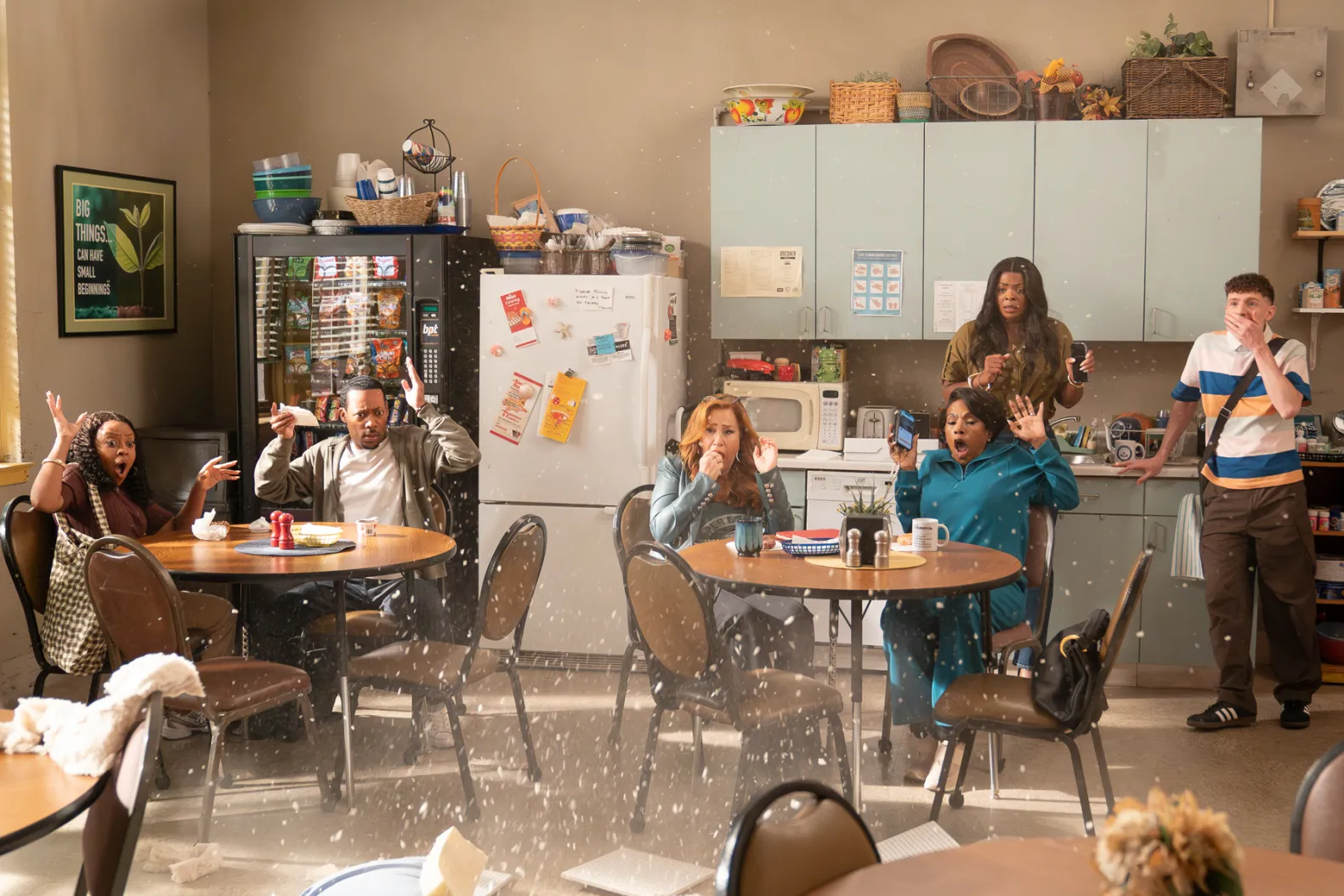
In its fifth season, Abbott Elementary elevates the school building from a mere setting to a central character representing institutional neglect. The premiere meticulously documents its state of disrepair, making the systemic crisis of underfunding tangible. The episode opens with a hole collapsing in the ceiling of the teachers’ lounge.

Later, a gas leak from an ancient oven in the cafeteria forces a full evacuation, with the cameraman comically passing out from the fumes. The episode ends with a maintenance worker’s grim report on the school’s failing HVAC systems. These are not isolated incidents; they are symptoms of a chronic illness.
By presenting these infrastructure failures as active plot points, the show powerfully visualizes the daily reality for countless under-resourced schools across the country. The crumbling walls and failing utilities establish a clear, season-long antagonist and a primary objective for the staff: to secure the funding needed for essential repairs, a fight that is both a practical necessity and a matter of dignity.
This internal threat is compounded by a new form of external pressure. The school district, in its infinite wisdom, has sent a representative, Craig, to monitor the staff. Played with perfect bureaucratic blandness by Mikey Day, Craig is not a villain but a symbol of impotent, top-down authority.
He is tasked with enforcing mandatory team-building exercises, a superficial solution imposed as a consequence for the staff’s creative fundraising ethics in the previous season. His presence and his methods represent a sharp critique of institutional responses to grassroots problems. The district offers performative gestures of “rebuilding trust” instead of providing the actual resources the school needs.
This dynamic is expertly balanced by the arrival of Dominic, the new teacher. As Barbara’s former student, his presence is a powerful counter-narrative to the story of failure told by the crumbling building and the distrustful district. He is the human evidence of Abbott’s success, a tangible return on the faculty’s investment of labor and love. He embodies the hope that keeps the teachers going.
Community as a Radical Act
The episode’s thematic core is crystallized in the subplot of Gregory teaching Mr. Johnson to ride a bike. This storyline operates on multiple levels. On the surface, it is a brilliant comedic set piece, offering hilarious physical comedy and another opportunity to expand Mr. Johnson’s impossibly rich and fabricated personal history. Beneath the humor, however, it functions as a profound statement on the nature of community.
The district’s version of “team building” is a series of sterile, condescending exercises designed to enforce compliance. The faculty’s response is to ignore these directives and instead rally around a deeply personal, human goal. The sight of the entire staff cheering for Mr. Johnson as he wobbles across the schoolyard is the episode’s most powerful image. This is the real team building: an organic, joyful act of mutual support and chosen family.
It is a quiet act of defiance, a demonstration of solidarity that is far more meaningful than any corporate-style workshop. It perfectly encapsulates the show’s central thesis that genuine community is built through shared vulnerability and collective encouragement, not through mandated activities.
This spirit is reflected in the episode’s masterful use of its entire ensemble. “Team Building” successfully gives every principal character a distinct purpose and a moment to shine, reinforcing the sense of a collective ecosystem. The writers continue to find comedic gold in unexpected character pairings, such as the tense yet funny alliance of Melissa, Jacob, and Mr. Morton. Their interactions reveal the complex layers of rivalry, respect, and shared purpose that define any workplace.
The mockumentary format remains a key tool, capturing the small, authentic moments of connection and friction that build a believable world. The tight comedic timing and the palpable chemistry among the cast members are the engine that drives the show. Even as the premiere lays the groundwork for the season’s overarching conflicts, it never forgets that its primary strength lies in these character-driven moments. The humor and heart of Abbott Elementary are inseparable, emerging directly from the staff’s shared struggle and their unwavering commitment to one another.
Abbott Elementary is the critically acclaimed, Emmy Award-winning mockumentary sitcom created by and starring Quinta Brunson. Season 5 of the series has recently premiered on Wednesday, October 1, 2025, on ABC. The new season continues to explore the lives of the dedicated teachers and staff at the underfunded Willard R. Abbott Elementary School in Philadelphia. New episodes are broadcast weekly on the ABC network, and you can typically stream them the following day on Hulu.
Full Credits
Director: Randall Einhorn, Jennifer Celotta, Jay Karas
Writers: Quinta Brunson, Joya McCrory, Brittani Nichols, Kate Peterman, Justin Tan
Producers and Executive Producers: Quinta Brunson, Randall Einhorn, Justin Halpern, Patrick Schumacker, Josh Greene, Richie Edelson
Cast: Quinta Brunson, Tyler James Williams, Janelle James, Lisa Ann Walter, Chris Perfetti, Sheryl Lee Ralph, William Stanford Davis, Josh Segarra
Director of Photography (Cinematographer): Michael J. Pepin, Kurt Jones
Editors: Richie Edelson, Sarah Zeitlin
Composer: Maker
The Review
Abbott Elementary Season 5
Abbott Elementary returns for its fifth season with a premiere that is as sharp, funny, and socially resonant as ever. While the challenges of underfunding and bureaucratic oversight are familiar, the show deepens its analysis by focusing on the personal and professional evolution of its characters. It masterfully balances laugh-out-loud comedy with a poignant critique of a failing system, proving that its greatest strength is its unwavering belief in the radical power of community. The series remains a vital and heartwarming piece of television that continues to set the standard for the modern network sitcom.
PROS
- Offers sharp, relevant social commentary on the challenges facing public education.
- Features meaningful and mature character development, especially Janine's evolution into a mentor.
- The ensemble cast's chemistry remains a standout, driving both the humor and the heart.
- Expertly balances episodic comedy with the setup of compelling season-long conflicts.
- Finds profound thematic depth in simple, character-driven subplots.
CONS
- The core conflict of systemic struggle, while effective, risks feeling familiar five seasons in.
- The introduction of a bureaucratic antagonist from the district leans on a common sitcom trope.
- Its focus on the faculty means the student experience remains largely in the background.