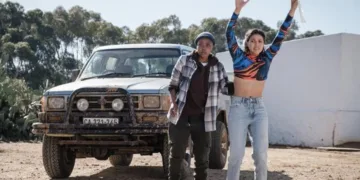























Low Rider marks Campbell X’s second feature, a road trip drama shaped by grief and dislocation. Londoner Quinn, played by Emma McDonald, follows old correspondence to South Africa after her mother’s death to seek a long-absent father. The search turns into a shared trek with Harley, a trans man Quinn meets in Cape Town, portrayed by Thishiwe Ziqubu. Their partnership sets the story’s frame. The film grips first through image.
Cinematographer Robert Wilson renders South Africa with arresting clarity, from neon-lit Cape Town clubs to sun-baked vistas that carry beauty and risk in equal measure. The story traces Quinn’s self-interrogation through mixed-race identity, queerness, and family memory. Place matters here. South Africa’s layered history anchors an intimate tale within living social textures that shape how characters see themselves and each other.
Narrative Momentum and Structural Roadblocks
The road from London to South Africa mirrors Quinn’s inward excavation. The device is familiar, yet Campbell X gives it pointed specificity through a Black British and South African queer lens. The flow stumbles at times. The script leans on convenience that asks for generous belief.

An early stretch has Quinn lose her valuables yet keep Harley’s card, and similar fortuitous beats slip in again, softening the story’s grip on probability. Rhythm wavers. The opening half hour lingers, while the final movement hurries. A key emotional release for Quinn lands without full preparation.
A late swerve into trippy imagery arrives with little set-up, and the resolution of both the father search and Quinn’s psyche compresses into a tidy finish that favors sentiment over a fully earned payoff. Character turns often snap into place rather than grow through the miles traveled.
Character Dynamics and Performance Nuance
Quinn emerges as a messy, impulsive queer lead. A drunken hook-up and a high-maintenance presentation sketch a persona that costume and make-up underline with precision. McDonald grounds the role yet sometimes stays near the surface, which keeps Quinn at a prickly distance, especially when the script frames conflict through petulance.

A mid-film monologue breaks through with force and becomes a standout passage. Harley arrives as a streetwise local whose guarded warmth carries scars. Ziqubu gives him depth that outpaces the page and supplies a core of integrity that matters, particularly for a transmasc character made by a transmasc director. The bond between Quinn and Harley supplies the film’s emotional axis.
Their chemistry flickers rather than builds in steady increments, and flirtation does not always settle into a felt attraction. The closing choice leans into a sudden romantic turn that pulls focus from Quinn’s personal growth, which leaves the relationship’s endpoint with a forced edge.
Visual Storytelling and Cross-Cultural Tensions
Form commands attention. Wilson’s images run glossy and hyper-saturated, with vibrant colours that mark the land’s range. Make-up and wardrobe do sterling work, especially in shaping Quinn’s flamboyance, and a cheerful, upbeat soundtrack threads through the ride.
The film’s Black and queer focus places it squarely in conversations about prejudice across race and gender. One scene reframes assumptions when Quinn reveals that her father is a white African, which complicates fixed ideas about mixed-race identity in a South African setting. The story reaches for the country’s sociopolitical past, touching on colonialism and apartheid, yet that engagement often stays thin. References sit at the level of personal reaction and do not consistently meet the scale of systemic realities.
Many white South African characters read as flatly hostile and racist, which undercuts a stated interest in resisting stereotype. The film still adds a personal Black British and South African queer thread to the map, with the House of Herm sequence serving as a deliberate invocation of ancestral queerness. Some sex scenes raise questions about placement and purpose, since they do not always fold cleanly into the story’s momentum.
The film’s cultural origins shape both its themes and its form. A Black British lens meets South African settings to test how identity, heritage, and desire travel across borders. Visual storytelling does heavy lifting while the script negotiates the tension between intimate confession and the weight of national history. The result invites conversation about how personal quests intersect with collective memory, even as the narrative engine hiccups at key turns.
Low Rider (2025) is a queer road movie drama. It had its world premiere at the Edinburgh International Film Festival (EIFF) in 2025, where it competed for the Sean Connery Prize. The film is a co-production between South Africa and the UK. As it is an independent film that premiered at a major festival, its subsequent distribution, whether through a specialist distributor, theatrical release, or streaming platform, would typically follow the festival circuit. Details on where you can currently watch it beyond its festival screenings will depend on its distribution deals and regional release dates, which may still be pending a wide release.
Credits
Director: Campbell X
Writers: Campbell X, Stephen Strachan
Producers: Rebecca Long, Stella Nwimo
Executive Producers: Norman Merry, Peter Hampden, Kristin Irving, Phil Hunt, Compton Ross
Cast: Emma McDonald, Thishiwe Ziqubu, Brümilda van Rensburg, Nellie Modimola, Martin Kluge, Tu Nokwe, Izel Bezuidenhout
Director of Photography (Cinematographer): Robert Wilson
Editors: Sian Clarke, Mark Ready
Composer: Ré Olunuga
The Review
Low Rider
Low Rider is a technically superb film, visually gorgeous thanks to phenomenal cinematography and vibrant, hyper-saturated aesthetics. It makes a vital contribution to Black British and South African queer cinema, offering authentic representation, particularly through Thishiwe Ziqubu's standout performance as Harley. However, the powerful thematic core is undermined by a cluttered narrative that relies too heavily on convenience. Inconsistent pacing and an abrupt, underdeveloped final act prevent the film from fully realizing its emotional potential. Its aesthetic excellence outweighs its structural shortcomings.
PROS
- Phenomenal cinematography, vibrant color palette, and glossy visuals create an arresting style.
- Provides an important, personal, and authentic Black queer and transmasc narrative.
- Thishiwe Ziqubu's performance as Harley is strong, bringing a much-needed soulfulness to the role.
- Uses the South African landscape in an original way for the road trip genre.
- Features a powerful, memorable monologue delivered by Emma McDonald.
CONS
- The plot relies on strained conveniences, undermining believability.
- The film features a slow start and an overly rushed, abrupt final act.
- The central romantic relationship between the leads lacks consistent, sincere chemistry.
- Quinn's characterization is sometimes simplistic, making her difficult to connect with.
- Complex socio-political themes regarding race and prejudice feel underdeveloped, particularly the one-note depiction of some supporting characters.