













Long Shadows reaches for a new entry in the Western revenge line, a tradition that travels from the American frontier to the era of Italian Spaghettis. The story sits in the Arizona Territory of the late 1880s and follows Marcus Dollar (Blaine Maye), who carries the shock of seeing his parents murdered. He leaves the mission orphanage that raised him and pursues the outlaw gang responsible.
His first steps bring him to the Purgatory Saloon, where he meets Dulce Flores (Sarah Cortez). A pursuit of justice soon carries another pressure, since local lawman Sheriff Wesley Tibbs (Grainger Hines) tracks Marcus. William Shockley makes his feature directing debut here and co-writes the script, with a stated aim of rooting violence in psychological motive.
Clash of Form and Visual Storytelling
The images seldom anchor a convincing sense of place or intention. Shockley’s first feature often resembles a rehearsal, closer to the safe polish of a made-for-TV effort than a developed theatrical vision. Cinematographer A.J. Raitano records Arizona locations, yet the frames and sets come off overly clean and decorative, which erodes the rough, lived quality that an Old West setting demands. The look works against the film’s serious register.
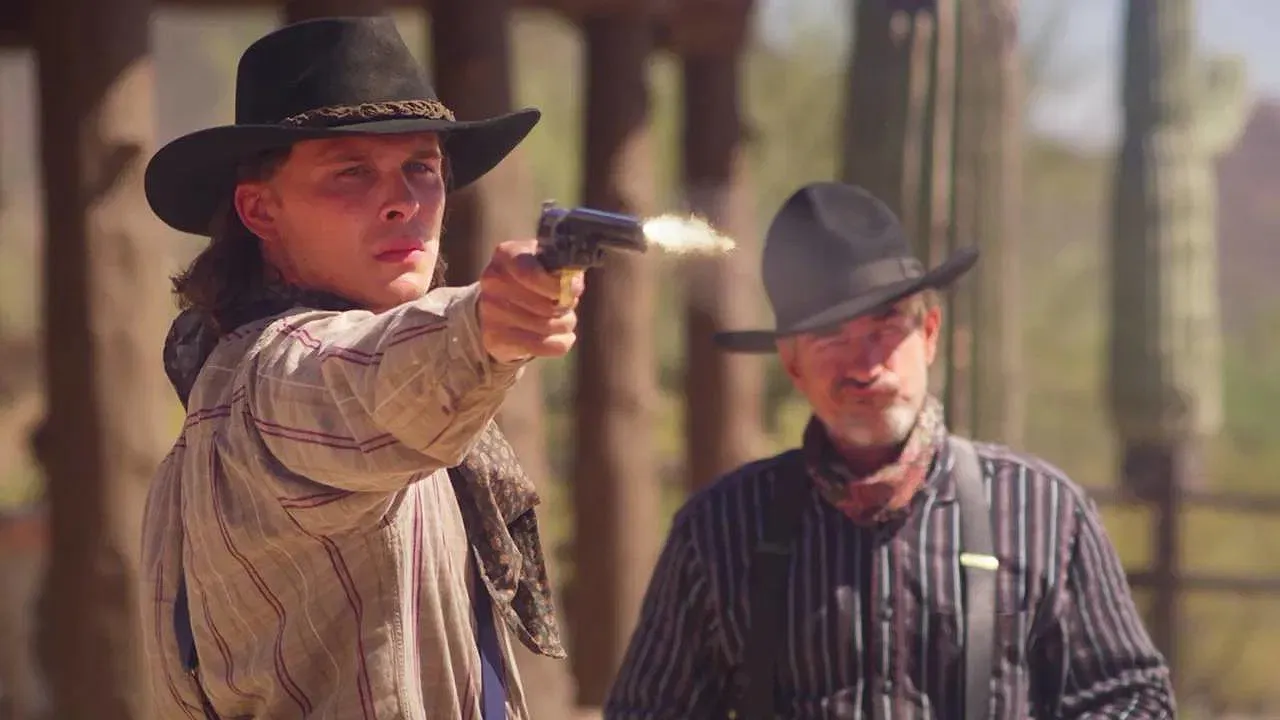
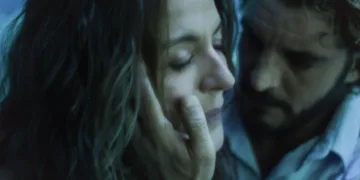
The rhythm of the story conflicts with the film’s presentation. A heavy, solemn tempo stifles suspense, and the cuts compound the problem. The structure jumps around through awkward, excessive flashbacks that cloud the plot and hold back key information until the closing stretch. The film stacks on other miscalculations: syrupy slow-motion during romantic beats, frequent canted angles without clear purpose, and a general looseness in the visual grammar. A visible anachronism, such as modern paper stock used for a wanted poster, draws attention to that looseness. The craft signals a filmmaker reaching for psychological depth without finding a visual system that communicates it.
Exposition and Performance Dynamics
Thin characterization undercuts any hope for broad appeal across audiences who come to the Western with different regional traditions in mind. Motivations read as surface statements, often delivered through brisk, forced exposition. Histories arrive as sudden data drops. Sheriff Tibbs will share a private tragedy out of the blue, and Dulce unpacks a painful past within minutes of meeting Marcus. These choices trade organic build for speed.
Performances rarely bring the needed charge. Blaine Maye’s Marcus Dollar feels stiff and muted, which weakens a revenge path that depends on visible inner pressure. Across from him, Sarah Cortez plays Dulce with a heightened, wide-eyed intensity that pushes the tone toward soap opera. That energy clashes with the severity of her circumstances and with a stoic mode that many Western traditions prize across regions and eras.
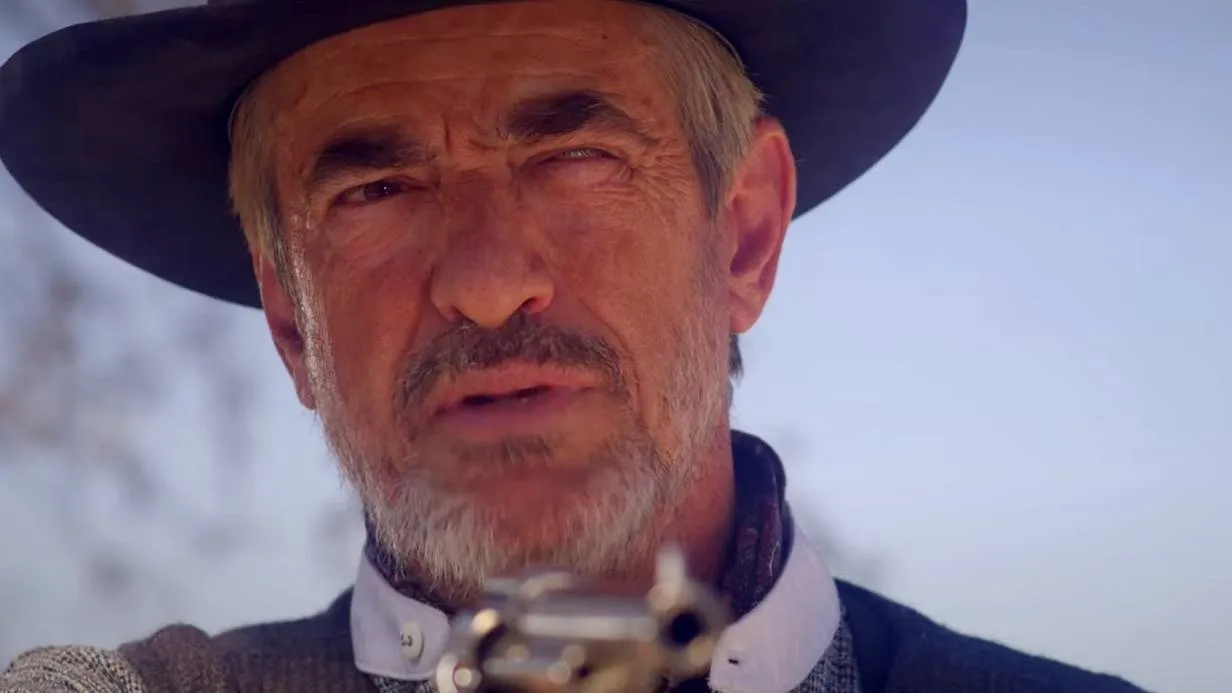
Familiar faces appear in support, though their parts lack shape. Dermot Mulroney’s Dallas Garrett reads as the cool cowboy archetype, present largely to run Marcus through essential gun training. Jacqueline Bisset as Vivian Villeré and Dominic Monaghan as Ned Duxbury occupy time with bickering and petty schemes that do not steer the central revenge thread. Grainger Hines offers a notable exception as Sheriff Wesley Tibbs. He projects a layered portrait of a worn lawman carrying grief, which hints at the psychological register the film seeks.
Thematic Overreach and Narrative Cheat
The film sets its sights on a cerebral Western, one that weighs healing and redemption and maps a conflict between tradition, represented by impulsive violence, and modernity, represented by measured response. The last act even folds in a mental health component. The intention reaches for a dialogue that Westerns have carried across cultures: how communities balance codes of honor with new systems of order. The execution falls short. Flat roles and stiff line readings drain the charge from these ideas, which makes an emotional connection to Marcus’s struggle hard to form.
The final fifteen minutes introduce a revelation tied to historically informed shifts in legal procedure and to the rise of psychology. Earlier events receive a reframing. The shift reads as a forced device, an odd add-on that does not grow from the film’s earlier groundwork. It mainly clears a convenient path for the protagonist and sidesteps the usual reckoning that revenge stories deliver. Medical progress and legal technicalities arrive abruptly to gesture at social change challenging Old West traditions, yet the film has not set a foundation that would make that gesture feel earned. The ending flattens the impact the story seeks to leave.
Long Shadows positions itself within a genre that already connects across cultures, where American frontier myths and Italian reinterpretations converse about justice, fate, and personal code. The film points to that conversation and tries to add a psychological layer that could speak to audiences across regions. The attempt remains largely theoretical. Form, performance, and structure rarely move in tandem, which keeps the film from finding the synergy between story and screen that might bridge local setting and global view. The frontier here is Arizona, yet the work needed to translate that place into a shared cinematic language remains unfinished.
Long Shadows is a Western thriller film that premiered with a limited theatrical release on November 7, 2025, distributed by Quiver Distribution. The story is set in the 1880s American West and centers on a young man, a survivor of childhood tragedy, who is torn between a path of vengeance and the promise of redemption through love. The film marks the feature directorial debut of William Shockley and features a cast that includes seasoned actors alongside newcomers.
Credits
Title: Long Shadows
Distributor: Quiver Distribution
Release date: November 7, 2025 (Limited)
Rating: R
Running time: 100 minutes
Director: William Shockley
Writers: William Shockley, Shelley Reid, Grainger Hines
Producers: William Shockley, Tom Brady, Grainger Hines, Allen Gilmer, Justin Kreinbrink, Tiiu Loigu
Executive Producers: Allen Gilmer, Riki Rushing
Cast: Dermot Mulroney, Dominic Monaghan, Jacqueline Bisset, Blaine Maye, Sarah Cortez, Chris Mulkey, Grainger Hines, Ronnie Gene Blevins, Anthony Skordi, David St. Louis
Director of Photography (Cinematographer): A.J. Raitano
Editors: Chris Patterson
Composer: Tommy Fields
The Review
Long Shadows
The film's ambition to modernize the Western with a psychological focus is commendable, but its execution falls short on multiple fronts. Director William Shockley struggles with pacing and visual coherence, leading to a jarring, amateurish presentation. Flat characterizations and wooden performances from the lead actors prevent any emotional connection, despite strong work by Grainger Hines. The late-act thematic twist involving legal and medical shifts feels unearned, functioning as a narrative mechanism rather than a genuine exploration of redemption. This results in a film that is ultimately shallow and difficult to recommend, failing to realize its potential for depth.
PROS
- Ambitious attempt to layer modern psychological themes onto the classic Western genre.
- Decent location shooting and cinematography.
- Grainger Hines offers a layered performance as Sheriff Tibbs.
CONS
- Amateurish direction and jarring editing choices.
- Lead performances (Maye and Cortez) are often wooden or melodramatic.
- Character writing is shallow; backstories are forced exposition.
- Pacing is consistently slow and plodding.
- The nonlinear structure is confusing and ultimately unhelpful.
- The final thematic twist feels like an unearned "cheat" to force a conclusion.