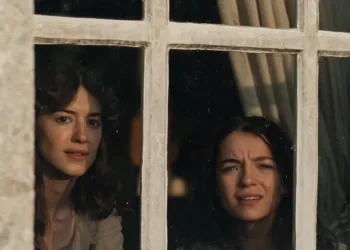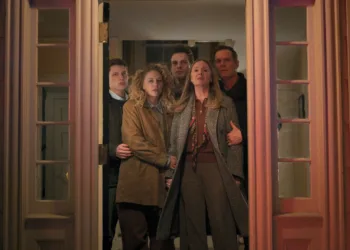






Dutch writer-director Nanouk Leopold’s drama Whitetail plants itself in a lush and foreboding nature reserve in southern Ireland. From the first minutes the film sets a tone of melancholy and guarded emotion. The story introduces Jen (Natasha O’Keeffe), a disciplined forest ranger whose life remains bound to the woods where a horrific accident marked her adolescence.
The structure builds from Jen’s buried past. Her controlled routine starts to wobble under two pressures: the return of Oscar (Aaron McCusker), a former boyfriend who witnessed the trauma, and the unsettling appearance of poachers who trespass on the protected land. The film unfolds as a slow-burning psychological study that uses stillness to express the weight of unprocessed pain. The quiet invites the audience to sit with Jen’s isolation and feel its hold.
The Body as Testimony: O’Keeffe’s Stark Portrayal
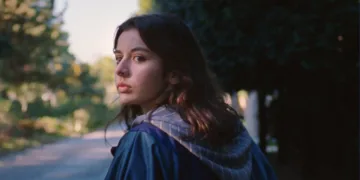
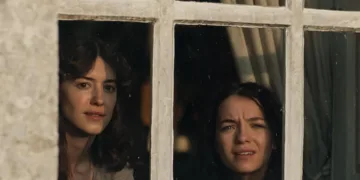
Natasha O’Keeffe gives a grounded, lived-in performance that holds the film together. The role highlights physical expression more than dialogue. Jen reads as emotionally distant, intent, and relentlessly industrious, channeling ranger work and daily tasks to keep anguish at bay. O’Keeffe thrives in extended passages without speech, where years of grief and muted guilt surface through small, precise gestures.
A slight tilt of the head, the slump in her shoulders, or a quick flare of the nostril signals the pressure she carries. I think of performers in classic slow cinema who let the body carry meaning and invite viewers to read silence as text.
The film allows Jen to appear prickly or difficult at times, a choice that feels direct and honest, and O’Keeffe roots that quality in palpable hurt. The supporting figures, including Oscar and Jen’s father, Daniel (Andrew Bennett), operate as mirrors that press her toward an acknowledgment of what she tries to keep underground.
Leopold’s Austere Vision and Visual Poetics
Leopold shapes the film with an austere script where drama lives between lines. The characters speak sparingly, which asks the audience to watch behavior and assemble emotional logic from action and pause. The experience can feel exacting, and it pays off for viewers who tune into the quiet.

Slow pacing and long takes set the audience inside Jen’s stasis and her inability to gain forward motion. Cinematographer Frank van den Eeden photographs the Irish landscape as beautiful and haunted at once. The setting functions as more than scenery; it reflects Jen’s interior life and reads as both refuge and confinement.
The recurring image of a ranger tending the same place that hurt her works as a pointed metaphor for memory’s grip. My long-standing affection for independent filmmaking often pulls me toward directors who tell stories through image and rhythm. Here the sound design and Stephen Rennicks’ score deepen the mood of dread and unease, hinting at danger that lingers inside stillness.
Trauma, Structure, and the External Threat
The film studies grief, guilt, regret, and the paralysis that follows unresolved trauma, tracing how a single event can harden the shape of a life. Structurally, Leopold makes a clear choice by presenting the traumatic incident in a striking prologue, which removes mystery around the event itself. The tension shifts toward Jen’s adult response, a sharp turn from more conventional mystery-driven frameworks.
The poacher thread introduces a concrete outside threat and a faint thriller current. This turbulence reflects Jen’s inner state, though the material can feel thin or distracting unless treated as a metaphor for the chaos rising inside her. The renewed connection with Oscar serves as the essential spark that brings the past back into view. Whitetail asks for patience. The film grants its rewards to viewers willing to meet its quiet tempo and sit with Jen’s searching gaze.
Whitetail, directed by Nanouk Leopold, had its World Premiere at the 2025 Toronto International Film Festival (TIFF) in September 2025. It is a slow-burn psychological drama centered on Jen, a forest ranger in Southern Ireland who is forced to confront unresolved trauma from a teenage accident when her ex-boyfriend returns to town. As of now, the film has been playing the festival circuit, including TIFF, but a wide theatrical or streaming release date for general audiences is listed as Coming Soon in the U.S. and other regions.
Credits
Title: Whitetail
Distributor: Circe Films (International Sales), Keeper Pictures, Kaap Holland Film, Savage Film, VPRO Television
Release date: World Premiere: September 2025 (Toronto International Film Festival)
Running time: 100 minutes, 103 minutes
Director: Nanouk Leopold
Writers: Nanouk Leopold
Producers and Executive Producers: Stienette Bosklopper, Maarten Swart, Katie Holly, Evan Horan, Bart Van Langendonck, Martien Vlietman, Jorn Baars, Anne Carey, Mike Goodridge
Cast: Natasha O’Keeffe, Aaron McCusker, Andrew Bennett, Simone Kirby, Rory Nolan, Aidan O’Hare, Abby Fitz, Seán Treacy, Hélène Patarot
Director of Photography (Cinematographer): Frank van den Eeden
Editors: Katharina Wartena
Composer: Stephen Rennicks
The Review
Whitetail
Nanouk Leopold’s Whitetail is a rigorous character study anchored by Natasha O’Keeffe’s remarkable, physical performance. The film succeeds through its visual command and the actor’s ability to communicate deep trauma through stillness and silence. While the glacial pacing and the somewhat underdeveloped poacher storyline may test patience, the film offers a powerful meditation on how grief calcifies human life. It demands surrender from the viewer, rewarding those who accept its austere and introspective style.
PROS
- Natasha O’Keeffe delivers a staggering, lived-in central performance.
- Frank van den Eeden's cinematography is beautiful, capturing the landscape as a haunted character.
- The director’s austere style focuses tension on the character’s internal experience.
- Effective narrative structure, which subverts convention by focusing on the aftermath of trauma.
- A powerful meditation on guilt, regret, and emotional paralysis.
CONS
- The deliberate, slow pacing and long takes may be too challenging for some viewers.
- The subplot involving the poachers feels underdeveloped or distracting from the main emotional arc.
- The protagonist's severe emotional remoteness makes the film hard to connect with at times.