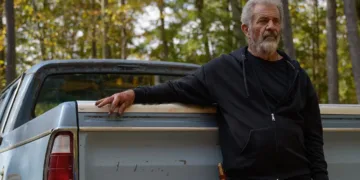




















Hunting Season opens in a cinematic space that feels pre-written into the collective imagination: retreat as a way of life. The film presents itself as a crime-thriller built around Bowdrie (Mel Gibson), a man who has turned isolation into a disciplined practice. He lives off the grid in the remote Oklahoma woods with his teenage daughter Tag (Sofia Hublitz), a self-imposed exile from social structures he may once have helped sustain. Their existence follows a strict routine of basic, almost Spartan, self-sufficiency, a kind of Neo-Stoic Rustic lifestyle that treats solitude like a creed, a chosen condition.
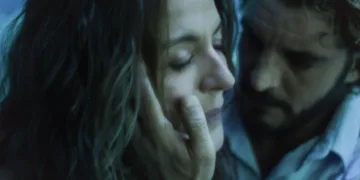
This carefully arranged order collapses when Tag discovers January (Shelley Hennig), a young woman badly hurt and washed ashore, a human fragment cast off by the very world Bowdrie tried to leave behind. Her sudden presence brings immediate danger. January is hunted by a ruthless local syndicate led by crime boss Alejandro (Jordi Mollà). Once Bowdrie’s perimeter is breached, he has to bring dormant violent skills back into play to protect his home and his ward. The film shapes itself as a survivalist action story, tracing the collision between a withdrawn individual and the brutal forces of the outside world that insist on entry.
The Economy of Presence
Gibson’s Bowdrie functions as an essay in charismatic entropy. The performance stays gruff, intense, and deliberately pared down. He fits the familiar “strong, silent type,” a man of carefully chosen words. Each line of dialogue works like a tactical move, a spoken action that pushes toward a result, and that decisiveness gives shape to a role that could feel purely formulaic.
This screen persona belongs to a long-running cinematic type, yet Gibson’s weathered intensity, including the unblinking blue eyes, lends Bowdrie a sense of accumulated history, as if the character carries decades of film violence in his posture.
The father-daughter dynamic adds essential weight. Sofia Hublitz plays Tag with spirit and resolve. She plays as an active presence, never a passive victim or decorative foil, a fiercely capable counterpart. Their relationship supplies the film with its emotional core and gives the violence that follows a specific charge. Tag mirrors her father’s grit, taking an active part in defending the only territory they truly claim. Within this configuration, January functions as catalyst, the person whose need for shelter sets the lethal machinery in motion. The solidity of these central turns keeps the project steady and prevents it from drifting into anonymous genre exercise.
Rhythms of Rural Violence
Director RJ Collins leans into a measured, almost agrarian rhythm in the early stretches, echoing Bowdrie’s buried life in the woods. The slow build, familiar from stories about quiet existence shattered by intrusion, suggests a careful descent into chaos. The film maintains a certain practical efficiency, running 93 minutes, a brisk mix of crime, thriller, and action with clear dramatic shades.

The staging of violence does not always hold that promise of acceleration. Certain sequences play sharply and with control, particularly Bowdrie’s siege on the criminals’ hideout, which features a precisely staged shootout. Yet the momentum across the film can feel stop-start.
Collins’s direction wavers when sustained escalation is required, especially once the antagonists reach Bowdrie’s land. The anticipated explosion of chaos never quite matches the patient waiting that precedes it, and the climactic clash lands with slightly less force than the setup seems to promise.
Dialectics of Decay and the Kitsch Villain
Adam Hampton’s script supplies the actors with what one might call nutritionally dense dialogue, especially for Bowdrie, whose blunt speech has a kind of brutal poetry. His negotiating style arrives fully formed in a line such as, “You tell me what I want to know or I’ll kill you.” That directness occasionally gives way to dark, self-aware humor. A moment of interrogation exasperation, for example, offers a small jolt of surprise, a brief flash of humanity amid the mechanics of survival.
Alejandro, played by Jordi Mollà, stands as the film’s most aggressively heightened element. Mollà leans into an eccentric, violent and overtly sleazy register, the cinematic crime lord archetype turned up to a kitsch frequency. Some viewers may see the character as a collection of genre clichés arranged for effect.
That baroque excess plays against Gibson’s quiet control. Alejandro embodies a chaos principle, his theatrical manner shaped to highlight Bowdrie’s strict economy of movement and language. Their final confrontation gains distinction from that aesthetic split. The film relies on a familiar survival template, yet the sustained attention to character, supported by Hampton’s sharp dialogue, gives it a steady anchor.
Hunting Season is a crime-thriller starring Mel Gibson as a reclusive survivalist who is forced to protect his daughter and a mysterious wounded woman from a ruthless drug lord. The film is set for release on December 5, 2025, and will be available in select theaters and on Digital/VOD platforms.
Full Credits
Title: Hunting Season
Distributor: Samuel Goldwyn Films
Release date: December 5, 2025
Running time: 93 minutes
Director: Raja Collins
Writers: Adam Hampton
Cast: Mel Gibson, Shelley Hennig, Sofia Hublitz, Jordi Mollà, A.J. Buckley, James DuMont, Rocky Myers, Scarlet Rose Stallone
The Review
Hunting Season
Hunting Season delivers a proficient, if slightly languid, genre exercise. Its greatest strength lies in Mel Gibson's compelling, understated central performance and the robust father-daughter relationship, which grants emotional depth to the familiar "man pulled from isolation" template. The film features sharp dialogue and a memorable, kitschy antagonist that contrasts effectively with its hero. Despite some erratic pacing and action that feels curtailed, it functions well as an efficient survival thriller that understands the appeal of its lead actor.
PROS
- Mel Gibson’s intensely understated and charismatic performance.
- The strong, effective father-daughter dynamic anchors the story emotionally.
- Adam Hampton’s screenplay features enjoyably sharp and witty dialogue.
- The eccentric and flamboyant villain, Alejandro, provides an engaging contrast to Bowdrie.
- The film maintains a brisk and efficient genre-hybrid runtime (93 minutes).
CONS
- Pacing can feel stop-start, resulting in a languid momentum at times.
- The action sequences, while well-choreographed, are often short-lived or feel curtailed.
- The director, RJ Collins, fails to fully raise the tension stakes consistently.
- The highly stylized portrayal of the antagonist may come across as excessively over the top or parodic.
- The climactic confrontation does not fully justify the build-up or waiting time.