





















In the quiet, salt-strewn air of the California coast, Courtney Marsh presents a narrative debut that reads like a post-mortem performed on people still breathing. The setting is a beachfront secondary home, a structure of glass and wood with none of the warm, nostalgic echoes of a childhood residence. That chill matters. These siblings do not wrestle for roots so much as they wrestle for the remains of a life they no longer inhabit.
Cynthia, Bryce, and Miles return to this pristine shell each year to mark the anniversary of their parents’ death, and the ritual has soured into duty played for its own sake. Marsh’s background in observational documentaries shows in the way she pares mourning down to something plain and abrasive, then lets greed speak in the silences and clipped sentences.
The spark arrives when Cynthia exposes the rot beneath her stability and proposes selling the property to survive her pivot into the precarious world of full-time writing. The request for liquid assets collides with Bryce’s rigid preservationism and drops the youngest, Miles, into the role of reluctant arbiter of their shared history.
The film watches what happens when the patriarch and matriarch are gone and the space they leave behind fills with something smaller than adulthood: raw competition, childish scorekeeping, and the old nursery instinct to grab what you can before someone else does.
The Anatomy of a Fractured Trinity
The film’s emotional gravity rests on three performances that break the myth of sibling solidarity into jagged pieces. The story treats kinship like a fragile agreement, signed long ago, now questioned line by line. Under Marsh’s gaze, family becomes a philosophy seminar held in a locked room, except the participants have no interest in truth. They want ownership. They want to feel safe inside a narrative that keeps slipping away.
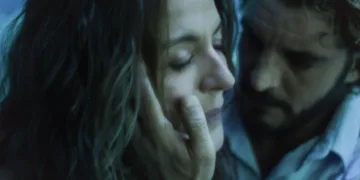
Carey Cox plays Cynthia with a sharp, defensive vulnerability that feels lived-in and abrasive. Her physical reality with Ehlers-Danlos Syndrome arrives without soft music or inspirational framing. It sits inside her as fact, shaping her advocacy and sharpening her anger.
A quiet resentment simmers toward a world, and a family, that demand she justify her needs again and again. Cynthia looks at the house and sees ransom. She treats it as leverage for a future that feels constantly at risk, and her certainty begins to resemble moral absolutism, the kind that turns survival into a courtroom where every objection sounds like betrayal.
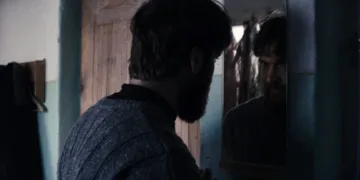
Amadeus Serafini’s Bryce stands opposite her, a man who has turned the cold pragmatism of the real estate market into a weapon. He is the eldest, and he wears the role like armor that has started to pinch. Arrogant and dismissive, he treats the family’s beachfront legacy as a ledger that proves his worth, a balance sheet where sentiment is a rounding error.
Serafini lets glimpses through the professional veneer: a hollow man measuring himself against his father’s professional ghost. Bryce clings to the property as proof of relevance, as if a sale would confirm what he already fears, that the lineage ended and he lacks an identity that belongs solely to him.
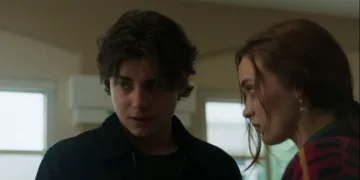
Between these two pillars of conviction sits Carson MacCormac’s Miles. As the youngest, he becomes the emotional spillway for the family’s toxic discharge. MacCormac captures the exhaustion of a college student who wants to be anywhere else, his eyes carrying the weight of a vote he never asked to cast.
His work shifts the most over time. He begins behind a mask of youthful apathy, and the mask fractures as his siblings’ cruelty escalates and the room grows smaller. The argument expands beyond property and becomes an existential crisis, with each sentence functioning like a choice between sustaining a lie and detonating a bond that has already begun to rot.
A Crucible of Glass and Shadow
Marsh directs with a claustrophobic intensity that undercuts the openness of the coastal setting. The house functions as a pressure cooker, and it keeps refusing the comfort of sanctuary. Tight, intrusive medium shots crowd the characters and crowd the viewer, leaving almost no room to breathe.
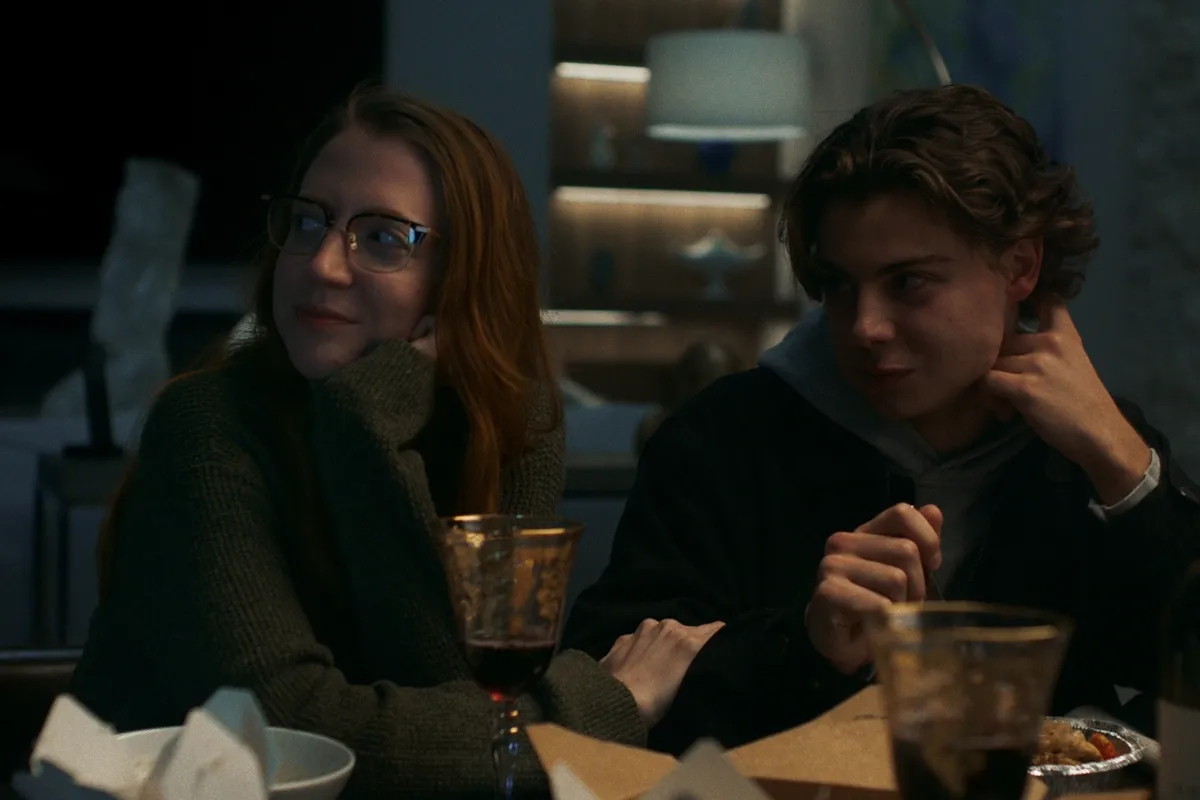
Visual grandeur stays out of frame on purpose. The camera fixates on a tightening jaw, a trembling hand, the small violences that arrive before civility collapses. The pacing moves in erratic surges, echoing the unpredictable rhythms of a long-standing family feud, where an old wound can reopen in a single breath and no one remembers how to stop pressing.
Blistering verbal warfare gives way to scenes of hollow levity, most clearly when the trio retreats to a hot tub. Steam and water smooth their edges for a moment, and they resemble siblings again. The silence between them carries the shape of everything they refuse to say. This choice amplifies the script’s documentary-like realism, with dialogue that feels unpolished and dangerously spontaneous, the sort of talk that can turn into a confession by accident.
The supporting presence of characters like Gabby, the ex-girlfriend, punctures the family’s sealed ecosystem and reminds us that this internal war leaves shrapnel in other lives. Maximilian Schmige’s cinematography leans into a naturalistic palette that grows more shadowed as the day wanes, and Steve London’s score runs underneath with subtle dissonance, hinting at the approach of a breaking point. The mansion becomes a character itself, a silent, expensive witness to the indignity of its owners.
The Silence After the Scream
The final movement descends into a primal state where language collapses under its own failure. The verbal abuse that simmers for ninety minutes finally boils over into physical eruption, shocking for its suddenness and its lack of grace. Miles, pushed past endurance, attacks Bryce in a sequence that feels frantic, like a desperate attempt to stop the noise with his hands when words cannot do it. The moment does not carry the clean geometry of choreography. It carries panic. Bryce’s body at the bottom of the staircase ends the last pretense they can keep calling themselves a family.
Marsh refuses the comforts of a traditional resolution, and that refusal becomes the film’s most haunting achievement. The story ends in the sterile, fluorescent vacuum of a surgical waiting room. Wealth and argument lose their shine there, and what remains is the cold reality of what they have done to one another. Catharsis stays out of reach. A question lingers: can any bond survive at the intersection of grief and greed, or does that crossing always demand a sacrifice?
The film’s title returns as a final, mocking observation of adult children who have burned their inheritance to keep themselves warm. We watch them sit inside silence and stare at the wreckage they made, and it feels possible that wreckage is the last thing they truly share. The film lands as a grim, poetic reminder that the death of a parent can kill the fiction called family, leaving behind only the hard light of what people choose when love turns transactional.
Where Did the Adults Go? arrived on October 9, 2025. This independent project is a work by director Courtney Marsh. The movie appeared on YouTube for a temporary release period. The producers chose this path after the film faced rejections from the festival circuit. The plot follows three siblings at a California estate. You can find the film on the official YouTube channel for the project.
Full Credits
Title: Where Did the Adults Go?
Distributor: Black Phoebe Films, Cynasty Films, The Group Entertainment
Release date: October 9, 2025
Running time: 1 hour 29 minutes
Director: Courtney Marsh
Writers: Courtney Marsh
Producers and Executive Producers: Jerry Franck, Sushila Love, Nic Novicki, Gill Holland
Cast: Carey Cox, Amadeus Serafini, Carson MacCormac, Samantha Rose Baldwin, Joanna Nava Goldsmith, D’Ann Connelly, William Atherton
Director of Photography (Cinematographer): Maximilian Schmige
Editors: Sushila Love
Composer: Steve London
The Review
Where Did the Adults Go?
Courtney Marsh provides a brutal autopsy of the familial bond. This film strips away the facade of maturity to expose the feral instincts triggered by grief and greed. It offers no comfort. It offers a cold observation of a house divided by the weight of the past. The performances are devastatingly honest, capturing the exact moment love curdles into a transaction. It is a haunting work that lingers in the silence of its own unresolved violence.
PROS
- The casting of Carey Cox provides a grounded physical presence and emotional depth.
- The screenplay maintains a commitment to psychological realism without sentimental filters.
- The visual style creates a palpable sense of confinement that heightens the script.
CONS
- The side story featuring the ex-girlfriend lacks the weight of the central conflict.
- The absence of traditional closure may alienate viewers seeking a clean resolution.