





























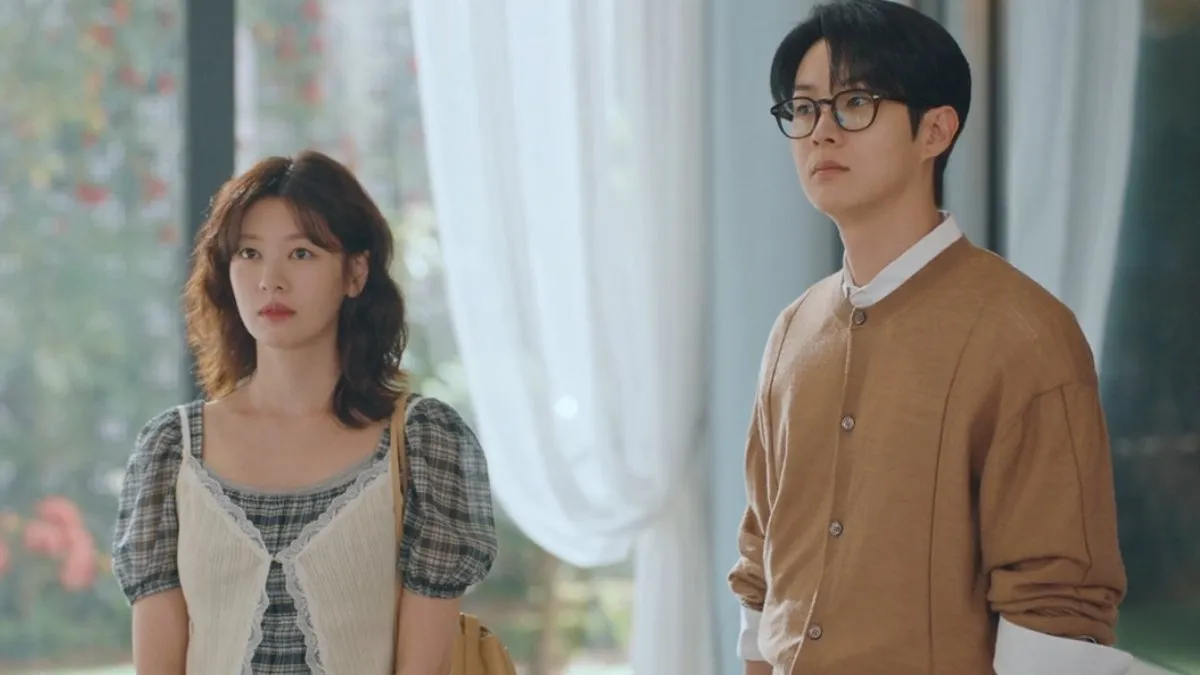

The series builds its entire engine around one bureaucratic mistake that refuses to stay small. Yoo Me-ri, a designer running Merry Design Studio, carries herself with the kind of grit that reads as hard-earned. Then she catches her fiancé, Kim Woo-ju, cheating right as the wedding prep reaches the finish line. The timing hurts, yet the real damage sits in paperwork: they already registered their marriage to lock in a shared future.
That legal link turns from romantic shortcut to practical problem solving when Me-ri wins a luxury home in a raffle run by Beaute Department Store. The prize comes with public ceremonies and legal transfers that demand the presence of her husband. The man who was meant to fill that role has already drifted toward another woman, and he has already proven he cannot be trusted to show up for anything that matters.
Me-ri’s way out arrives through coincidence with a mischievous streak. She meets a stranger who shares the exact name of her ex, Kim Woo-joo. This second Kim Woo-joo happens to be the grandson of the powerful family behind the Myungsoondang bakery, which gives the situation social heat before anyone even speaks. Their first meeting goes sideways through a chaotic mishap involving a cactus and an emergency room visit, the kind of introduction that signals a story interested in friction. From there, the show commits to its premise: an administrative accident pushes two strangers into a partnership built on deception, and the plot treats that lie as a tool for survival that keeps demanding new payments.
Administrative Traps and Fake Unions
The tension comes from the raffle’s fine print and the corporate agenda wrapped around it. Beaute Department Store presents the giveaway as a glossy public stunt, yet the conditions function like a trapdoor. The house requires ninety days of residency, plus a strict ban on flipping the property right away. Those rules keep Me-ri pinned in place and turn the prize into a daily obligation, not a clean escape hatch.
Inside the department store, executives Sung-woo and Sang-hyun treat the house like a political chip. They want it as a bribe for the local mayor to secure approval for a new building complex, and Me-ri’s win becomes an obstacle they try to remove. Their sabotage attempts force her into a fast decision: she asks the second Kim Woo-joo to pose as her husband so she can protect her financial future and stay eligible for the transfer rituals.
His consent has its own logic. His family bakery is tangled in a copyright dispute with Me-ri’s studio, and he reads the fake marriage as leverage to settle the debt while managing pressure from his grandmother. The show keeps the scheme active by throwing the pair into high-visibility events where one slip can end everything. They even wear masks during photo shoots to keep the media from catching their identities, then claim a viral infection as the reason for covered faces. It is an excuse with the shelf life of milk, which is part of the fun.
Surveillance tightens the screws. Their neighbor, Sang-hyun, doubles as a director at the department store, and he watches them with the patience of someone waiting for a mistake. The arrangement forces these strangers to share a home they cannot leave, with each morning carrying a fresh chance of exposure. Coworkers and relatives press for details about the sudden union, and every answer breeds another question. The story tracks how one “temporary” performance multiplies into a whole routine of social acting that becomes harder to drop with each passing day.
Character Grit and Moral Failures
Jung So Min grounds the series with a performance that keeps Me-ri readable as a working professional, not a walking premise. She plays Me-ri as someone who places real value on professional integrity and refuses to let a cheating partner rewrite her identity. The show also gives her a steady resistance to the sexist attitudes that surface in industry panels, and Jung’s choices make that resistance feel lived-in rather than staged. Her resilience becomes the stabilizing force when the plot starts piling complications on her doorstep.

Choi Woo Sik plays the second Kim Woo-joo with a quieter kind of strength. He carries wealth and family power on paper, yet his presence avoids the standard swagger associated with chaebol characters. The performance leans into calm kindness and a sense of interior caution. The script ties that caution to a childhood car accident that killed his parents, and that history shapes how he moves through risk, including his decision to help a stranger with a plan that can explode in public.
The antagonists represent different kinds of rot. The first Kim Woo-ju comes off immature and self-serving, a man who shrugs off responsibility and keeps chasing comfort. Uncle Jang Han-gu brings a darker menace: he maintains a polished public face while running money laundering and tax evasion, and the story paints him as someone prepared to use violence to hold onto power.
The emotional momentum sits with the leads’ chemistry. Jung So Min and Choi Woo Sik sell the shift from suspicion to functional partnership, and the show frames that shift as a response to shared pressure rather than instant romance. Supporting players widen the conflict. Baek Sang-hyun’s stoicism and Doctor Yoon Jin-gyeong’s moral clarity add different forms of scrutiny, keeping the threat of discovery close enough to feel constant. Their presence pushes the protagonists to adapt, recalibrate, and keep rewriting the rules of their own secret marriage.
Nostalgic Production and the Price of Truth
Writer Lee Ha Na works in a mode that salutes classic K-dramas from two decades ago, and the production leans into familiar tropes that invite nostalgia without making the show feel stuck in amber. The cinematography reinforces the social divide at the story’s core by contrasting Me-ri’s modest studio with the prize home’s cold luxury. The images keep reminding you what the characters are performing for, and what the performance costs them.
Tonally, the series swings between comedic misunderstandings and a corporate-thriller thread, and that shift tracks the plot’s escalation. As the fake marriage gets tied to financial crimes and family secrets, the stakes darken in a way that feels earned by the story’s own logic. The theme stays clear: honesty carries a high price in a culture obsessed with public status, and each character faces the decision to show a true self or keep acting for safety.
The first two episodes move with clean pacing and a strong sense of structure, keeping attention on the immediate fallout of the fake-marriage scheme instead of drifting into filler. Traditional storytelling beats sit alongside high production values that keep scenes polished and brisk.
The central conflict comes through as a fight for personal integrity under survival pressure, and the show watches a single lie grow into something with its own momentum. The result plays like a study of social expectations and the roles people accept to protect a place in the world, even as the characters keep searching for authentic connection inside a fabrication.
Would You Marry Me? premiered on October 10, 2025, on the South Korean network SBS TV as a highly anticipated Friday-Saturday romantic comedy. The series quickly gained international traction and is currently available for streaming on Disney+ and Hulu in various regions. Centered on a chaotic 90-day contract marriage between a struggling designer and a wealthy bakery heir, the show concluded its 12-episode run on November 15, 2025, leaving fans with a heartwarming resolution just in time for the holiday season.
Full Credits
Title: Would You Marry Me?
Distributor: SBS TV, Disney+, Hulu
Release date: October 10, 2025
Rating: TV-14
Running time: 70 minutes
Director: Song Hyun-wook, Hwang In-hyeok
Writers: Lee Ha-na
Producers and Executive Producers: Ahn Je-hyun, Shin Sang-yoon, Jo Eun-jeong, Park Young-soo, Hwang Cheol-min, Yoon Eun-jung
Cast: Choi Woo-shik, Jung So-min, Seo Bum-june, Shin Seul-ki, Bae Na-ra, Jung Ae-ri, Kim Young-min, Baek Ji-won
Director of Photography (Cinematographer): Kang Woo-ryang, Kim Ki-hun, Yu Jun-ho
Editors: Studio S Post-Production Team
Composer: Juho, Dohyeong Lee, Minjoo Kim, Z, Huze, Sondia
The Review
Would You Marry Me?
Would You Marry Me? succeeds as a comforting exercise in traditional storytelling. It relies on the charisma of Jung So Min and Choi Woo Shik to carry a plot built on familiar foundations. While the corporate thriller elements occasionally clash with the lighter romantic moments, the series remains a satisfying watch for those who appreciate the charm of a well executed fake marriage scenario. The emotional payoff feels earned. It offers a nostalgic escape that prioritizes character warmth over narrative innovation. This is a reliable choice for fans of the genre.
PROS
- Strong chemistry between Jung So Min and Choi Woo Shik.
- Effective use of nostalgic romantic comedy tropes.
- Engaging pacing in the opening episodes.
- High production values and attractive cinematography.
CONS
- Jarring shift into darker corporate thriller subplots.
- Predictable narrative progression.
- Underutilized secondary character arcs.
- Repetitive behavior from the antagonist ex-fiancé.







