
















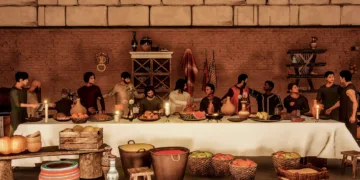





Twenty-seven moving curtains drift across the Lisbon stage like shifting mist, catching flickers of digital light and turning the air into something translucent and alive. This captured performance from September 2023 preserves the most intricate theatrical undertaking of a career built on restless evolution, with pop structure giving way to something closer to a staged ecosystem. The film plays like a record of a high-concept installation, with the artist positioned as a conduit between primordial nature and a digital frontier.
The setlist draws heavily from the airy, flute-laden compositions of the Utopia era and the dense, fungal textures of Fossora. Technology becomes a means of making organic rhythms visible, translating what stays hidden in soil, breath, and pulse into image and sound. Inside the Lisbon arena, quiet reverence holds the room between bursts of sensory intensity. The stage reads as a workshop for multisensory experimentation, with celebrity receding behind the demands of craft.
The Mechanics of Collaborative Sound
The musical landscape is anchored by Viibra, a seven-piece flute septet that moves as a nomadic choral and instrumental force. The performers sing and dance across the stage, and they form striking geometries around the lead vocalist, including a moment where a massive, descending circular flute surrounds her, acting as a physical perimeter and a resonant chamber.
That woodwind foundation gives the music lift and motion beside the earthy weight of the Hamrahlíð Choir, whose otherworldly harmonies stand in for synthesizers and electronic pads. Their presence brings a communal, human force to the production, holding its high-tech imagery in a voice that feels bodily and shared.
Custom instruments press the show further away from standard concert habits, keeping sound tactile and materially grounded. A reverb chamber shaped like a rustic flower pot or a primitive hut produces acoustic echoes that recall the resonance of a cave or a secluded forest clearing. Percussionists work with water bowls and a magnetic harp, generating textures that suggest ancient ritual and speculative futurism at once, tethered to earth and water as physical elements.
Familiar songs are remade to suit this particular sonic habitat. “Isobel” loses its original orchestral sweep and takes shape as a delicate lattice of electronic blips and regal woodwinds. “Pagan Poetry” arrives with its flow reversed, sliding into the heavy, distorted beats of “Losss.” The centerpiece, “Body Memory,” stands as an eleven-minute masterclass in songwriting, using the full scale of choir and ensemble to raise a towering wall of sound. It serves as the emotional anchor of the set, a sprawling meditation on physical presence and ancestral knowledge that drives the instrumentalists to their technical limits.
Biomorphic Spores and Digital Metamorphosis
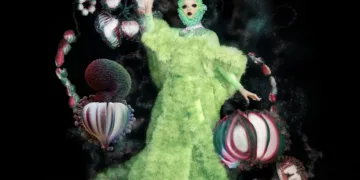
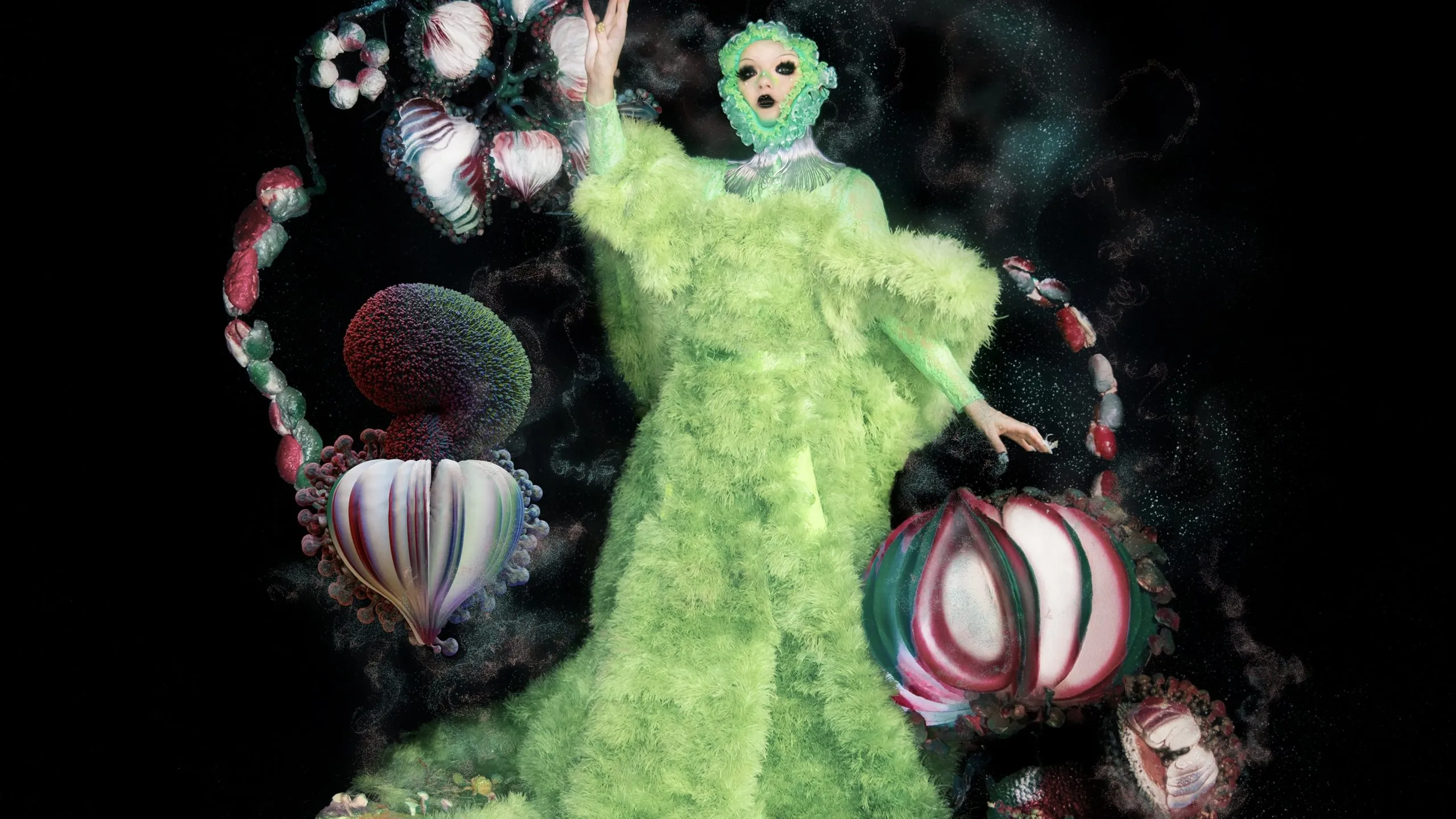
Visually, the production commits to biomorphic surrealism, pressing the viewer to constantly re-evaluate what is physical and what is rendered. Projections across the tiered curtains and a massive rear screen generate a feeling of endless depth, where biological forms unfurl in slow motion and reveal intricacy in every curl and filament.
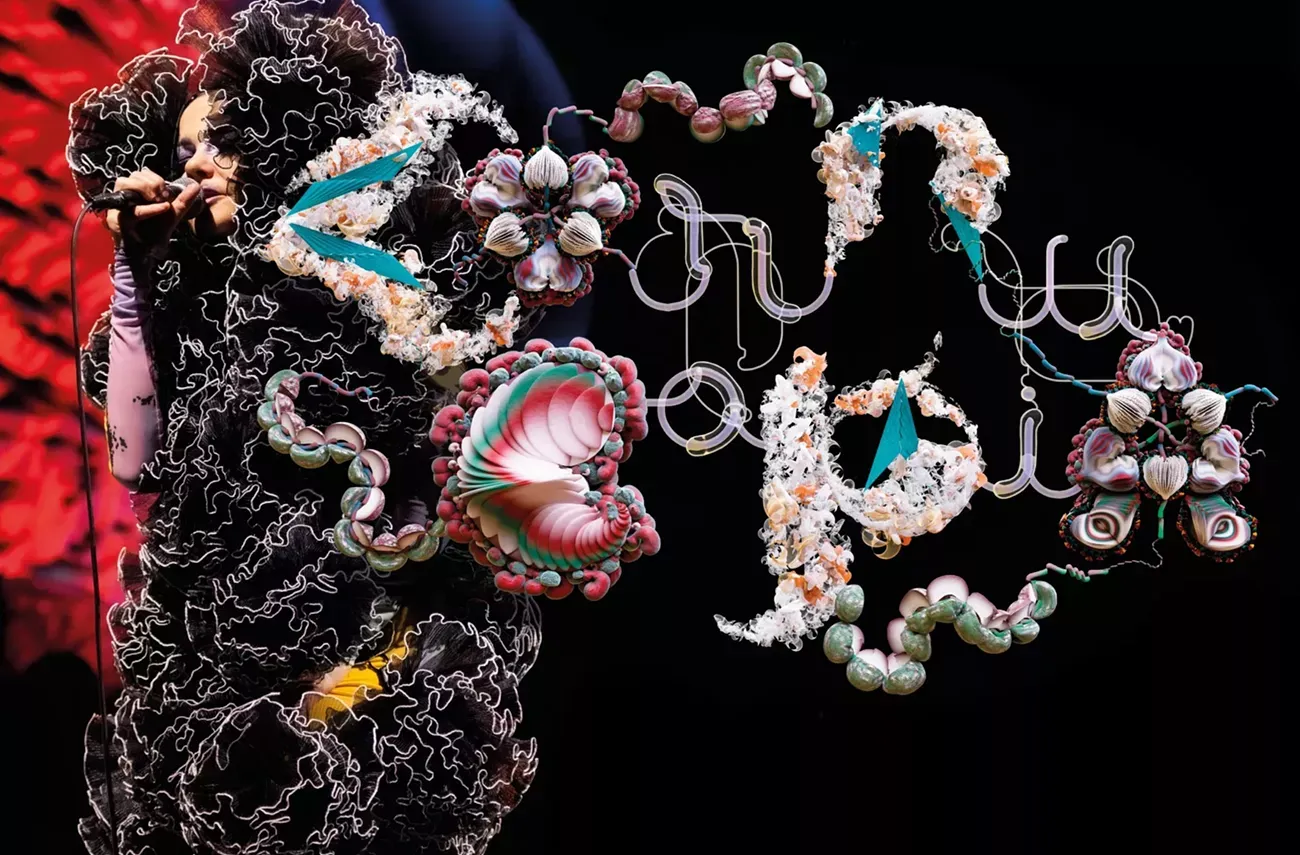
The stage itself is lined with ridges that resemble the gills beneath a portobello mushroom, implying that the performance unfolds inside a living organism. Filaments, rhizomes, and sprouting spores dominate the palette, pulling the microscopic and the cosmic into the same frame, with beauty that carries an undertow of unease.
Balmain-designed costumes strengthen that connection to the earth through porous, bulbous shapes that turn away from the expected pop-star silhouette. They resemble coral structures or overgrown gardenias, putting sculptural form ahead of displaying the human body and releasing the performer from the male gaze. In post-production, digital art is layered directly onto the live footage, building a hybrid reality that treats the camera as a collaborator.
The artist’s face repeatedly shifts into alien configurations, lit with bioluminescent patterns that suggest extraterrestrial evolution or a fresh species of digital life. The edit stays tightly locked to the musical pulse, with zooms and cuts timed to the sharp breaths of the flutes. Digital air snakes dart through the frame in response to the harp’s commands, creating a sensory density that demands full attention. The result reads as curated video art shaped through deliberate digital intervention, extending the live experience through design choices that remain visible in every composite layer.
The Ecological Call and Cinematic Communion
Environmental advocacy carries real weight here, sharpened by a video address from Greta Thunberg on the climate crisis. The message functions as the show’s thematic spine, giving gravity to visuals that might otherwise drift into pure whimsy. The production imagines a utopian future where humanity, technology, and nature exist in symbiotic balance, oriented toward cooperation instead of collapse.
In a cinema, the film holds the rhythmic cadence of a live event, and it can spark a collective energy that echoes the Lisbon room. Audience members respond to the screen with the same intensity reserved for a performer in the flesh, creating a living connection between recorded time and the present tense of communal watching.
That theatricality also signals a fierce artistic independence, with the production pushing back against commercial pressures and gendered expectations placed on global stars. Recognizable hits and easy accessibility have little space here; the emphasis stays on the craft of building a singular vision that asks the audience to meet it on its own terms. The finale, strengthened by the choir and the percussive weight of Fossora material, leaves an afterimage of urgency and hope.
The sound mix captures dense melodic layers with clarity, even when arrangements surge toward chaos. The stage becomes a site for radical imagination, proposing that the fusion of art and ecology can point toward a different way of inhabiting the world. The film closes as both concert document and manifesto, arguing for creative existence shaped by ambition and experimentation, resisting the constraints of genre and industry expectation.
Björk: Cornucopia is a 2025 documentary and concert film that captures the final performance of the artist’s four-year world tour at the Altice Arena in Lisbon. The production is a high-concept art installation that translates a intricate 19th-century theatrical setup into a modern cinematic experience using 4K visuals and Dolby Atmos sound. It originally premiered as a shortened edition on Apple TV+ on January 24, 2025, before seeing a limited global theatrical release in over 500 cinemas on May 7, 2025. Currently, the film is available to stream on Apple TV+ and was released on physical media, including 4K Ultra HD and Blu-ray, in October 2025.
Full Credits
Title: Björk: Cornucopia
Distributor: Trafalgar Releasing, Apple Music, Apple TV+, One Little Independent Records
Release date: January 24, 2025 (Apple TV+), May 7, 2025 (Theatrical)
Rating: 12A
Running time: 98 minutes
Director: Ísold Uggadóttir
Writers: Björk
Producers and Executive Producers: Björk, Sara Nassim, Kat Mansoor, Derek Birkett, Adrienne Becker, Roger Clark, Davíð Helgason, Ian Wheeler, Susan Lord, Brogan Bambrogan, Benjamin Ratz, Sigrid Dyekjær
Cast: Björk, Bergur Þórisson, Manu Delago, Katie Buckley, Viibra, The Hamrahlíð Choir
Director of Photography (Cinematographer): Artur Tort
Editors: Walter Mauriot
Composer: Björk
The Review
Cornucopia
This film captures a monumental shift in artistic expression. It rejects standard entertainment to present a dense, multisensory environment where biology and digital art meet. The technical execution of the Lisbon stage and the reimagined sonic landscape provide a rare look at a creator working without compromise. It functions as a challenging, high-concept visual document that rewards those seeking an experience beyond traditional cinema.
PROS
- Extraordinary use of custom instruments and choral arrangements.
- Striking biomorphic stage design and Balmain costuming.
- High-quality sound recording that preserves the detail of the Lisbon concert.
- Successful translation of a complex live art installation to the screen.
CONS
- The dense melodic layers can feel overwhelming during the two-hour runtime.
- Subtitles are permanently fixed to the image and cannot be removed.
- Lack of behind-the-scenes material to explain the custom instrument builds.
- Certain digital overlays occasionally obscure the live performers too much.