










![Kingdom Hearts Collection [I-III] Review](https://gazettely.com/wp-content/uploads/2026/10/Kingdom-Hearts-Collection-I-III-1-360x180.webp "Kingdom Hearts Collection [I-III] Review: KHII Holds Steady as Newer Entries Fluctuate 33")








San Francisco exhales beneath a thin veil of fog as Damien and his eight-year-old daughter, Josephine, move through their weekly ritual. Their run through Golden Gate Park carries the quiet rhythm of domestic routine. That calm ruptures when Josephine strays onto a different path.
She becomes the silent witness to a brutal sexual assault carried out by a stranger against a lone jogger. Damien arrives in a surge of paternal adrenaline, chasing the attacker and calling for the authorities. The immediate danger ends quickly. The wound that follows remains open.
Beth de Araújo’s film sets aside the familiar machinery of a thriller and lingers inside the suffocating aftershock of this event. The following weeks unfold as a slow, disoriented passage through a world that no longer feels recognizable. The story keeps its gaze on a child who lacks language for the cruelty she has absorbed. Innocence fractures in an instant. What follows is an agonizing, bureaucratic trek toward a legal resolution that carries no promise of peace.
The Gaze Without Mercy
Cinema often relies on ellipses to offer mercy. It cuts to black. It drifts toward swaying trees. It shields the viewer from the direct sight of violation. De Araújo refuses that shelter. She places us behind the tree where Josephine stands and makes us stay. We watch the assault in full because the child cannot look away. The moment binds the audience to the confusion of a developing mind trying to name the unthinkable. Time stretches. Meaning collapses. Witness becomes burden.
The violence arrives with blunt, clinical coldness, echoing the stunned stillness of the observer. Horror emerges through duration rather than spectacle. The scene insists on the existential cost of seeing, the way an image embeds itself in consciousness and refuses erasure.
The chaos that follows offers no relief. The film records a collapse of empathy inside the institutions meant to protect. Josephine ends up in the back of a patrol car beside the weeping survivor. The camera lingers on that proximity, on two forms of pain pressed into the same confined space.
She identifies with a bug trapped against the glass. A male officer, blind to her fragility, handles her like a data point to be processed. The sequence tightens into a chilling exchange of looks when Josephine locks eyes with the perpetrator in his aqua polo. In that stare, he stops being a passing shadow. He becomes fixed in her reality, a presence that refuses disappearance.
The Architecture of a Haunting
Mason Reeves gives Josephine a startling interior life. She plays her as a soul retreating into a fortress of silence, with rage simmering beneath the quiet. Her secret settles into her body. The thousand-yard stare. The jagged movements. The sense that her skin has grown too tight for the self she used to inhabit.
Trauma takes on the weight of a physical presence. Philip Ettinger appears in her room at night, a mute specter by her bed, watching her sleep. He functions as the embodiment of a memory that refuses eviction. The film enters an existential register here. Evil, once seen, takes up residence.
Josephine’s effort to understand what happened becomes a lonely, digital pilgrimage. She steals her mother’s phone and searches for “raip,” the misspelling carrying its own quiet tragedy. The error speaks to isolation, a child assembling meaning with the wrong letters and no guide. The adults around her freeze in discomfort, leaving her to construct her own understanding of male aggression.
The absence of direct language reshapes her. The spry athlete gives way to a volatile student who drags the violence of the park into the playground. She fixates on the mechanics of defense, as if technique could seal the crack that has opened in the world. The film watches this shift without diagnosis. It feels like a portrait of a mind trying to build rules for survival after learning that bodies can break without warning.
The Fragility of the Protectors
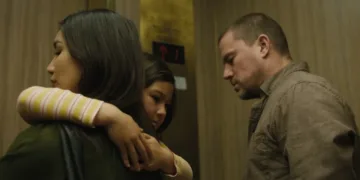
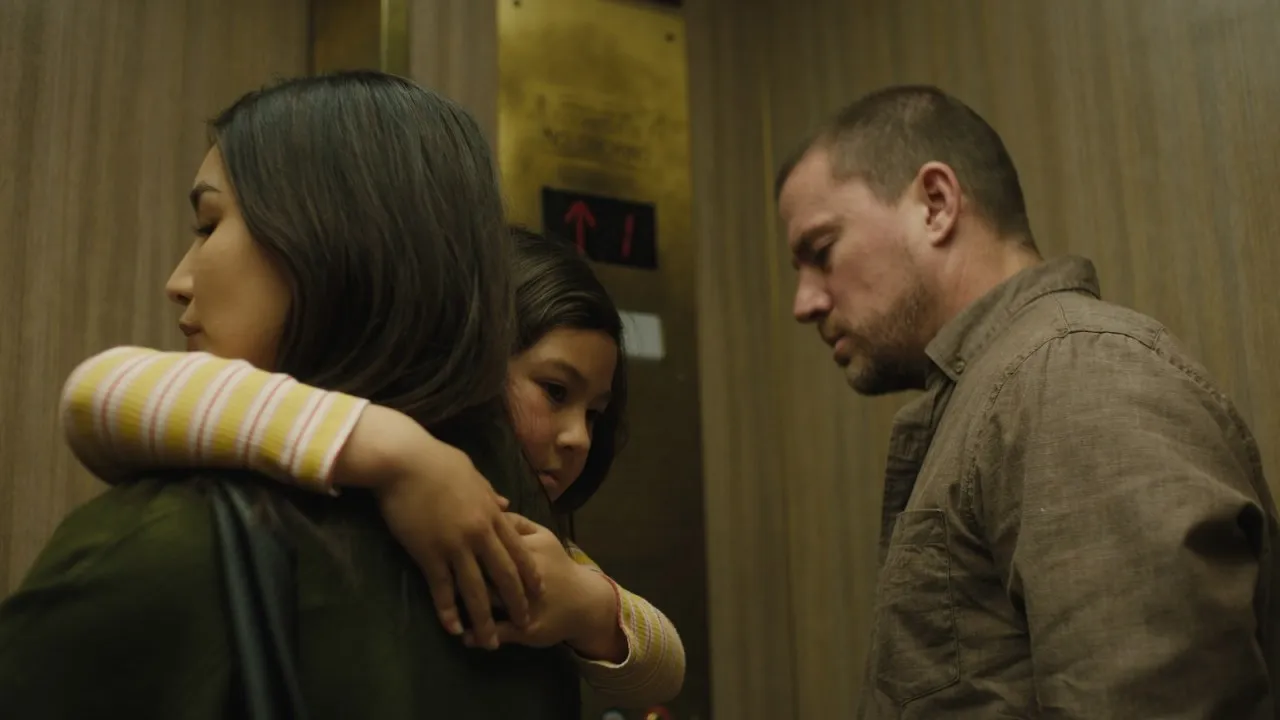
Home turns into a theater of competing beliefs about safety and healing. Damien, played by Channing Tatum with wounded, muscular desperation, views life through physical resilience. He believes in safety drills and soccer kicks. He treats Josephine’s trauma like a sports injury, something grit can push through, something silence can contain. His “rub some dirt on it” mentality functions as armor, covering his own sense of inadequacy with toughness.
Gemma Chan’s Claire carries a different impulse. As a dancer, she understands the body as a vessel for expression, a place where emotion lives. She pushes for therapy. Her attempts at connection drift into the same vagueness she wants to erase, as if clarity itself might burn. The film frames both parents as human. Love does not grant insight. Love arrives with blind spots.
That blindness sharpens during the performance where the parents take Josephine to watch Claire dance. The piece brims with aggressive, sensual physicality. The choice exposes Josephine to triggers she cannot process. The moment reveals a staggering lack of awareness. Adult life carries its own ego, even in gentle forms, and the film lets that ego show. Parents can care deeply and still miss the exact contours of a child’s suffering.
The most devastating note lands in a quiet car ride. Josephine asks her mother if she has ever been raped. Claire’s answer arrives without words, delivered through a single silent tear. The moment opens the suggestion of a buried lineage, a genealogy of pain passed from woman to woman, carried in the body when speech fails. The film leaves the implication unresolved, heavy and unfinished.
The Aesthetics of Disquiet
Greta Zozula’s cinematography stays tethered to Josephine’s eye level. Handheld movement keeps the frame in a state of imbalance. We remain at her height, forced to look up at a world of giants who keep failing her. San Francisco loses its postcard glow. The fog becomes a shroud that isolates the family. The park’s lush greenery turns into a maze of possible threats. Beauty remains on the surface, sharpening the ugliness of what happened within it.
Miles Ross’s soundscape works like an auditory fever dream. Heavy, pulsing synths echo the body’s response to fear, turning music into something physiological. The score fixes on sounds that snag a child’s attention. The hum of a fluorescent light. The rhythmic clicking of a police siren.
Small noises swell into pressure. All of it funnels into the final act in the courtroom. Cold grays take over. Harsh, institutional lighting flattens faces. The camera follows the family through sterile corridors on the approach to the witness stand. The moral weight of the room settles onto an eight-year-old’s shoulders.
The film leaves us inside unresolved dread. It poses a question that refuses comfort. Is truth enough to mend a spirit split open by what it was forced to see. The image offers presence rather than closure, and that presence lingers, heavy, unfinished.
Josephine premiered at the Sundance Film Festival on January 23, 2026, where it garnered significant acclaim for its unflinching look at childhood trauma and recovery. Following its festival debut, the film became available for a limited time through the Sundance Online platform from January 29 to February 1, 2026. While a wide theatrical release date and specific streaming platform have not yet been finalized by a major distributor, the film is expected to land on a premium streaming service later this year.
Full Credits
Title: Josephine
Distributor: Kaplan Morrison, Vibrato, Kinematics, Spark Features, Free Association (Currently seeking theatrical distribution)
Release date: January 23, 2026
Rating: R
Running time: 114 minutes
Director: Beth de Araújo
Writers: Beth de Araújo
Producers and Executive Producers: David Kaplan, Josh Peters, Marina Stabile, Mark H. Rapaport, Crystine Zhang, Channing Tatum, Joshua Beirne-Golden
Cast: Mason Reeves, Channing Tatum, Gemma Chan, Philip Ettinger, Syra McCarthy, Eleanore Pienta, Dana Millican
Director of Photography (Cinematographer): Greta Zozula
Editors: Paul LeBoterff
Composer: Miles Ross
The Review
Josephine
Josephine is a haunting meditation on the collateral damage of violence. It eschews easy comfort to explore how trauma reshapes the architecture of a child's mind. While the pacing occasionally falters in its parental subplots, the central performance by Mason Reeves and the unflinching direction create a profoundly visceral experience. It is a difficult, necessary work that interrogates the silence adults use as a shield, ultimately revealing that innocence is not lost so much as it is violently stolen.
PROS
- An astonishingly mature and intuitive debut that anchors the film's emotional weight.
- The choice to maintain a child’s perspective creates a unique and harrowing level of immersion.
- The synth-driven sound design effectively mirrors the internal panic of the protagonist.
- The use of the "specter" provides a powerful, non-verbal representation of lingering trauma.
CONS
- Some character choices by the parents feel frustratingly obtuse or inconsistent with reality.
- The momentum slows significantly as the narrative transitions into the legal proceedings.
- Gemma Chan’s character occasionally feels limited to a single note of quiet distress.