
























![Kingdom Hearts Collection [I-III] Review](https://gazettely.com/wp-content/uploads/2026/10/Kingdom-Hearts-Collection-I-III-1-360x180.webp "Kingdom Hearts Collection [I-III] Review: KHII Holds Steady as Newer Entries Fluctuate 37")




Evy Babic lives in her childhood home in Toronto and spends her days and nights caring for a comatose mother whose presence arrives as a rhythmic wheeze from the upstairs bedroom. The house is a duplex crowded with Catholic icons and the constant pressure of impending loss. To fill the silence and earn money, Evy co-hosts a paranormal podcast called The Undertone with Justin, who calls in from London.
They record in the early morning hours, usually around 3:00 a.m., when the world outside is still. Their show runs on a clear dynamic: Justin embraces belief and Evy applies logic. That domestic isolation defines her life as she balances the exhaustion of watching a parent die with the professional work of exploring the supernatural.
The arrival of ten anonymous audio files changes this routine. The recordings document a young couple, Mike and Jessa, who are expecting a child and appear to be targeted by a sinister force. Those files introduce a new strain of tension into Evy’s house and force her to listen more closely to shadows.
Acoustic Haunting and the Digital Medium
The film shifts the found-footage instinct away from sight and toward listening. The ten audio files sent to Evy and Justin become the primary engine of storytelling. The domestic life of Mike and Jessa corrodes into something frightening through fragments and static. Moments of sleep-talking and warped nursery rhymes create a story within a story that reads as immediate and dangerous. The structure asks the audience to assemble the horror from pieces and gaps in the sound.
Evy and Justin’s rapport anchors these files. Justin’s enthusiasm for the paranormal highlights Evy’s skepticism. Their long distance connection emphasizes Evy’s physical solitude. She sits in a dark room while her colleague exists as a voice in her ear. This separation makes her move toward belief feel earned and costly. As the evidence within the files resists easy explanation, skepticism begins to erode.
Recording is staged as a contemporary ritual. The living-room studio reads as a vulnerable workspace. Evy uses a laptop and audio software to hunt for older terrors concealed in the white noise. She reverses clips and stretches distorted syllables to tease out messages. Those technical actions turn the podcast into a kind of digital seance. The movie uses modern tools to investigate old fears and shows how technology can act as a conduit between our world and something darker.
The Claustrophobia of a Childhood Home
Keeping the story in one location creates an oppressive intimacy. Ian Tuason filmed in his own childhood home, which gives the setting a lived-in texture. The duplex functions like a character. The house is defined by its history and by a slow process of dying. The staircase reads as a connection between the living and the nearly dead. The closed door of the mother’s room is a steady source of tension and a reality Evy cannot evade.
Graham Beasley composes the camera work to increase unease. He uses negative space to make rooms feel oversized and empty. Large swaths of darkness sit behind Evy as she works and the laptop’s cold glow is often the only light source, which deepens hallway shadows. Wide shots place Evy small and isolated at the frame’s edge, suggesting an unseen gaze. The framing implies observation by something the audience cannot fully see.
Visual pacing depends on stillness. Slow pans and gradual zooms focus attention on details that might be threats. The camera sets up a clear contrast between the sterile medical equipment for the mother and the cluttered religious artifacts around the house. Crucifixes and icons hang near oxygen tanks and monitors. The camera frequently leaves Evy at her desk to drift through the quiet house. Those wandering moments create a lingering sense of dread.
The Architecture of Sound
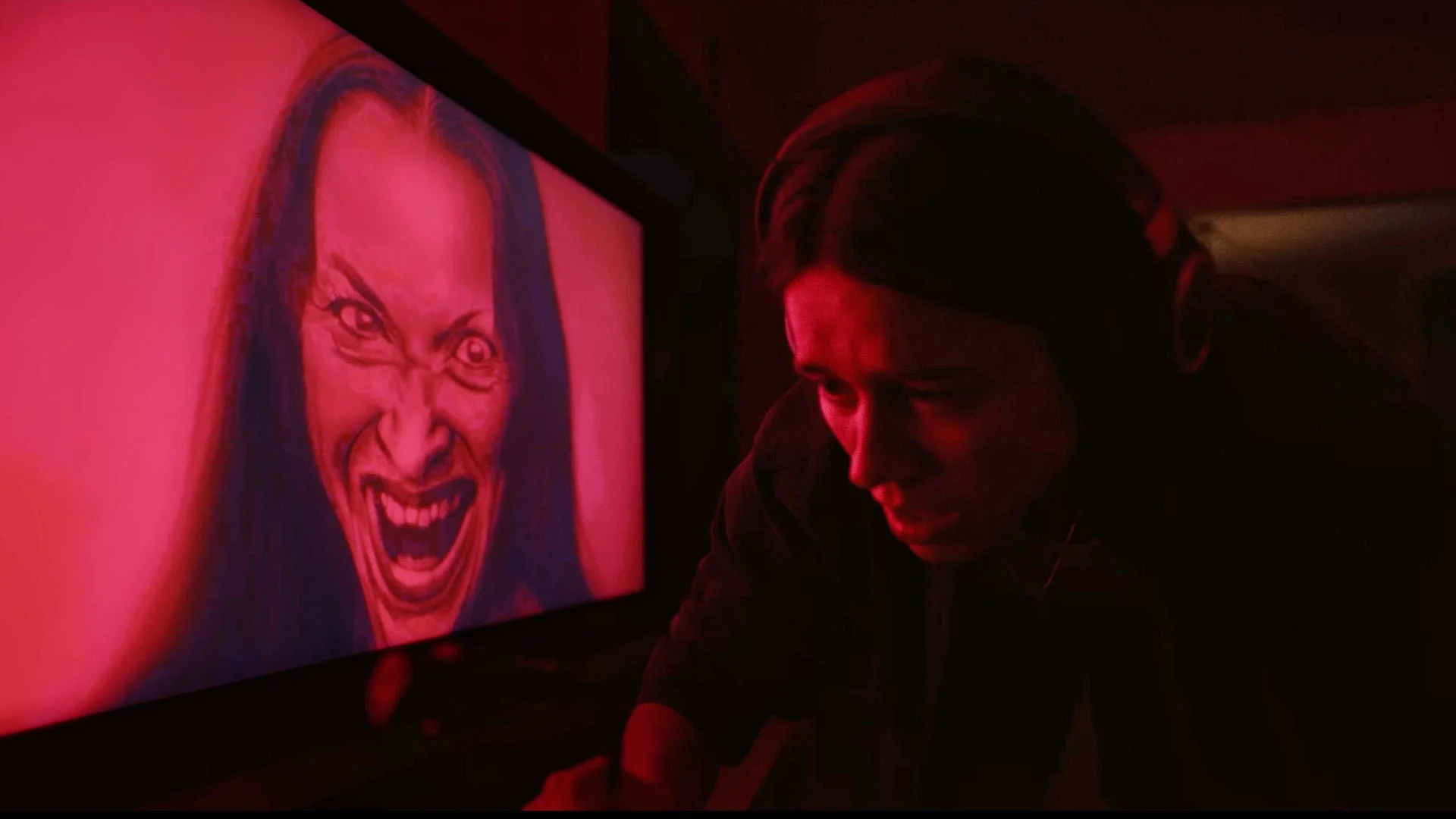
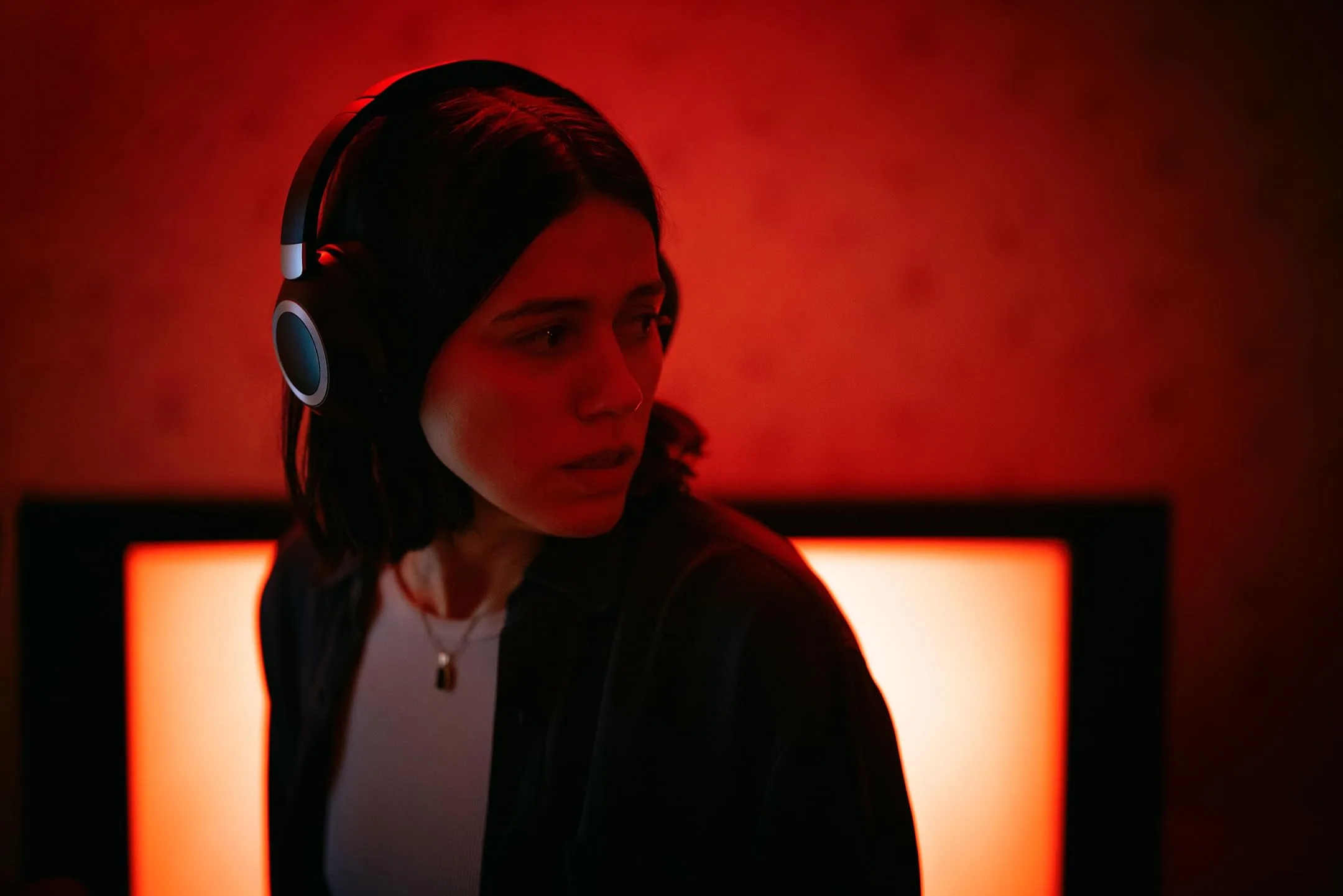
Noise-canceling headphones function as a key narrative device. When Evy puts them on, house sounds drop away for her and the audience experiences that change directly. The film tightens its audio field to her breathing and to the recordings, producing a specific vulnerability. She focuses on a digital ghost while remaining unable to hear what may be happening in the room behind her.
The 360-degree surround mix transforms the viewing space into a haunted room. Sounds are placed with precision. The rhythmic death rattle of the mother registers from a point above the listener. Thuds and scratches sit on the periphery and prompt visual scanning. Nursery rhymes reversed on tape read as physical and close. The film keeps a distinction between noises inside the podcast files and noises occurring in the house, and that distinction blurs as the plot advances.
Silence becomes an instrument of pressure. Absolute quiet makes each small noise register intensely. A floorboard creak or a soft breath turns into a cause for alarm. The sound design demands the same concentrated attention the protagonist gives her files. That level of listening makes louder and sudden noises land harder. Audio cues are layered to produce a tightening sense of entrapment.
The Weight of Caregiving and Unseen Fears
Nina Kiri gives a performance that acts as the visual nucleus of the film. She remains on screen alone for most of the runtime and communicates caregiver exhaustion through posture and weary eyes. Her physical presence keeps the supernatural elements tethered to a human reality and makes the emotional stakes feel as immediate as the ghosts.
Religious themes and inheritance are important story elements. Evy’s rejection of her mother’s Catholic faith creates internal conflict. Icons that she no longer believes in still surround her and create a persistent guilt that the film links to the haunting. Her mother’s religious hallucinations may extend beyond illness. The artifacts in the house work as reminders of a spiritual world Evy tries to ignore but cannot.
Internal struggles render Evy an unreliable narrator. Her history with alcoholism and a secret pregnancy add pressure to an already strained situation. She is near a breaking point before the recordings arrive. The film repeatedly asks whether the things she hears exist outside her mind or act as projections of her inner state. Her fear about the future mirrors the terror in the audio files. She contends with private demons while facing an external pursuit.
From Psychological Tension to Ancient Terror
The film shifts from quiet psychological pressure to a more conventional horror mode. The slow, internal buildup yields to the introduction of demonic folklore. That shift reorients the stakes from personal struggle to confrontation with a mythic entity. The reveal of the source of evil is staged as an inevitability and moves the narrative from household dread into explicit supernatural territory.
The third act leans on recognizable genre elements to resolve the escalation. Occult research and disturbing drawings surface. The pacing accelerates and scares become more direct. The mother’s “death rattle” becomes a recurring auditory motif that signals peril and ties the physical reality of a dying parent to the demon’s presence. Those genre moves deliver a clear escalation for viewers who follow those conventions.
The film leaves a heavy, persistent effect. It frames the podcast as a cursed object that cannot be unheard and shows listening closely as costly. The ending avoids a tidy resolution and leaves an open feeling of unease. The final shot distorts time to suggest that the sounds Evy uncovered have become a lasting part of her life.
Title: Undertone
Distributor: A24, VVS Films
Release date: July 27, 2025 (Fantasia), March 13, 2026 (United States/Canada)
Rating: R
Running time: 85 minutes
Director: Ian Tuason
Writers: Ian Tuason
Producers and Executive Producers: Dan Slater, Cody Calahan, Al Akdari, Chad Archibald, Melodie Austria, Charles Bern
Cast: Nina Kiri, Adam DiMarco, Michèle Duquet, Keana Lyn Bastidas, Jeff Yung, Kris Holden-Ried, Sarah Beaudin, Brian Quintero
Director of Photography (Cinematographer): Graham Beasley
Editors: Sonny Atkins
Composer: Shanika Lewis-Waddell
Full Credits
Undertone is a 2025 Canadian horror film that marks the directorial feature debut of Ian Tuason. After its world premiere at the Fantasia International Film Festival on July 27, 2025, where it won the Gold Audience Award for Best Canadian Feature, the film was acquired by A24 for worldwide distribution. It follows Evy, a paranormal podcast host who moves into her childhood home to care for her comatose mother, only to be haunted by a series of mysterious audio recordings. Following its success on the festival circuit, including a screening at the 2026 Sundance Film Festival, the movie is scheduled for a wide theatrical release in the United States and Canada on March 13, 2026.
The Review
Undertone
Ian Tuason creates a sensory experience finding terror in the spaces between sounds. Nina Kiri carries the weight of the film with a grounded performance making the domestic grief feel tactile. The final act falls back on familiar horror tropes. The technical execution of the audio seance remains effective. It is a sharp debut using silence to unnerve an audience. This film proves a small budget and a strong concept can yield high tension.
PROS
- Immersive 360-degree sound design.
- Nuanced lead performance by Nina Kiri.
- Creative use of a single domestic location.
- Tense atmosphere built through negative space.
CONS
- The finale relies on predictable genre clichés.
- Some repetitive pacing in the middle act.
- The transition into folklore feels sudden.







