































The screen opens on a particular kind of expensive silence. Amazon invested forty million dollars to document the twenty days before a return to the East Wing. The film presents a woman who registers as a living statue. We watch her move through gilded corridors. Cameras track her steps and accept her choreography.
The piece operates as a study of political celebrity dressed in couture. It examines the logistics of a global event through the filter of personal taste. Production values point to a Hollywood-level machine. The frame remains concentrated on three weeks of preparation (a countdown to a coronation).
What appears on screen is the careful assembly of a public image. The film offers access to the private perimeter of a figure often seen but seldom heard. Street noise is excluded. The camera lives inside a mobile bubble. The result functions like a high-end catalogue brought to life.
The Directorial Gloss and Static Spectacle
Brett Ratner applies an unexpectedly austere hand. Where his earlier work favored loud explosions and rapid cuts, here he cultivates frozen beauty. The shift functions as a reinvention for a director seeking renewal. Action gives way to a style the film names “Gloss-Ocularism.” Visual texture alternates between high-definition digital images and grainier Super 8 inserts. The analog fragments try to summon a sense of history by mimicking old home movies. That mimicry reads as manufactured nostalgia. The grain becomes a veil over the present-day digital sheen. The film suggests a Kennedy-style elegance through surface cues while the underlying image remains contemporary.
The camera treats Mar-a-Lago and Trump Tower as fashion sets. These locations look cleaned of human disorder. The lens keeps an observational distance. It privileges beauty and declines intimacy (the lens performs as a protective buffer). This produces an “Aura-Stasis.” The gaze clings to surface and preserves the stillness of a museum. Viewers are asked to stare. They are not asked to know. Sightings accumulate; insight does not.
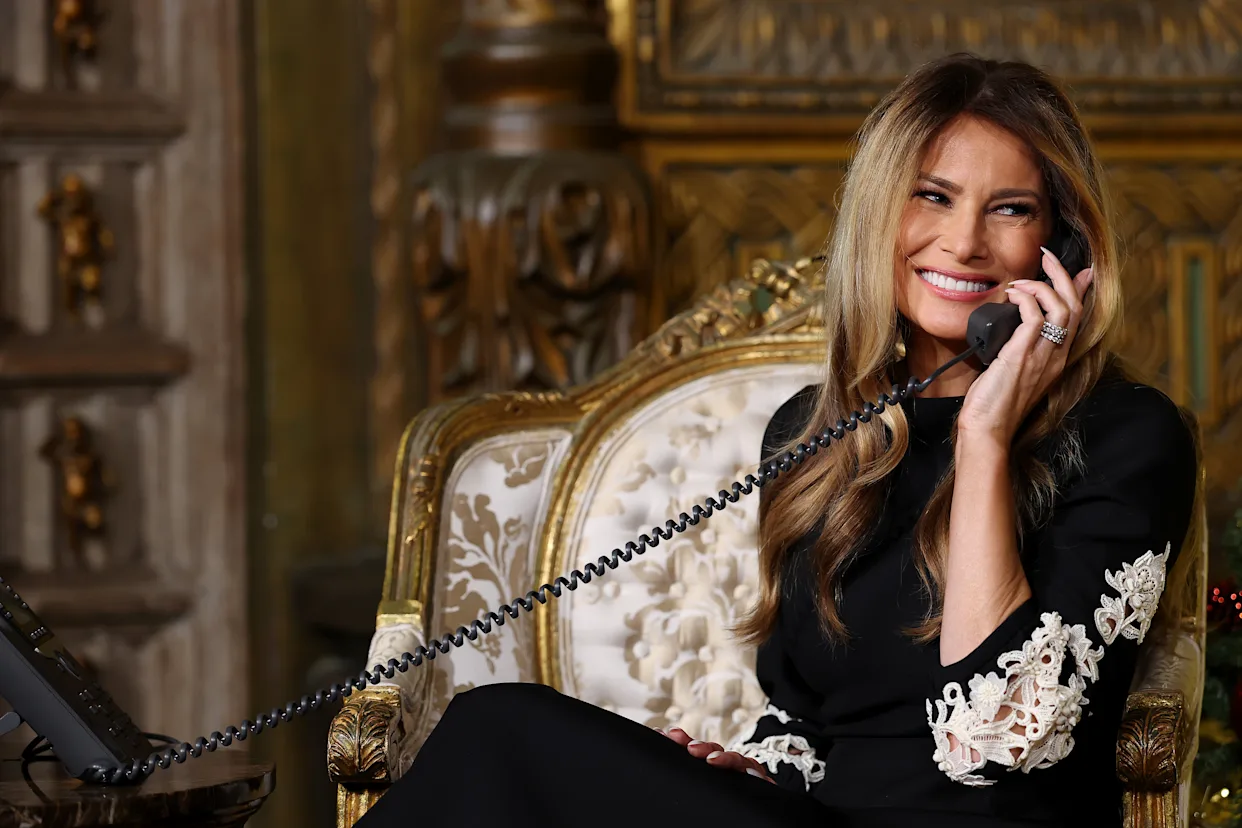
Interiors stay immaculate. Heavy gold leaf and polished marble dominate the frame. Dust never crosses into view. That directorial choice mirrors a controlled political apparatus. The film reads like a visual press release. It minimizes friction and complication. Ratner allows the subject to set the terms of watching. The work resembles designer taxidermy: cold, ornamental, ceremonious (a gift presented to a sovereign). The movie does not attempt to close the distance between observer and observed. It functions as a moving monument.
Materialist Rites and the Architecture of the Bubble
The film concentrates on the material world. Camera attention rests on expensive fabrics and the weight of table settings. Wardrobe fittings are shown with exacting care. Melania emerges as the principal designer of her surroundings. She approaches the White House as a renovation scaled to monumental proportions (a grander version of home improvement). A “White and Gold” motif dominates the palette. That motif encodes a particular vision of power rooted in 18th-century European royal signifiers. The screen fills with objects that carry force.
Logistics of wealth appear in close-up. Golden eggs sit beside caviar. These objects signify a social class and imply an era of “Marie-Antoinette-ism.” The narrative traces movement between Florida, New York, and Washington D.C. The subject exists inside a mobile luxury capsule that separates her from street realities. Interactions with collaborators such as Hervé Pierre and Tham Kannalikham illustrate control. She makes notes on ribbon width, asks for lapels to be tightened, inspects the hue of invitation envelopes.
Scenes position her as the architect of an image. Inaugural logistics become performances of status. The film implies that power is preserved through flower arrangements and the precise shade of scarlet stationery. The piece advances a materialist theory of leadership in which objects dictate narrative. People on the periphery remain measured and guarded. The “Starlight Ball” and the “Candlelit Dinner” unfold like class rituals. Ritual takes the place of explanation. The budgetary or moralled costs stay off-screen. Presentation becomes the sole criterion for authority.
A Symphony of Disconnection and Scripted Echoes
A voiceover supplies the only interior access. The delivery maintains distance. Lines read like passages lifted from a self-help handbook (phrases are smooth and scrubbed of texture). The tone holds flat and sometimes sounds robotic, even when gestures refer to personal loss. The effect is what the film calls “Narcotized Reflection.” Spontaneity is absent. Words arrive as if prearranged; pauses feel engineered. The narration describes surface without offering causal account. It functions like a voice inside a dream.
Soundtrack choices introduce a jarring friction. Famous tracks by the Rolling Stones and Michael Jackson appear over scenes of domestic preparation. The use of “Gimme Shelter” and “Billie Jean” resembles a shallow effort to borrow cultural heft. Songs with histories tied to rebellion are stripped of that context and repurposed as backdrop for luxury marketing (a runway soundtrack). Music detaches from image. Needle-drops fill an emotional vacuum.
A deliberate musical irony operates throughout. Scores that evoke classic cinema frame family rituals and suggest cinematic lineage. The attempt to map cinematic legend onto the current administration reads as staged. Scripted dialogue dominates. Speech functions tactically; unrehearsed utterance is absent. That absence gives the film the cadence of an advertisement or an infomercial. A single tonal note repeats. The soundtrack rings louder than lived experience. The auditory field is curated to match the visual one.
The Elite Mirror and the Myth of the American Return
The film stages a world where a handful of people carry significance. Donald Trump and Barron appear as background figures, elements of scenery within the subject’s orbit. The narrative casts her story as a particular version of the American Dream. Emphasis falls on a transition from a Slovenian model to an international persona. References to her birthplace are brief and episodic (attention centers on arrival). The story functions as “Dream-Logic” for the ultra-wealthy: ascension presented without the accounting of struggle.
The production includes meetings with international figures such as Brigitte Macron and Queen Rania. Those encounters work to assemble a geopolitical profile for the first lady, staging her as equal to world leaders. The film occludes the outside world. Social friction and political conflict beyond the gates receive no treatment. The frame privileges scenes from a private jet window: clouds and gold.
Closing credits enumerate achievements in a celebratory register. That listing acts as an attempt to define legacy through accumulation. The film concludes with a sense of pre-ordained triumph. Complexity of the era is omitted. The piece opts to inhabit the reality it composes. It will persist as a striking artifact from a moment when image operates as adjudicator of truth. The project functions as a designed reality show devoted to excluding the messy world beyond its borders. Final images show her posing for a portrait, presented as both alluring and authoritative. She occupies the frame with ease. The movie ends where it began: with a gaze that yields nothing.
Melania is a 2026 American documentary film that offers an intimate, behind-the-scenes look at Melania Trump during the twenty days leading up to her husband’s second presidential inauguration. Directed by Brett Ratner, the film explores her transition back into the role of First Lady, focusing on her personal style, the architecture of her public image, and the logistics of high-stakes political life. The project made headlines for its record-breaking $40 million acquisition price. It premiered at the Kennedy Center on January 29, 2026, and was released in theaters worldwide on January 30, 2026; it is expected to be available for streaming on Prime Video shortly after its theatrical run.
Full Credits
Title: Melania
Distributor: Amazon MGM Studios, Sony Pictures Releasing
Release date: January 30, 2026
Rating: PG
Running time: 104 minutes
Director: Brett Ratner
Writers: Brett Ratner
Producers and Executive Producers: Brett Ratner, Fernando Sulichin, Marc Beckman, Melania Trump
Cast: Melania Trump, Donald Trump, Barron William Trump, Hervé Pierre, Tham Kannalikham, Adam Lippes, Peter Sohn, Aiko Mizutori, David Monn
Director of Photography (Cinematographer): Barry Peterson, Dante Spinotti, Jeff Cronenweth
Editors: Alex Márquez
Composer: Tony Neiman
The Review
Melania
Melania presents a gilded cage of cinema. It captures the surface with cold precision. It ignores the pulse of the world. The production values create a shimmering wall. This wall prevents real connection. It offers a view of power as a purely aesthetic choice. Those seeking the machinery of status find interest here. Those seeking a human story find a vacuum. It remains an artifact of a specific political moment.
PROS
- Sharp cinematography.
- High production values.
- Intentional use of Super 8 film to suggest history.
CONS
- Detached narration lacks depth.
- Material objects overshadow the human subject.
- Jarring music choices.
- Absence of spontaneous interaction.