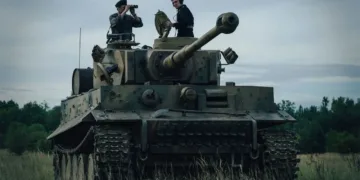




























The Tank, first released as Der Tiger, frames the final years of the Second World War as a slow, unsettling study of men sealed inside an instrument built for domination. Set in autumn 1943 during the Battle of the Dnieper, it tracks a five-man Panzer VI crew holding a bridge under Soviet pressure. After a close escape, Lieutenant Philip Gerkens is assigned a high-stakes order: find a missing Colonel believed to be in a secret bunker.
That assignment pushes the crew into shattered forests and blasted Eastern Front terrain, where the landscape feels emptied out by violence and time. Director Dennis Gansel treats the Tiger as a cramped metal habitat, a world where fear, loyalty, and moral strain keep ricocheting off the same steel surfaces.
The story sits on the psychological weight of duty as the German retreat speeds up, and it treats combat less as spectacle than as a condition that reshapes the mind. The film keeps returning to the tension between the instinct to survive and the hard commands of a regime in collapse. With the Tiger as the center of the film’s attention, the vehicle reads as shelter and grave at once, a steel refuge that can turn into a sealed chamber.
The Platoon as a Microcosm of Duty
Within those iron walls, the crew plays like a condensed portrait of a German military experience built on hierarchy, routine, and denial. David Schütter gives Lieutenant Philip Gerkens a constant look of strain, the kind that suggests the uniform has become a mask glued to his face. His authority rests on total commitment to the assignment, even while the world outside the hatch keeps falling apart. That devotion creates friction with the men under him, since orders offer structure while reality keeps arguing back.
Leonard Kunz, as Helmut the driver, brings an aloof, difficult calm, the person who keeps the machine moving through sheer competence. Laurence Rupp’s Christian, the gunner, lands as the steady second voice, direct enough to keep the group tethered to what is happening in front of them.
Sebastian Urzendowsky plays Keilig the radio operator with a scholarly, half-serious manner that fits a man trying to think his way through a situation that punishes thinking. Yoran Leicher’s Michel, the reloader, carries a painful innocence. Michel embodies the cost of a war that eats the young before they have the language to grasp what they are serving.
The script gives them bawdy jokes and shared memories, and those exchanges matter because they create a lived-in bond instead of a lineup of wartime types. Their chemistry keeps the film grounded in human behavior, small rituals of connection that feel necessary for staying sane. That shared past becomes a kind of armor against the darkness pressing in from the Eastern Front, even as the Tiger’s real armor keeps sealing them away from the world.
From Combat to Existential Expedition
The structure starts with recognizable genre rhythms, then slides into something more abstract, like a war story that turns into a test of the soul. The premise of searching for Colonel von Hardenburg recalls the classic-cinema pattern of a mission shaped around a missing officer. The film chooses a deliberate, methodical pace in place of forward-charging heroics. Long stretches through fog-heavy woods and quiet fields create a monotony that matches the crew’s exhaustion. The slow burn keeps attention on what the assignment is doing to their minds, minute by minute.

A standout sequence turns the Tiger into a submersible hiding place as Soviet patrols pass nearby. Tension rises through sound, water pressure against metal, and the sense of Russian tanks circling above like ghosts with teeth. The moment underlines the era’s strange engineering imagination while also cutting down the Tiger’s aura of invulnerability. The machine can protect them, and the machine can trap them.
As they push deeper into No Man’s Land, the search gains a mythic charge. The Colonel begins to feel like a figure who has stepped outside the rules, a presence in the woods that hints at a darker truth about the war the crew is helping to sustain. The assignment shifts into a confrontation with complicity, since following the order means continuing to carry the regime’s violence forward in their own bodies and hands.
The Architecture of Dread and Machinery
The film’s atmosphere depends on technical rigor, turning the Panzer VI into something close to a character with its own demands and moods. The camera stays close to vibrating gauges, leaking oil, and sweat slicking the crew’s faces.
Those details make the tank feel like a physical container and a mental one, a sealed space where the line between man and machine starts to smear. Carlo Jelavic’s cinematography builds a harsh dialogue between suffocating interiors and open, haunted landscapes. Tight close-ups amplify confinement, and the wide views of ruined spaces underline how small the crew is inside a vast, depopulated war zone.
Sound design sustains the threat. Metallic groans from the hull and the far-off, rhythmic thud of artillery create a constant sensory pressure, as if doom is part of the air itself. Visual symbolism threads through that precision without turning the film into a puzzle.
A brief exchange of looks between the commander and an animal caught in crossfire captures the absurdity of their position. The image suggests a battlefield where predators still suffer under a larger system that grinds everything down. The armor that shields them also reshapes them, cutting them off from the world they claim to protect and pushing them toward a colder, more mechanical version of themselves.
Guilt and the Collapse of Realism
The final act leans into collective guilt and the logic of “following orders.” The crew stands as a miniature portrait of a nation capable of horrific acts through obedience that refuses moral scrutiny. Flashbacks point toward sins from earlier in the war, and those glimpses complicate any easy sympathy.
The film lands an anti-war stance by letting the men register as human without turning their cause into something noble. They come across as ordinary soldiers worn down by a conflict they helped create, moving toward an end that feels sealed.
As their mission reaches its endpoint, the storytelling turns surreal. Early realism gives way to an abstract, allegorical finale that favors intellectual provocation over literal detail. The focus shifts from battlefield mechanics to moral injury, the psychic wreckage left behind in those who served a fascist regime.
The ending presses the audience to sit with psychological collapse, and it frames the destination as secondary to the inner reckoning unfolding inside the crew. The film’s refusal of a traditional action-heavy finish keeps attention on the philosophical consequences of the assignment and the weight of what these men carry forward as legacy.
The Tank arrived in German cinemas in September 2025 and reached a global audience via Amazon Prime Video on January 2, 2026. This production follows a German squad manning a Panzer VI on the Eastern Front in 1943 as they attempt a high stakes mission behind Soviet lines. Audiences can currently stream the film on the Amazon Prime Video platform.
Full Credits
Title: The Tank
Distributor: Amazon Prime Video, Amazon MGM Studios
Release date: September 18, 2025 (Theatrical), January 2, 2026 (Global Streaming)
Rating: R
Running time: 1 hour 56 minutes
Director: Dennis Gansel
Writers: Dennis Gansel, Colin Teevan
Producers and Executive Producers: Frank Kusche, Dan Maag, Marco Beckmann, Patrick Zorer, Stephanie Schettler-Köhler, Nicolas Paalzow, Leonard Häberle
Cast: David Schütter, Laurence Rupp, Leonard Kunz, Sebastian Urzendowsky, Yoran Leicher, André Hennicke, Arndt Schwering-Sohnrey, Tilman Strauss
Director of Photography (Cinematographer): Carlo Jelavic
Editors: Benjamin Kaubisch
Composer: Heiko Maile
The Review
The Tank
The Tank is a claustrophobic examination of moral decay that replaces traditional heroics with a haunting, psychological descent. While its methodical pacing may test some viewers, the technical precision and focus on collective guilt create a somber reflection on the cost of blind obedience. It functions as a cold study of men trapped within a machine of their own making. It is a demanding work that prioritizes philosophical weight over easy catharsis.
PROS
- Expert sound design and atmospheric cinematography.
- Strong, believable performances that anchor the internal drama.
- An unflinching look at the mental toll of wartime duty.
CONS
- The slow pacing in the second act might feel repetitive.
- A sudden shift toward surrealism in the final act could prove divisive.