







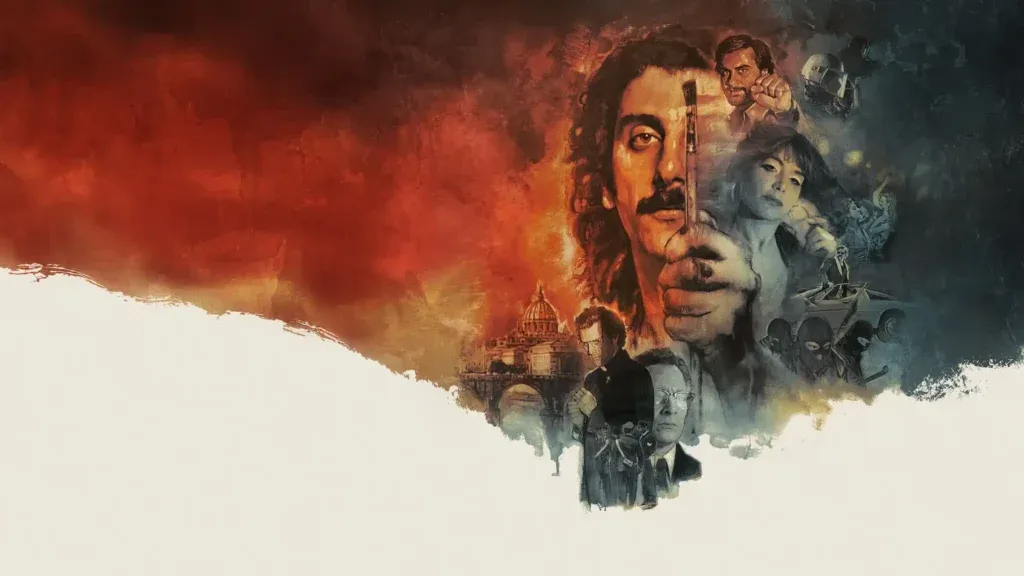

Late-1970s Rome is a volatile stage for this narrative, a city pulled between the Vatican, state interests, and the radical Red Brigade. The period’s clandestine operations suit a story preoccupied with unstable truths. The protagonist, Toni, starts as an aspiring artist in a quiet province and then moves to the capital. Once he arrives, the shift is quick: portrait sketches give way to a dangerous profession built on high-stakes forgery.
The film frames its moral gray zone against seismic historical events, specifically the kidnapping of Prime Minister Aldo Moro. It presents itself as historical fiction focused on Antonio Chichiarelli. Like the paintings he painstakingly recreates, Chichiarelli’s “real” self stays out of reach.
The structure treats his life as one possible version of the truth, and it openly suggests that the man we are watching is, in a sense, constructed. That “quasi-nonfictional” idea lets the story explore the overlap of the mob and the government through an intentionally warped lens, as distorted as a forged signature.
The Architecture of Disconnect
Toni’s bond with his two closest friends, Vittorio and Fabioni, works as a small-scale model of Italian society during this period. They begin as a tight trio leaving provincial roots behind, then their lives in Rome split almost immediately. Vittorio chooses the rigid hierarchy of the church. Fabioni is drawn to the radical labor movements of the Red Brigade. Their decisions map onto the polarized “Red” and “Black” factions that define the era’s pressure points.
Toni sits outside that binary. He adopts a “live well” philosophy that values immediate comfort over ideological loyalty. That lack of political affiliation acts like armor, something he can wear to slip through danger without declaring allegiance. The armor has a cost. His self-interest keeps showing up in the way he sells his talent to the highest bidder, and each transaction chips away at whatever integrity he had left.
Donata, an art dealer, connects Toni’s skill to the criminal underworld. She gives him a temporary sense of stability and a glamorous lifestyle, and her proximity pulls him deeper into work that keeps escalating. Through her, Toni meets figures who embody the system’s decay.
Balbo comes across as a greasy facilitator who arranges the physical crimes. “The Tailor” stands in for the State, steering low-level criminals as part of a larger effort to smear political enemies. In these relationships, Toni reads less like a player with full control and more like a piece being moved by colder, more cynical forces.
The Moral Cost of a Perfect Copy
Forgery becomes the film’s central metaphor for identity and self-erasure. Toni starts by replicating pencil portraits and quickly moves into forging passports and high-value propaganda. The progression carries an internal echo: as his work turns into higher-risk counterfeiting, his sense of self starts to resemble his output. He begins to mirror the image of a successful man, leaving the idea of a genuine artist behind.
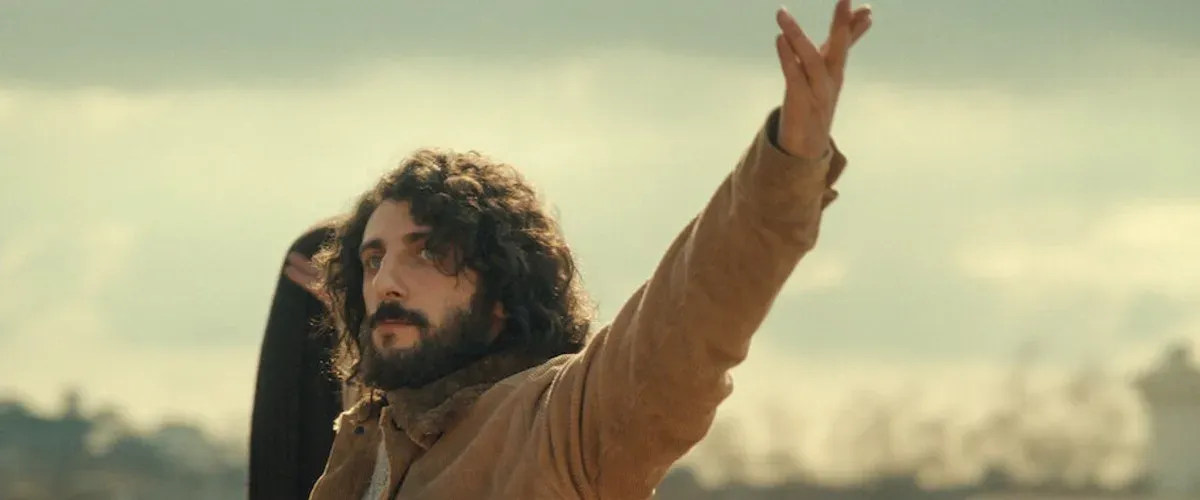
The tension comes from the charged political climate and Toni’s stubborn refusal to pick a side. He states that he does not care about colors, and he focuses on whoever helps him live well. In a world that treats loyalty as a requirement, that stance shapes him into an unreliable narrator of his own story. He keeps telling himself a clean, practical version of who he is, and the film keeps showing the damage that story does.
One scene makes the consequences plain: Toni witnesses a murder and keeps moving, treating it like background noise. That capacity for moral detachment functions as his sharpest survival tool, and it carries a steep personal cost. He turns hollow. Vittorio’s mention of “Tertium non datur” becomes a useful lens here.
The phrase argues for two opposing options with no third path, and Toni spends the film trying to manufacture a third path anyway, a narrow corridor between life and death. His failure to locate that option underlines how impossible neutrality becomes when everything around you is burning.
Structural Rhythms and Pacing Pitfalls
The narrative avoids the familiar “learning the trade” arc common to crime dramas. It introduces Toni as an established conman early in the runtime, and that decision trades character growth for immediate plot momentum. The speed has a side effect: the audience misses the struggle that would explain how Toni built his skills, and the film’s emotional tuning starts to feel slightly miscalibrated. We can track what he does. The story gives fewer footholds for understanding what it costs him to become capable of doing it.
The middle stretch hits a slump, leaning hard on dialogue-heavy interior scenes. These passages pack in exposition. They clarify the machinery behind the conspiracy, but they also cool the paranoia and urgency the script tries to sustain. The sensation is like a system that pauses too long in a menu screen: information keeps arriving, forward motion slows, and the dread that should be tightening the screws starts to diffuse.
The third act changes the tempo. A specific heist arrives and tries to reconnect Toni with his supposed artistic roots. The sequence is kinetic, and its momentum introduces a needed streak of playfulness into an otherwise somber story. The framing device also matters here.
The film opens with the hook, “The day I died,” creating a circular structure that keeps the audience questioning how final anything really is. This kind of device shows up frequently in streaming cinema, and it functions well in this case because it reinforces the theme of fakery. Toni’s ending feels as questionable as his beginning, which fits a protagonist defined by replicas and masks.
The Surface of Seventies Rome
Stefano Lodovichi makes striking use of wide shots to capture Italy’s grand architecture and sweeping provincial landscapes. Those open images sit beside claustrophobic, dimly lit rooms where the Roman underworld conducts business. The visual split reinforces a key idea: beauty on the surface, grime underneath. The production design is richly detailed, using authentic costumes, hairstyles, and set pieces to build a tactile 1970s environment. Galleries and hovels alike feel lived-in and tied to a specific time and place.
The soundtrack leans on needle-drop moments to establish a restless tone, with an early use of Iggy Pop’s “The Passenger” standing out. The song matches Toni’s drifting posture as he watches the world without fully taking part in it. Pietro Castellitto brings a strong physical screen presence to Toni, though the script treats the character like a blank page. Castellitto plays Toni as a mystery, a difficult line to hold across a full film. The performance stays consistent, yet Toni’s thin internal life makes it difficult for the audience to find an emotional anchor, even when the direction shows technical control.
The Legacy of the Maze
The film ends in ambiguity, leaving questions about Toni’s actual contribution to history and his final fate. It plays as a stylistic showcase, with limited interest in sustained psychological excavation, and it prioritizes the era’s mechanics over the inner lives of the people caught inside them. The experience favors observation over immersion. We watch the conspiracy’s gears turn. We feel less of the heat.
The story also acts as a doorway to real-world curiosity about Antonio Chichiarelli. The film can register as a shrug on the emotional side, yet it does highlight an underappreciated and bizarre chapter of Italian political history. Antonio’s legend remains more gripping than the fictionalized version on screen. The film argues that some lives become so convoluted that even a straightforward retelling carries the texture of a forgery.
The Big Fake premiered globally on Netflix on January 23, 2026. This Italian crime drama, set against the turbulent political landscape of 1970s Rome, explores the life of Toni Chichiarelli, an artist who becomes entangled in the world of high-stakes forgery and state secrets. You can stream the movie exclusively on Netflix, where it has quickly climbed the streaming charts since its release earlier this week.
Full Credits
Title: The Big Fake (Original Title: Il falsario)
Distributor: Netflix
Release date: January 23, 2026
Rating: TV-MA
Running time: 116 minutes
Director: Stefano Lodovichi
Writers: Lorenzo Bagnatori, Sandro Petraglia
Producers and Executive Producers: Riccardo Tozzi, Giovanni Stabilini, Marco Chimenz, Claudia Aloisi
Cast: Pietro Castellitto, Giulia Michelini, Andrea Arcangeli, Pierluigi Gigante, Aurora Giovinazzo, Edoardo Pesce, Claudio Santamaria
Director of Photography (Cinematographer): Benjamin Maier
Editors: Roberto Di Tanna
Composer: Santi Pulvirenti
The Review
The Big Fake
The Big Fake succeeds as a stylish period piece but falters as a human drama. It captures the grimy, paranoid atmosphere of 1970s Rome with technical precision and a stellar soundtrack. However, the protagonist remains a hollow vessel, making it difficult to care about his moral decline or his dangerous political games. If you appreciate aesthetic detail and historical conspiracies, it is a watchable diversion, yet it lacks the emotional weight to leave a lasting impression. It is a polished surface with very little underneath.
PROS
- Excellent recreation of late-70s Italy through costumes and set design.
- Effective use of period-appropriate tracks like "The Passenger" to set the mood.
- The third act provides a much-needed boost in energy and creativity.
- Offers a fascinating look at the intersection of crime and politics during the Moro kidnapping.
CONS
- The protagonist lacks a clear emotional arc or relatable motivations.
- Heavy reliance on exposition and dialogue-heavy scenes slows the momentum.
- The "live well" philosophy makes the main character feel cold and unapproachable.
- The film touches on deep political themes without fully exploring their significance.