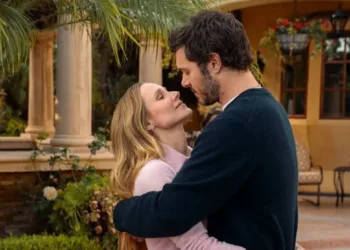





















Tanja Arnheim lives inside the frantic pulse of Berlin-Neukölln, a successful novelist who treats her own life as raw material for the next manuscript. Jerome Daimler keeps to a calmer address, a bungalow in Maintal, with the Frankfurt skyline hovering nearby like a distant promise of relevance.
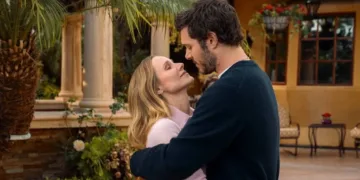
Their relationship reads as a case study in controlled spacing: weekend visits supply the body, the smartphone supplies the ongoing illusion of closeness. They are thirty-somethings operating under a “state of detached, life-affirming openness,” language that sells emotional freedom while quietly protecting a fear of entanglement.
They also enjoy a rare kind of comfort: intellectual security and financial security, the kind that lets them turn feeling into a professional project. The film watches their on-off affair with clinical patience, placing the romance inside a cultural setting where every gesture begs to be interpreted for its symbolic weight.
It sketches a generation trained in self-surveillance, converting the mess of love into carefully composed moments. The lovers become curators of their own tenderness, as if intimacy were a gallery installation with strict lighting.
The Labor of Leisure and the Burden of Choice
Sylvaine Faligant plays Tanja with a subtle French accent that feels deliberately estranging, like someone who wandered into the German literary scene from a sleeker dimension and decided to stay. Her performance captures a woman whose appetite for order edges toward pathology. Jerome offers her a personal website as a birthday present and her response lands as pure alarm. Horror arrives first and stays. She reads the tiled digital layout as stalking-by-design, a neat little architecture meant to pin down an identity she prefers to keep fluid.
Jannis Niewöhner’s Jerome pairs empathy with a visible vanity. He wants closeness, and he also wants the camera to like him. The film gives him that telling detail: a man who adjusts the angle of his chin in selfies with the seriousness of a sculptor, then turns around and longs for something that cannot be filtered.
They live in a “post-struggle” reality where familiar romantic impediments have evaporated: poverty, social disapproval, lack of opportunity. What remains is the terrifying blankness of choice. The film treats this blankness like a new social condition, one that produces a fresh strain of millennial neurosis. I kept thinking of it as affective auditing: sex and drug use become measurable inputs, logged and reviewed for evidence of self-improvement.
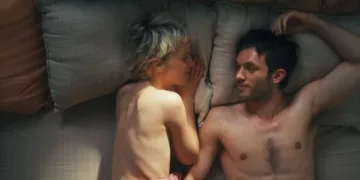
A sexual encounter becomes a data point. Passion exists, yet their attention snaps toward what the experience can produce, how it might upgrade the self. The absence of existential friction yields an oddly bloodless tone, as if the characters have been granted every option and lost the ability to want any of them with force. The movie seems to flirt with a grim idea: too much clarity can function as its own blindness. Then it hesitates, as if unsure it wants to accuse anyone of being spoiled. (It accuses them anyway, gently.)
Digital Cartography and the Three-Phase Heart
The narrative form mirrors the rhythm of their connection. Tanja maps their bond through three repeating phases: physical intimacy, long-distance dialogue, and the tight anticipation that gathers before the next reunion. The structure creates friction between the digital and the biological, a tug-of-war between the screen and the body.
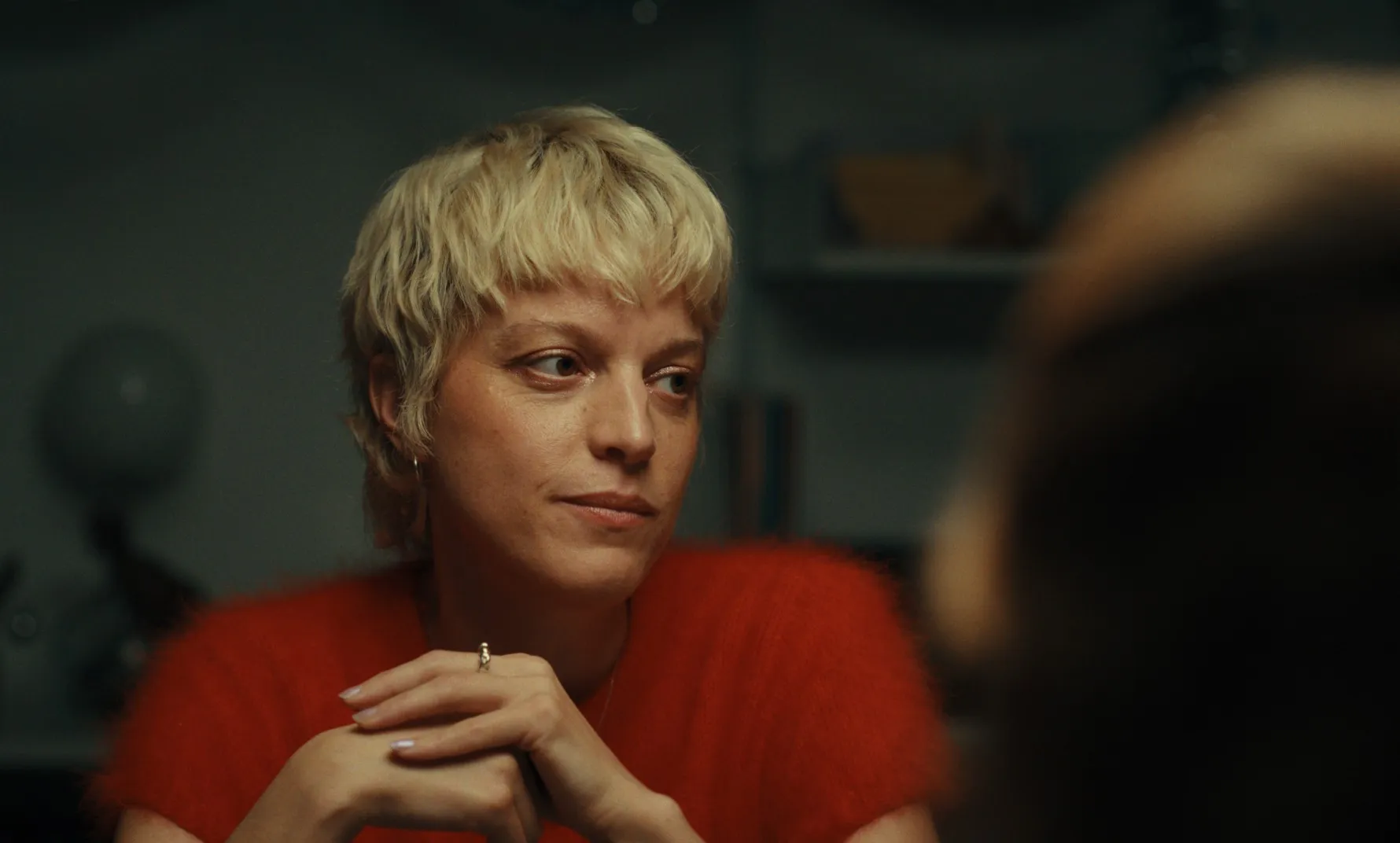
Their emails and Telegram messages often carry more depth than their in-person conversations. Safety lives inside the screen. In that protected space, they become their most authentic selves, and their most carefully curated selves, at the same time. The film leans hard on voice-over to stitch geography into psychology, letting the streets of Berlin and Frankfurt absorb the weight of their interior monologues. The cityscapes turn into listening devices. A sidewalk becomes a confessional. A train line becomes a thesis statement.
Jerome’s design work sits at the film’s symbolic core as a metaphor for digital intimacy. He imagines a website interface shaped like a lava lamp, pitched as a “communicative retreat” for contemporary spirituality. The concept is funny in that bleak modern way: transcendence, delivered through UI. The motif captures their desire for a space that feels “hermetically sealed and flexibly playful,” a capsule that promises protection and play in the same breath.
For these characters, a well-designed interface offers comfort that a warm body fails to supply. Maintal and Berlin remain separated by more than geography. The real measurement arrives as lag time, the stretch between a sent message and the moment a read-receipt appears. The film turns that micro-wait into a kind of fate. A modern tragedy, played in the key of high-speed data, where devotion gets expressed through typing bubbles and timing.
The Curation of the Self in Pastel Hues
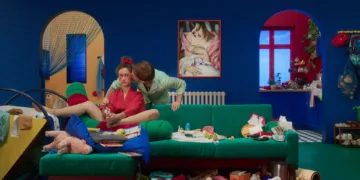
Visually, the film behaves like a high-end catalog. Pastel greens dominate, punctuated by bursts of “Aperol red,” as if the world has been run through a permanent Instagram filter and nobody remembers the original file. That curation extends into the production design, which feels like catnip for furniture enthusiasts. The camera shows iconic Thonet 209 and Wassily chairs. An apartment features neon green grout, a bold choice for the “brat” era, and the film treats that choice like a personality trait.

These objects function as social signals. Taste becomes a résumé. Status sits in the corner of the frame, upholstered and expensive. The film keeps returning to the idea that identity takes shape through aesthetic decisions, through the accumulated proof of what one buys, arranges, and photographs. The self becomes something you style, then maintain.
Felix Pflieger’s cinematography periodically drifts away from the couple to rest on a raindrop or a streetlight. The pauses feel like symbols of the clarity the characters seek and rarely occupy. The film captures a specific Berlin moment with near-documentary precision, calling out the “BerlKönig” bus and the Kurfürstenstraße U-Bahn station with an attention that brushes against nostalgia. That grounded texture sits beside the sterile quality of the characters’ interactions, a realism that exposes how curated their private lives have become.
At times, the furniture carries more personality than the people sitting in it. That line sounds like a joke, and it plays like one, yet it lands as a quiet indictment. Have we become so skilled at designing our lives that we have misplaced the practice of living? The film lets the question hover, shimmering and evasive, like a lava lamp bubble that rises, swells, and refuses to pop.
Allegro Pastell premiered at the 76th Berlin International Film Festival in the Panorama section on February 14, 2026. Based on the celebrated 2020 novel by Leif Randt, the film follows the meticulously managed long-distance relationship between a novelist in Berlin and a web designer in Maintal. Following its successful festival debut, the film is scheduled for a wide theatrical release in Germany starting April 16, 2026, handled by DCM Film Distribution. It captures the specific cultural pulse of the late 2010s with a focus on intellectual privilege and digital intimacy.
Full Credits
Title: Allegro Pastell
Distributor: DCM Film Distribution
Release date: February 14, 2026
Rating: FSK 12
Running time: 100 minutes
Director: Anna Roller
Writers: Leif Randt
Producers and Executive Producers: Tobias Walker, Philipp Worm, John Wallace, David McLoughlin
Cast: Jannis Niewöhner, Sylvaine Faligant, Luna Wedler, Martina Gedeck, Wolfram Koch, Haley Louise Jones, Nico Ehrenteit, Vera Flück, Jakob Schreier
Director of Photography (Cinematographer): Felix Pflieger
Editors: Andreas Wodraschke
Composer: Max Rieger
The Review
Allegro Pastell
This film functions as a high-definition mirror for a demographic that prefers its reflection filtered. While the lack of traditional stakes might alienate those seeking visceral drama, the precision of its social observation provides a sharp, if bloodless, satisfaction. It captures the paralysis of the hyper-reflective mind with a dry, observational wit. You might find yourself more attached to the mid-century modern furniture than the protagonists, yet the film succeeds as a clinical dissection of modern intimacy. It is a beautiful, sterile object.
PROS
- Visually stunning production design featuring iconic designer furniture.
- Sharp, satirical script that avoids typical romantic clichés.
- Strong lead performances that capture a specific generational angst.
- Accurate depiction of how digital communication reshapes emotional closeness.
CONS
- The deliberate lack of conflict can feel stagnant or boring.
- Protagonists are difficult to like due to their extreme self-obsession.
- Heavy use of voice-over may feel too much like a staged reading.
- The emotional distance prevents a deep connection with the story.