
























![Kingdom Hearts Collection [I-III] Review](https://gazettely.com/wp-content/uploads/2026/10/Kingdom-Hearts-Collection-I-III-1-360x180.webp "Kingdom Hearts Collection [I-III] Review: KHII Holds Steady as Newer Entries Fluctuate 37")




Heysel 85 returns to the harrowing European Cup final tragedy of May 29, 1985, at Brussels’ Heysel Stadium, where a collapse and fan violence claimed thirty nine lives. Director Teodora Ana Mihai brings a documentary sensibility to this fictionalized drama, extending the realism associated with her earlier work on Waiting for August and La Civil.
The film takes the shape of a political and moral thriller, set almost entirely inside the stadium’s suffocating underground corridors. The narrative follows the hours surrounding the match between Juventus and Liverpool, keeping the pitch largely out of view. Two vantage points guide the telling: Marie, the press secretary and daughter of the Brussels Mayor, and Luca, a Belgian-Italian radio journalist.
Their proximity to the event gives the historical catastrophe a human scale without shrinking its enormity. The film tracks the collision between bureaucratic negligence and human suffering, turning a sporting event into a grim study of institutional collapse. A day built for spectacle becomes a scene of emergency, misrule, and irreversible loss.
The Architecture of Failure
The film renders the disaster intimate through Marie and Luca, two figures caught inside the machinery of a failing state. Marie Dumont occupies a precarious position as the Mayor’s daughter and his press attaché. She becomes a quiet intermediary, translating for ego driven male officials who stay insulated from the carnage outside. Her work exposes a brutal separation between decision makers and the reality of dying bodies, treated as an abstraction until it becomes impossible to ignore.
Luca Rossi supplies the film’s emotional current. He is an Italian journalist with family members in the ill fated Block Z, and his professional duty collides with immediate fear. The incident room becomes a bureaucratic chamber piece: officials sip champagne while blood stains the concrete only yards away. These men argue about optics and financial repercussions, shifting blame with practiced ease, speaking in the polished grammar of self preservation while the building fills with the consequences of their choices.
Mayor Marc Dumont embodies this rot as an alcoholic figurehead who retreats into scotch and self pity when faced with the costs of his incompetence. Authority appears as a group of pompous custodians of procedure, preoccupied with reputation and control. Human life registers as background noise, something to manage, contain, and explain away.
A Grainy Descent into Dread
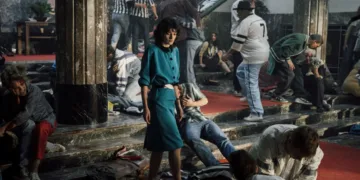
Mihai employs a visceral aesthetic to recreate the 1980s, shooting on 16mm film to produce a grainy, period accurate texture. That texture enables a clean integration of archival footage from the day, tightening the bond between staged moments and historical record. The visual field feels worn, immediate, and abrasive, as if the image itself has absorbed the stadium’s grime.
The cinematography leans on snaking, handheld long takes that trail characters through claustrophobic catacombs. These sinuous passages build mounting panic as the hallways thicken with bodies, sirens, and shouted fragments of instruction. The camera keeps moving, then keeps moving again, turning corridors into traps that refuse release.
Sound carries the weight of what happens off screen. Muffled screams and the low rumble of collapsing masonry echo through the stadium’s bowels, amplified by the chillingly detached tone of radio broadcasts. The tragedy stays present even when it slips outside the frame, pressed into the mix like a pulse that will not slow.
The pacing shifts from the electric, chaotic energy of pre match anticipation to the somber stillness of a war zone. The transition lands with a sickening clarity, following the real time escalation of the disaster. Technical precision serves the narrative by placing the viewer inside a world that feels physically tangible and emotionally exhausting.
The Cynicism of the State
Heysel 85 operates as an indictment of the dysfunctions that predate the first drop of blood. It details the stadium’s dilapidated state, the lack of police radio batteries, and the fatal decision to place rival fans in adjacent sections. These failures read as the routine product of a system that prioritizes profit over public safety, a logic that keeps repeating until something breaks.
Gender dynamics sharpen the critique. Marie is repeatedly silenced, treated as a linguistic instrument by an aging patriarchy that speaks over her. Disastrous choices follow from that dismissal, made in rooms where volume counts for wisdom and certainty substitutes for competence.
The moral dilemma of the second half hinges on the decision to proceed with the match while corpses pile up in the hallways. The stated justification claims the game will prevent further riots, and the reasoning carries the odor of financial preservation.
One official remarks that morality is a luxury they cannot afford, a line that hangs over the command center like a policy statement. The crisis also curdles any idea of European unity. Cooperation collapses into finger pointing and nationalistic retreat. The film suggests that during disaster, institutions tasked with protection often fracture first, then ask to be admired for managing the debris.
Heysel 85 is a historical drama that premiered at the Berlinale Special section of the 76th Berlin International Film Festival on February 14, 2026. Directed by Teodora Ana Mihai, the film revisits the tragic 1985 European Cup final at Brussels’ Heysel Stadium, where 39 people lost their lives. Rather than a traditional sports film, it operates as a political thriller focusing on the institutional failures and moral dilemmas occurring within the stadium’s backrooms. Following its festival debut, the movie is scheduled for a wider theatrical release in autumn 2026 through Kinepolis Film Distribution.
Full Credits
Title: Heysel 85
Distributor: Kinepolis Film Distribution, Salaud Morisset
Release date: February 14, 2026
Running time: 91 minutes
Director: Teodora Ana Mihai
Writers: Lode Desmet, Isabelle Darras, Teodora Ana Mihai
Producers and Executive Producers: Hans Everaert, Frans Van Gestel, Anette Unger, Delphine Tomson, Sven Rudat
Cast: Violet Braeckman, Matteo Simoni, Josse De Pauw, Fabrizio Rongione, Paolo Calabresi, Bobby Schofield, Ben Segers
Director of Photography (Cinematographer): Marius Panduru
Editors: Bert Jacobs
Composer: Anna Katharina Bauer
The Review
Heysel 85
Heysel 85 is a harrowing, claustrophobic examination of institutional rot that prioritizes bureaucratic tension over stadium spectacle. By filtering a historical atrocity through the eyes of those trapped in the catacombs of power, Teodora Ana Mihai creates a chilling portrait of how ego and indecision lead to tragedy. While the fictionalized portrayal of the Mayor occasionally veers into caricature, the film’s technical mastery and oppressive atmosphere make it a formidable cultural critique. It is a somber, essential look at the fragility of safety when governed by the indifferent.
PROS
- Visceral 16mm cinematography that seamlessly blends with 1985 archival footage.
- Exceptional sound design that uses off-screen noise to build immense dread.
- Strong, grounded performances by Violet Braeckman and Matteo Simoni.
- A sharp, necessary focus on the gendered power dynamics of the era.
CONS
- The portrayal of Mayor Dumont can feel like an overly broad, grotesque caricature.
- Some dialogue-heavy scenes in the "incident room" lose narrative momentum.
- The script occasionally uses characters as purely explanatory tools for history.
- The brief runtime may leave some supporting characters feeling underdeveloped.







