



























The four-part series Michael Jackson: The Trial arrives during a period in which the legacy of one of the most famous entertainers in modern culture is being shaped for younger audiences. The documentary operates as an uncomfortable counterweight to the glossy, expensive biopics now moving through production.
The series leaves the moonwalk and the hit records in the background and places its attention on the 2005 courtroom fight in Santa Maria, California. Its central case involves accusations made by Gavin Arvizo, a 13-year-old cancer survivor who had been a frequent guest at Neverland Ranch.
The historical record remains clear on the legal outcome: Jackson was acquitted on all ten counts, including child molestation and supplying alcohol to a minor. Even so, the series uses previously unbroadcast audio and video to rebuild the sequence of events with persistent unease.
It tracks the path from the 2003 Martin Bashir interview, where Jackson’s own comments about sharing a bed triggered a global uproar, through the verdict. This is a dirty, detailed study of power and of the people pulled into a superstar’s orbit. By returning to testimony and evidence through a modern frame, the series presses viewers toward a colder reassessment of a man who lived as a deity in public and a legal target in court.
Shadows in the Archive and the Relics of Neverland
The series draws much of its narrative force from archival access, and that material gives the film a stable foundation for its portrait of Jackson’s inner life. The most significant pieces are audio recordings of conversations between Jackson and his spiritual advisor, Rabbi Shmuley Boteach, recorded between 2000 and 2001.

The tapes open a window onto a fractured mind. Jackson speaks with stark candor about his childhood and about the monstrous force of his father, Joe. He describes adult life as a burden and presents the company of children as his only source of oxygen.
In one deeply unsettling passage, he says he would kill himself if he were barred from seeing children. The statement becomes a key support point for the prosecution’s claim that his interest in minors reflected pathology, not eccentricity.
The visual record makes the portrait harder to dismiss or simplify. Footage from the Santa Barbara sheriff’s office raid on Neverland shows a place that feels surreal and disorienting. Investigators move through a property that plays less like a home and more like a fever dream. They record life-sized mannequins, including Bruce Lee and Lara Croft, arranged in ways that feel watchful and strange.
The discovery of a naturist magazine containing advertisements for videos of naked children gives the case a concrete item that the defense had trouble smoothing over. A reproduced Last Supper by Leonardo da Vinci hangs above Jackson’s bed, with Jackson’s face inserted among the apostles.
The image points to messianic self-regard and a private world where persona and self had begun to merge. Even the Arvizo family support video, filmed before the allegations emerged, gains a hellish tone in retrospect. It shows a family absorbed in a fantasy that later collapses into litigation.
The Inner Circle and the Friction of Testimony
The documentary builds its account through interviews with people who lived close to the Jackson machine, and the clash between those accounts gives the series much of its tension. Vincent Amen, a former publicist, delivers some of the most forceful testimony. He believes Jackson was guilty, and he ties that belief to materials he describes as grooming tools.
His response carries the feeling of an old wound that never healed. Personal cinematographer Christian Robinson offers a defense that frames Jackson as an asexual man-child. Robinson describes someone trying to flee the weight of fame through water balloon fights and play, and he presents Jackson as a victim of his own innocence.
The series also gives important space to Louise Palanker, a family friend who watched the Arvizos during their time at Neverland. Her recollections offer a sobering view of a struggling family that first saw Jackson as a godsend, a male figure with the care and resources they did not have.
The documentary’s balance remains uneven. It favors voices aligned with guilt, with thirteen of sixteen interviewees supporting the prosecution’s frame. That choice creates an advocacy tone that can crowd out a cooler review of the evidence.
A juror appears, and local law enforcement voices appear too, including Ruby Wolff, whose visible distress two decades later speaks to the force of the case. These interviews place Jackson’s god-like public image beside the sordid detail handled in private by people who reviewed evidence behind closed doors. The result plays like a methodical demolition of a legendary reputation, not a balanced argument.
The Media Circus and a Legacy of Dysfunction
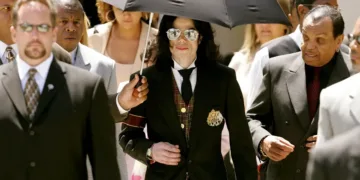
The closing sections capture the courthouse spectacle in Santa Maria and the media storm around it. The proceedings are described as a soap opera on steroids, with hundreds of fans arriving each day. The documentary links that atmosphere to a culture of willful infantilization, and Jackson becomes its clearest symbol during the morning he came to court in pyjamas.
The series reads the moment as performance aimed at sympathy, a gesture meant to pull attention away from the charges. The Jackson family sought the image of the black Kennedys, yet the courtroom record presented a far messier family picture.
The documentary returns to the strange routines of Jackson’s life, including toy train rides across the estate and one-on-one picnics with young guests. Defenders describe these acts as pure. The series frames them as pieces of a disturbing behavioral pattern. The gap between his musical genius and the swamp of dysfunction in the trial record creates sharp dissonance for the viewer. The narrative closes on a somber coda built around a slurred audio clip from May 2009, only weeks before his death.
The voice is barely recognizable and sounds like a man consumed by prescription drugs and by the weight of his own myth. The film also recognizes the size and intensity of Jackson’s fan base, which remains vast and loud. For many of those supporters, the music continues to outweigh his private conduct.
The series ends by pressing a hard question about truth and fame, asking if facts can penetrate the shield built by global celebrity. It stands as a grim, revolting study of power and of the kind of world that power can build once reality stops setting the limits.
Michael Jackson: The Trial is a four-part documentary series that offers a forensic re-examination of the singer’s 2005 criminal trial. Premiering on Channel 4 in February 2026, the series utilizes exclusive archival footage and previously unheard audio recordings from Jackson’s inner circle to explore the complex intersection of fame, race, and the American justice system. It provides a sobering look at the events starting from the 2003 Martin Bashir interview to the final legal verdict, and is currently available for streaming on Channel 4’s digital platform.
Full Credits
Title: Michael Jackson: The Trial
Distributor: Channel 4
Release date: February 4, 2026
Rating: TV-MA
Running time: 60 minutes per episode
Director: Gillian Pachter, Tom Peppiatt (Edit Director)
Writers: Gillian Pachter
Producers and Executive Producers: Tom Anstiss, Samantha Anstiss, Tom Garton, Siraj Patel, Rachael Getzels, Georgina Brown
Cast: Michael Jackson, Gavin Arvizo, Shmuley Boteach, Vincent Amen, Christian Robinson, Louise Palanker, Janet Arvizo, Ruby Wolff
Director of Photography: Information not available
Editors: Sejal Dholakia, Franco Bogino, Eduardo Estevez Espitia
Composer: Paul Englishby
The Review
Michael Jackson: The Trial
This documentary serves as a stark, uncomfortable interrogation of power and the mechanisms of celebrity. While it occasionally leans toward advocacy by prioritizing voices of guilt, the inclusion of unbroadcast audio tapes provides a haunting look into a fractured psyche. It effectively strips away the polished veneer of the "King of Pop" to reveal a world of profound dysfunction. The series avoids sensationalism for its own sake, offering instead a methodical, sobering reconstruction of a landmark legal battle. It is essential viewing for those seeking a counter-narrative to the upcoming cinematic biopics.
PROS
- Exceptional access to previously unheard audio recordings and home video footage.
- Balanced by historical context regarding the media frenzy and the Jackson family dynamics.
- Provides a sober, well-researched alternative to sanitized biographical depictions.
- Strong interviews with law enforcement and inner-circle figures like Vincent Amen.
CONS
- The ratio of interviewees is lopsided, favoring the prosecution’s narrative over the defense.
- Minimizes the role of lead defense attorney Tom Mesereau and his courtroom strategy.
- Relies heavily on the established narrative of previous documentaries.