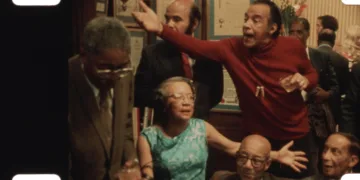

















In the dense heat of August 1972, time seemed to crease and double back inside Duke Ellington’s New York townhouse. Filmmaker William Greaves convened an assembly of people who had once helped spark the Harlem Renaissance, and he filmed their presence on grain heavy 16mm stock.
Poets, painters, and thinkers gathered to pick through what remained of a movement that had shaped Black creative life five decades earlier. Then the footage went quiet for years, a sleeping archive of faces and voices, until William’s son, David Greaves, carried the project across the finish line.
The result stands like a narrow bridge between the original artistic awakening of the 1920s, the political fatigue of the early 1970s, and the splintered present. It captures a room of survivors. They speak of a past that keeps rising. The film refuses the comfort of a tidy historical document. What emerges is a slow recognition of what it meant to live and make art inside a world built to look past that beauty, then move on as if nothing had happened.
The Parlor of Unfinished Business
Inside the townhouse, the air feels swollen with memory and the closeness of the void. Photographer James Van Der Zee sits at the piano, drawing out a melody from keys he has left untouched for years. The music becomes a phantom heartbeat for a room holding figures like Eubie Blake and Noble Sissle, men who shaped the stage through Shuffle Along.
The talk turns rough as the group wrestles with the names placed on them and the names they choose. “Negro” is weighed against “Black” and “Afro-American,” and the argument lands as a struggle over self definition, over what language can hold without cracking. The dead press close to the living. Langston Hughes, Zora Neale Hurston, and Marcus Garvey hover in the room through memory and dispute, their ideas still capable of striking sparks.
Eubie Blake recounts a cold moment from the past: Bill ‘Bojangles’ Robinson reached for a handshake and a white man refused him. The story carries the sharp edge of the social lines they grew up with, lines that cut without needing to announce themselves. Ida Mae Cullen speaks with a quiet force, guarding the legacy of her husband, Countee Cullen, and refusing any smoothing of his place in history.
These people never sit still as museum pieces. They argue. They stay alive in their disagreements. They circle the question of immortality while their bodies show age at the edges, and the room holds that tension without resolving it. The scene offers no clean answer, and the lack of a clean answer feels truthful.
Grain, Ghost, and Glass
The film’s visual language has a tactile, bruised feel. Shot handheld in a 16mm vérité mode, the camera moves with the jitter of an uninvited guest trying to find footing. That nervous motion pulls the viewer into the party’s physical space, close enough to feel the breath between sentences.
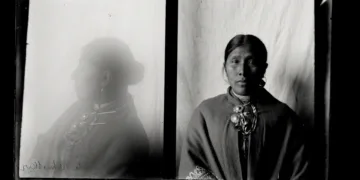
David Greaves, working with editors Anne de Mare and Lynn True, shapes a form that feels intimate while still opening outward. Split screen passages let us watch the quiet faces of listeners as someone else speaks, catching a flicker of recognition, doubt, or weariness in features marked by time. Archival photographs from the 1920s anchor these conversations. The film shows the subjects in radiant youth, then cuts back to 1972, where they appear as graying sages. The pairing lands hard. Time grants grace, then asks for payment.
The project carries an inherited duty. David served as a cameraperson during the original gathering, and his return to the material completes his father’s work through an act of personal continuity. The grain becomes its own surface of history, a texture you can almost feel between your fingers, like old paper that might tear if you press too firmly.
The Persistence of the Awakening
Watching this record feels like witnessing a shared awakening happening again, late and bruised and still luminous. The Harlem Renaissance appears as a prism that throws many kinds of light across decades of Black experience. The film emphasizes the need for sanctuaries like the 135th Street Library, spaces where intellect could live, gather strength, and defend itself against indifference.
The struggles named in 1972 carry a weight that remains familiar today. The threat of racial violence persists. The demand for self expression persists. The film operates as resistance against the hush that follows death, a refusal to let the grave have the final word. It shows the creative fire lit in Harlem continuing through change, still burning in altered forms, still present.
By keeping these voices in motion, the Greaves family offers protection against the erasure of memory. These figures are gone now, yet their defiance stays etched in the silver halide of the image. The film holds them as an ongoing challenge to the void, keeping their voices available for the quiet moments when the present turns its face toward the past and listens.
Once Upon a Time in Harlem is a landmark documentary that premiered at the Sundance Film Festival on January 25, 2026. Following a high-profile bidding war among major streamers and studios, the distribution rights were acquired by Neon on February 5, 2026. The film is a meticulously restored time capsule, utilizing 16mm footage captured in 1972 by legendary filmmaker William Greaves. It documents a one-of-a-kind gathering at Duke Ellington’s townhouse, where the surviving luminaries of the Harlem Renaissance met to debate their legacy and the future of Black artistry. Viewers can currently catch this vital piece of cinematic history through limited theatrical engagements via Neon, with a streaming release expected later this year.
Full Credits
Title: Once Upon a Time in Harlem
Distributor: Neon
Release date: January 25, 2026
Running time: 100 minutes
Director: William Greaves, David Greaves
Writers: William Greaves, David Greaves
Producers and Executive Producers: Liani Greaves, Anne de Mare
Cast: James Van Der Zee, Eubie Blake, Noble Sissle, Leigh Whipper, Richard Bruce Nugent, Arna Bontemps, Gerri Major, George Schuyler, Aaron Douglas, Ernest Crichlow
Director of Photography (Cinematographer): William Greaves, David Greaves
Editors: Lynn True, Anne de Mare
Composer: Tamar-kali
The Review
Once Upon A Time In Harlem
This documentary serves as a profound meditation on the resilience of the human spirit against the erosion of time. By capturing the final sparks of a legendary generation, it transforms a simple gathering into a timeless philosophical dialogue. The film is a haunting, lyrical victory over silence.
PROS
- Handheld 16mm style creates visceral intimacy
- Powerful, unscripted debates on identity and language
- Seamless integration of archival photography
- Deeply moving intergenerational filmmaking
CONS
- The 100-minute runtime feels brief given the history
- Some minor figures may lack context for new viewers
- The chaotic party noise can occasionally obscure dialogue